The Daily Wrap

Today on the Dish, Andrew spoke ill of Senator Byrd, readers dissented en masse, and Nick Gillespie pushed back. Due credit to Byrd on the Iraq war here. Andrew fisked Douthat over reasons to stay in Afghanistan, called out Cantor on the deficit, and commented further on the Weigel-WaPo row. Dave spoke out. Dissension in the Vatican here. Get your Palin fix here and a huge dose of Trig-gate here.

The nationalism of the World Cup explored here, here, and here. More Cup coverage here, here, and here. The blogosphere slowed down and the iPhone's phone continued to falter.

In assorted commentary, Kristol hearted Obama on Afghanistan, George Will invoked Vietnam, Joel Wing checked in on Iraq oil, Marc Lynch addressed the Islamic threat, and Beinart looked past the Tea Party to see the government's success. Laura Freschi tackled the source of food aid, Hale Stewart worried about housing, and Greg Beato was barraged by ads. Robert Stacy McCain had some wise words on the stigmatizing of reporting by conservatives, TNC talked journalist discourse, and Politico accidentally spoke the truth on access. A reader compared McChrystal and Barry Bonds and another called out conservatives who demonize libertarians.

Hewitt Award here and Malkin here. Hathos here. MHB here, VFYW here, and FOTD here. Andrew punted on the female orgasm.

— C.B.

Think Yourself Old

Dan Ariely trumpets a study:

One of the most interesting analyses on the ways in which our decisions kill us is one by Ralph Keeney (Operation Research, 2008), where Ralph puts forth the claim that 44.5% of all premature deaths in the US result from personal decisions – decisions that involving among others smoking, not exercising, criminality, drug and alcohol use, and unsafe sexual behavior…Using the same method to examine causes of death in 1900, Keeney finds that during this time only around 10% of premature deaths were caused by personal decisions. …

This is not because we’ve become a nation of binge-drinking, murderous smokers, it’s largely because the causes of death, like tuberculosis and pneumonia (the most common causes of death in the early 20th century) are far more rare these days, and the temptation and our ability to make erroneous decisions (think about driving while texting) has increased dramatically.

Ross On Afghanistan: Getting Warmer, Ctd

Noah Millman picks apart the Douthat column I took issue with earlier today:

Failure is always an option. Ruling it out in advance doesn’t make success probable or even possible – it just rules out doing any kind of cost-benefit analysis of trying to achieve it. Worse, it rules out asking whether “success” actually advances our interests in the region, or actually sets them back.

Face Of The Day

102465500

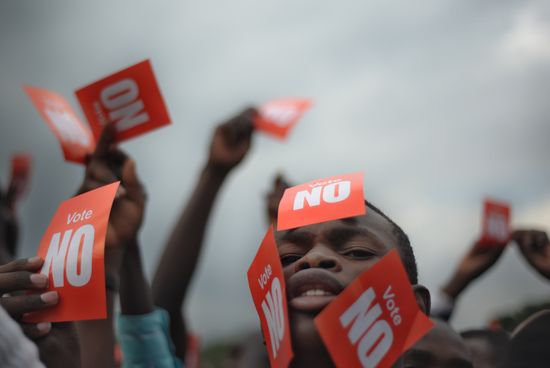
Kenyans hold up fliers during a 'No' rally called by religious leaders in opposition to the proposed Kenya constitution in the lakeside town of Nakuru on June 27. The rally, attended by Kenya's former President Daniel Moi, is the second since a series of grenade attacks rocked a similar rally in Nairobi on June 13, killing at least six and injuring scores more. The attack is a sharp reminder of the 2007-2008 post-election violence and is generating public tension as campaigns for and against a proposed Kenya constitution heat-up ahead of the August 4 referendum. By Tony Karumba/AFP/Getty Images.

World Cup War, Ctd

A reader writes:

I happened to be an exchange student in Potsdam, Germany during the 1998 World Cup and became completely swept up in all the excitement. One of the more surprising expressions of nationalism I experienced was two lines of graffiti, written in English, in a stall in the student dormitory I was assigned to:

Two world wars and one World Cup!
Doo-dah, Doo-dah!

A Financial Equivalent Of Drivers’ Ed

James Surowiecki wants one:

Some [critics of proper financial education] suggest that financial illiteracy is an example of what economists call “rational ignorance”—inattention that is justified because the costs of paying attention outweigh the benefits. But few decisions affect us more directly than the ones we make about our money. Critics also argue that financial education may make people overconfident, and therefore more likely to make bad decisions. In fact, the reverse is true: the less people know, the more overconfident in their abilities they tend to be.

One Reason The Press Is Liberal

Robert Stacy McCain is on to something here:

One of the reasons why there are so few conservatives in America's newsrooms is because the profession of journalism is relentlessly derided by those who claim to speak for the conservative cause. No kid who grew up listening to talk radio could possibly believe that becoming a reporter is a worthy ambition. (To be a talking-head pundit on cable TV, yes; to be a mere reporter, no.) …

There are indeed such things as conservative journalists, but it is a corollary of the anti-journalism worldview of Republicans that conservative journalists are judged not by their skill — the accuracy of their reporting, the readability of their prose, etc. – but by how useful they are in the service of advancing GOP political objectives. Republicans treat conservative journalists with a special disdain, as mere errand boys or stenographers whose job it is to spread the GOP message.

The Violence Of Writing

Goldblog backtracks further. TNC takes a step back:

Fallows offered some really wise words on how to criticize people in print, the gist of it being, "Speak to those you would criticize as though they were standing right there."… It's fun to be mean, and it makes your side howl – and sometimes it's even necessary. But  my game is as follows – stating my opinions directly, clearly and without equivocation and without undue malice. I am not a violent writer. Fuck Pat Robertson was cool. But that's a small part of me, that I am endeavoring to make even smaller. When it starts becoming larger, I need to go do something else.

I veer toward the Fuck Pat Robertson model myself. This isn't because I think being rude is somehow acceptable. I'm generally polite if blunt in real life (my life's too short for bullshit). Online, I adopt a bit of a debating persona, the way politicians do in, say, the House of Commons. What Cameron said there to Brown's grimacing face for five years was beyond rude and very colorful, deeply personal and often cheap. But when you saw the campaign debates, it was a much more Fallowsian discourse. This is because there is a convention that parliament is all fun and games (no blood, no foul), and venting in the House is part of the rough-and-tumble of democratic accountability. More to the point, the rudeness is a plus: it helps air stuff that polite people are unwilling to air. It can get to the real point more quickly. And airing stuff is more important in politics than permanent decorum.

The blogosphere is too new to have truly established conventions. But I really want to resist any creeping tide of civility and politeness. Raspberries matter in Anglo-Saxon political life; and if the gap between how we debate in public and how we talk in private gets too large, something else will give. I think the informality of the blogosphere is a perfect place for such venting – and has a different set of expectations than print media. 

That said, I am deeply grateful for the thoughtful engagement of my esteemed colleagues.