Trying To Understand The Tea Party II

Shot

Or maybe it's back to Hofstadter, citing Adorno (sorry, governor Palin, this post is probably one you'll want to skip):

From clinical interviews and thematic apperception tests, Adorno and his co-workers found that their pseudo-conservative subjects, although given to a form of political expression that combines a curious mixture of largely conservative with occasional radical notions, succeed in concealing from themselves impulsive tendencies that, if released into action, would be very far from conservative.

The pseudo-conservative, Adorno writes, shows conventionality and authoritarian submissiveness" in his conscious thinking and "violence, anarchic impulses and chaotic destructiveness in the unconscious sphere. The pseudo-conservative is a man who, in the name of upholding traditional American values and institutions and defending them from largely fictitious dangers, consciously or unconsciously aims at their abolition.

John Yoo anyone? Dick Cheney? I can think of few examples of this more telling than the suspension of habeas corpus, the enactment of preventative war as policy and the institutionalization of torture as the celebration of American traditional values. So Hofstadter helps me understand how a movement based on inalienable individual freedom had nothing to say about the most authoritarian period in the American executive branch in their lifetimes. But the maintenance of shrill ideology against reality is still the most prevalent feature. Hofstadter noted some classic examples from a previous era that seem plucked from Fox News today:

The lady who, when general Eisenhower's victory over Robert Taft had finally become official, stalked out of the Hilton Hotel declaiming "This means eight more years of socialism" was probably a fairly good representative of the pseudo-conservative mentality … [So also was] the general who told [the Freedom Congress] , demanding an Air Force capable of wiping out the Russian Air Force and industry in one sweep, but also a "material reduction in military expenditures …" the people who a few years ago believed simultaneously that we had no business fighting communism in Korea, but that the war should be immediately extended to an Asia-wide crusade against communism …

It all sounds weirdly familiar, doesn't it? The cognitive dissonance and the obvious human misery behind it:

The pseudo-conservative believes himself to be living in a world in which he is spied upon, plotted against, betrayed and very likely destined for total ruin. He feels that his liberties have been arbitrarily and outrageously invaded … he is the most bitter of all our citizens about our involvement in wars past but seems not the least concerned about avoiding the next one.

Brutally accurate, no? What you see is the predominance of acute alienation – the opposite of a natural conservative at peace with the world as it is – and the intensity of emotional rage it provokes. I would add one thing to this analysis. The Bush-Cheney presidency was, in some respects, the perfect pseudo-conservative administration. They waged war based on loathing of the experts (damned knowledgeable elites!); they slashed taxes and boosted spending for their constituencies, while pretending to be fiscally responsible; they tore up the most ancient taboos – against torture – with a bravado that will one day seem obscene; and they left the country in far worse shape than they found it.

Throughout all this, the Tea Partiers supported them. So how do they manage the cognitive dissonance that two failed wars, a financial collapse and a debt crisis have brought? How do they deal with the fact that their beloved president was manifestly the most incompetent and disastrous in modern times? They blame it on the next guy.

Yes, they are doing all they can to avoid facing the fact that they did all of this … to themselves. And sometimes, the truly, deeply humiliated can only carry on through blind rage.

(Painting: The arrest of Robespierre by Jean-Joseph-François Tassaert)

Trying To Understand The Tea Party I

MaxRobespierre_Best

This ad seems to imply that the Founding Fathers were opposed to all taxation, as opposed to taxation imposed by an alien power without any representation. Is this now the official view of Tea-Party Nation? One would have thought that the principle was no taxation without representation, not no taxation at all.

I confess to staying baffled by this whole movement. I spent many years wailing about spending under Bush, and the Tea Party was largely silent. I'd like to see serious cuts in entitlements, means-testing of social security benefits, and sharp reductions in military spending … to avoid the default that could one day come when we least expect it. The Tea Party has proposed no such entitlement cuts – let alone defense. Because taxation is historically low, and because we're never realistically going to tackle the debt without more revenues, I also favor some tax increases – on carbon, and on consumption. The Tea Party is opposed to any new taxation. So at that point, I don't know what to do. I don't know how to respond. Do I share a generalized frustration with a government that takes away half my earnings every year? Yes. Does an intervention to ease a huge market collapse drive me nuts? Sorry, but: no. Neither does a modest attempt to provide some subsidies to help millions get access to affordable healthcare at a time of extreme economic insecurity. Call me a Marxist, I guess. But I have yet to see anything in Obama's first eighteen months to convince me of a need for conservative rage.

J.M. Bernstein comes to my rescue with the help of, among others, yes, Hegel (and an intelligent understanding of same).

His thesis is that the tea-partiers know they need government – i.e. social security, Medicare, unemployment insurance, access to basic healthcare – and that need has been brutally revealed these past two years. We all know this somewhere deep down – but in some, this knowledge is too much to handle:

This is the rage and anger I hear in the Tea Party movement; it is the sound of jilted lovers furious that the other — the anonymous blob called simply “government” — has suddenly let them down, suddenly made clear that they are dependent and limited beings, suddenly revealed them as vulnerable.  And just as in love, the one-sided reminder of dependence is experienced as an injury.

All the rhetoric of self-sufficiency, all the grand talk of wanting to be left alone is just the hollow insistence of the bereft lover that she can and will survive without her beloved. However, in political life, unlike love, there are no second marriages; we have only the one partner, and although we can rework our relationship, nothing can remove the actuality of dependence.  That is permanent.

In politics, the idea of divorce is the idea of revolution.  The Tea Party rhetoric of taking back the country is no accident: since they repudiate the conditions of dependency that have made their and our lives possible, they can only imagine freedom as a new beginning, starting from scratch.

This, of course, is not conservatism, but its nemesis. And what happens when even that start-from-scratch utopia fails? I guess we may soon find out.

(Illustration: Mixed media portrait sculpture of Robespierre by artist George S. Stuart, Ojai, CA in the permanent collection of the Museum of Ventura County, Ventura, CA.)

Hewitt Award Nominee II

"The president had a choice between standing with Benjamin Netanyahu, or standing with Ahmadinejad and Hamas. Hamas is a terrorist organization. This should not have been a difficult choice, but the President chose to stand with Hamas and then they were rewarded this week with $400 million in aid," – Michele Bachmann, to FNC host David Asman (who titled a recent piece, "Is the president funding terrorism?").

“An Epidemic Of Not Watching” Ctd

David Pollock reads a new poll out of Israel:

In the aftermath of the recent ship-boarding incident, three-quarters of Jewish Israelis say Israel should not open the Gaza Strip to international aid shipments. Narrower, yet still solid, majorities also say Israel should not accept an international investigation, nor adjust its tactics to win favorable international consideration.

Even more surprising, Israeli Prime Minister Benjamin Netanyahu's job-approval rating has now climbed into positive territory: 53 percent of respondents were satisfied with his performance, while 40 percent were dissatisfied. By contrast, 71 percent voiced dissatisfaction with U.S. President Barack Obama, and a clear majority, 63 percent, are also dissatisfied with the overall U.S. reaction to the Gaza flotilla controversy so far.

The Use Of A Child, Ctd

A reader writes:

Count me as one of the fans that appreciates your continued beat on the Sarah and Trig Palin spectacle.

There's something that has always struck me as unusual about the timeline and the wanton risks associated with Trig's birth, and I observe it from the viewpoint of a parent of a child with special needs. My daughter was born with a chromosomal abnormality whose physical manifestation was, among other things, a congenital heart defect that required immediate intervention and support. While my daughter did not have Down Syndrome, her heart defect (Tetralogy of Fallot) was most common in children with DS – about 50% incidence. The heart defect was in fact one of the 'soft markers' for a prenatal diagnoses of Down Syndrome. Notwithstanding the immediacy of my daughter's cardiac defect, there were many other prenatal tests that we were going to 2-3 times a week as the due date neared closer, all standard in cases like hers.

When she was born, there was a team of neonatologists, pediatric cardiologists and NICU doctors and nurses there to help in any way possible.

I've gone over the Palin's scenario in my head a thousand times, and could not once imagine going through the steps that Sarah went through in terms of a.) traveling that far away in the third trimester and b.) waiting that long to get to the hospital. A Down Syndrome child is a high risk pregnancy and rest assured doctors would want to immediately evaluate a DS baby for muscle tone and oxygenation to determine if they needed to go to the NICU for assistance. Even if a cardiac defect was ruled out prenatally, I am guessing a cardiologist would want to verify with an echocardiogram.

To channel my inner Rummy, there are simply a lot of 'known unknowns' that need to be verified once the baby is born. So what I am getting at? At this point, I almost wish Trig was Bristol's. I can at least buy some sort of nobility in wanting to shield your daughter from the stigmatization, and this sort of thing wasn't that uncommon a generation or two ago.

But the alternative scenario is that Sarah Palin simply had a high risk pregnancy and yet made the infamous travel choices anyways, health of her child be damned. I suppose I am colored by my own personal experiences, but having a DS child and making those engagements and flights speaks to an ignorance and narcissism that is dangerously distorted. All this before the kid even dreamed of being a prop.

We've gone over this a million times, but I remain agnostic about what really happened. I wish Trig were Bristol's as well. The story would make more sense. But my point is – and has always been — that no one in his or her right mind can take Palin's various accounts of her pregnancy seriously without asking many questions that have never been answered. That's why I think that journalists should remain skeptical. I mean: Richard Blumenthal was called out on his own embellished war stories – but Palin has never even been asked about her baby stories by a serious magazine or newspaper and never asked to account for all the questions on national television. Yes, it's much harder to get proof of a maternity than war service, but it would be extremely easy for Palin to end these questions once and for all with what must be mountains of documentation of the birth. But still: nothing.

Lisa Miller and Jon Meacham believe there is nothing even faintly curious about the Palin family's account of this miraculous birth and have no interest in verifying the story or not. They believe everything Sarah Palin has said about her strange one-month public pregnancy. They have every right to do so. But they cannot pretend to be journalists when they do.

Iran – A Year Later

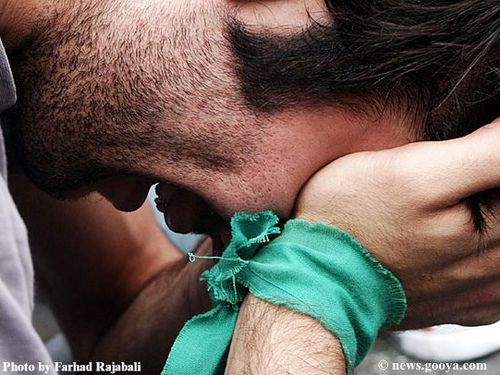
Weepiran

One way to see if an argument is worth its muster is to ask whether it addresses the core points of the best rebuttal. Reuel Marc Gerecht's op-ed completely fails this test today. The obvious reason that president Obama decided to keep his support for the Green Movement in Iran muted was … to help the Green Movement in Iran. His view – shared in large part by Mousavi and Karroubi – was that too strong a US public stand would backfire. It would allow the mullahs to play the Great Satan card more effectively, and marginalize the message of the Greens. Now, it's possible to disagree with that and see Iran as more like the old Soviet Union than a Muslim society with deep – and thoroughly understandable – suspicions about US meddling. But if so, you should make that case. Frankly, I remain unpersuaded that we should treat Iran like Czechoslovakia. I have learned something from this past decade which is that history and culture matter, that rhetorical grandstanding is no substitute for diplomacy and strategy, and that neoconservative projections about the Middle East have been proven spectacularly misguided, ill-informed and counter-productive.

Let's put it this way: Gerecht's op-ed this morning does nothing to change my mind.