When Bloggers Wed

Friends of the blog Megan McArdle and Peter Suderman got married over the weekend. Timothy Lee was in attendance:

I thought I'd mention another notable thing about the wedding: the promiscuous use of Twitter by the assembled guests. As you might expect at a marriage of two bloggers, we used Twitter for everything. Peter used it to announce that the deed was done. We used it to share blurry, realtime pictures with the world. And we used it for many more frivolous purposes, such as settling intra-table rivalries at the reception. There's a school of thought that says this is tacky and even anti-social.

On this view, people should be interacting in "real life" with the happy couple and each other, not ignoring each other as they stare at their cell phones. This isn't a view I share. For starters, no one was tweeting to the exclusion of face-to-face communication. One of the best things about Twitter is that it's extremely lightweight. You can read and write tweets in a few seconds, often during times (such as waiting in line for a drink) when you wouldn't be talking to anyone anyway. We did plenty of talking, dancing, eating, and drinking along with our tweeting.

The World Cup’s Money Machine

In one handy graphic. Courtney Knapp looks at the other side of the equation:

With more than 80 percent of the world's population expected to watch the World Cup, the month long tournament is a(nother) distraction to workers, an excuse for soccer-related absenteeism, and a strain on office resources as fans use network bandwidth to live-stream the matches at work.

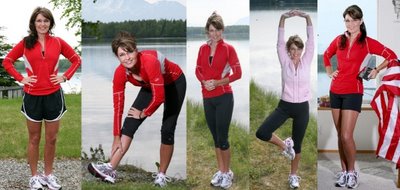
The Pernicious Lies Of Sarah Palin IV: They Victimize Me For Looking Hot

Sp running medley

Hard to beat this reader's take on boob-gate:

"What am I going to wear so that nobody will look in an area that I don't need them to look at?"

Nicely played. But then everyone should have expected this. A woman who does her bogus Q&A sessions sitting in a skirt so short that she can't even shift in the chair without threatening to show her "political credentials" and one half expects her to simulate the leg cross scene from "Basic Instinct"….Who shows up for a rally for special needs children wearing a tiny jean skirt more appropriate for her teenage daughters and sky high strappy "take me boys" sandals with elaborately sparkled show girl toenails….who appeared at Belmont, arriving late to be sure to be noticed, wearing inappropriate clothing including a black bra under a figure forming white shirt – well the problem isn't that she doesn't want them to look. It's that she wants them to look, so she can then cry "sexist".

She creates the situation she wants to gripe about. It's intentional. It's a way of appearing faux "feminist" while also displaying the wares that got every golddigger in history a sugardaddy. It's a way of controlling her product messaging.

Most Terrorists Are Nitwits, Ctd

Andrew Exum sizes up Daniel Byman and Christine Fair's argument:

I think the ineptitude is just one side of a wider trend. Keeping the argument to Britain for now; before 9/11, to become an extremist, you had to be fairly committed. There was none of the reflected glamour of being associated with people capable of scaring polite society. In those days, extremists were overzealous, a bit nerdy, waay too into religion and generally uncool. As Chris and Daniel's example of 9/11 lead attacker Mohammed Atta suggests, in such an environment, a potential recruit is more likely to possess a certain awareness, commitment and focus. Of course, there are examples of pre 9/11 Jihadiots, but in general terms, the cause was as cool as chess club and membership reflected that. 

Now that the cause is much more glamorous, many more people want some of the action. So the fact that there are numerous instances of idiocy means that extremists have been able to lots of idiots. And, just one idiot who manages to press the right button at the right time is a huge problem.

But more than that, if you are going to get lots of recruits, most will be idiots but you are also going to get a larger proportion of useful people.

This is how terrorism becomes self-sustaining. With the help of the West.

The Thugs And The Greens

32470_404289559453_45061919453_4062925_5899879_n

CNN asks Karroubi about the status of the reform movement:

The Green Movement today is stronger and more mature than last year. Despite a heavy climate of repression, this movement has been able to unite and spread to different layers of society. Incidentally, the (Iranian) leadership understands this important development very well. The fact that funeral processions take place with the presence of anti-riot police and the fact that they never grant permission for any gatherings, even to honor Imam Khomeini, shows the strength of this movement and their fear of this movement.

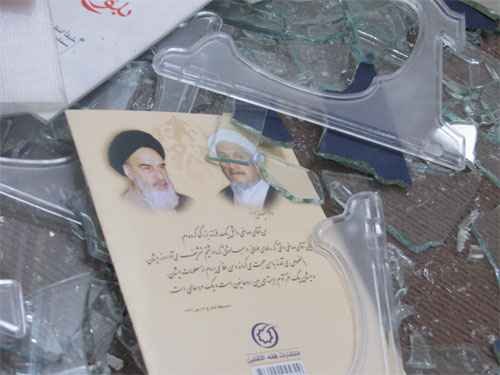
A photo caption from Mousavi's Facebook page explains the latest act of violence:

Following the trip of Mehdi Karroubi to the city of Qom and his visit to the house of Grand Ayatollah Saanei, pro-reform senior religious figure, a group of organized plain clothes thugs surrounded the house of Grand Ayatollah Saanei and damaged Karroubi’s car. This group of organized thugs also attacked the office of Grand Ayatollah’s Saanei and Montazeri and destroyed the property and it items while the police and security forces not only did not act but were in full cooperation with them!

Many more photos of the damage here.

Malkin Award Nominee

"Watching this Presidential commission discuss strategies for deficit reduction is like watching a pack of gluttons talk about getting in shape while they prowl up and down a buffet table. They linger over the deep-fried mortgage interest deduction caps, dip their spoons into the rich chocolate of the VAT tax, and lick their lips as they wait for the expired Bush tax cuts to pop out of the oven. They end up perched on the edge of creaking chairs, tittering at the wonderfully naughty idea of devouring everyone’s 401k plans for dessert. It’s a nauseating spectacle that will only end when they’re escorted from the restaurant by angry voters," – DocZero, HotAir.

Doctor Zero does not specify any spending cuts in his jeremiad. His solution? Ending $400 million on foreign aid to Gaza and abolishing public sector unions. Nearly there …

Afghan Bonanza Reax

Yglesias:

As Spencer Ackerman notes, this $1 trillion in deposits seems likely to set the stage for a lot of bad arguments about forward-looking military policy. He focuses on the fact that war for cell phone batteries makes a better conspiracy theory than more outlandish tales about oil pipelines. The reverse, however, is also the case and Risen’s piece already features evidence of military officials floating the theory that we need to stay in Afghanistan indefinitely lest China get its hands on vast quantities of copper. In general, though, waging war for control of natural resources makes a lot of sense for third world bandits & militias or would-be coup leaders, but doesn’t cost out for citizens of a developed market oriented democracy.

You think a president Palin would examine the “cost-out”? Thoreau:

For my part, I would be content to leave Afghanistan alone and say that if somebody there somehow finds himself in control of  minerals and manages to dig them out of the ground, we are willing to pay cash on delivery.  We are NOT, however, willing to do our own pick-up or provide armed escorts for those who do the pick-up or the mining.  The terms are cash on delivery.

Ambinder:

The way in which the story was presented — with on-the-record quotations from the Commander in Chief of CENTCOM, no less — and the weird promotion of a Deputy Assistant Secretary of Defense to Undersecretary of Defense suggest a broad and deliberate information operation designed to influence public opinion on the course of the war. Indeed, as every reader of Jared Diamond’s popular works of geographic determinism knows well, a country rich in mineral resources will tend toward stability over time, assuming it has a strong, central, and stable government.

Katie Drummond asks everyone to calm down:

The military (and observers of the military) have known about Afghanistan’s mineral riches for years. In a 2007 report, the Geological Survey and the Navy concluded that “Afghanistan has significant amounts of undiscovered non-fuel mineral resources,” including ”large quantities of accessible iron and copper [and] abundant deposits of colored stones and gemstones, including emerald, ruby [and] sapphire.”

Not to mention that the $1 trillion figure is — at best — a guesstimate. None of the earlier U.S military reports on Afghan’s mineral riches cite that amount. And it might be prudent to be wary of any data coming out of Afghanistan’s own Mines Minestry, which “has long been considered one of the country’s most corrupt government departments,” the Wall Street Journal reports.

Adam Ozimek:

One mechanism by which resource wealth translates to negative economic outcomes is the so-called “spending effect”…An example of this would be a huge growth in the diamond industry driving up the prices of haircuts and homes because they are non-resource tradeables whose prices are determined locally. These higher consumer prices then increases the reservation wage high enough that the costs in the local clothing industry, a non-resource tradeable whose prices are determined on the world market, go above world prices and thus the industry suffers.