A Papered-Over Problem

Umbra Fisk looks into the limits of recycling:

Paper can indeed be recycled only a finite number of times before its fibers get too short and frayed to be recovered. And according to the EPA, that magic number is about five to seven trips through the paper mill. That means we must always turn to some amount of brand-new pulp – called virgin pulp in the biz – to fulfill our needs. According to estimates from a nonprofit and a paper industry group, if we tried to make all paper from 100-percent recycled content starting now, we’d run out of materials in just a few months.

And the process is far more preferable than this abomination, however kickass it looks:

(Top video: Inside a paper recycling plant.)

When The End Is Near

Helen Thomson examines research on near-death experiences:

Steven Laureys, a neuroscientist at the University of Liège in Belgium who works with people in comas and vegetative states, started to investigate after his patients told him of their own near-death experiences. “I kept hearing these incredible stories in my consultations,” he says. “Knowing how abnormal brain activity is during a cardiac arrest or trauma, it was impressive how rich these memories were. It was very intriguing.” …

His team looked at 190 documented events that resulted from traumas including cardiac arrest, drowning, head injury and high anxiety. Using statistical analysis and a measurement called the Greyson scale to assess the number and intensity of different features of the near-death experiences, the team discovered that surprisingly, the reports shared many similarities.

The most common feature was an overwhelming feeling of peacefulness. The next most common was an out-of-body experience. And many people felt a change in their perception of how time was passing. There were only a few examples of negative experiences. “It turns out to be not so bad to have a dying experience,” says Laureys. Having a life flashback or a vision of the future – the kinds of things often depicted in Hollywood movies – were only reported by a small minority of people.

Previous Dish on NDEs here and here.

Why Herbert Endures

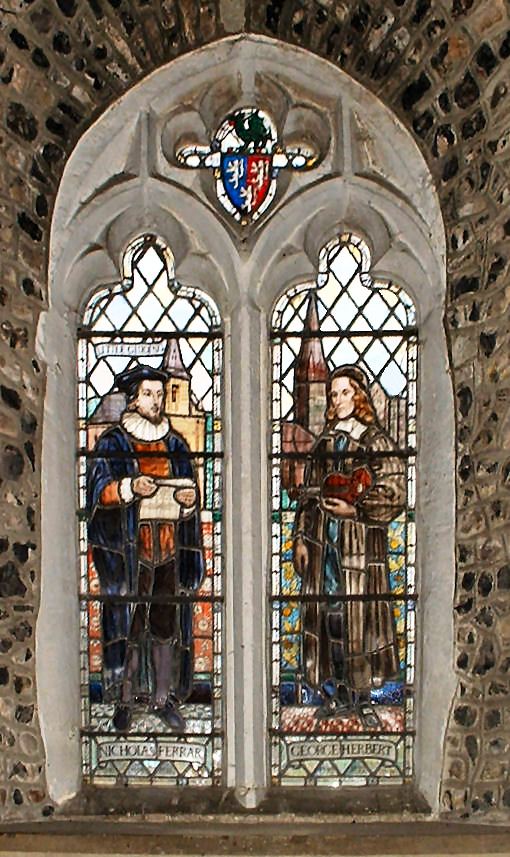
Noting a resurgence of interest in the 17th century poet and Anglican clergyman George Herbert, Wesley Hill unpacks why he resonates with modern believers:

[T]he reason Herbert’s Complete English Works still finds readers like me is because he fuses such rich truths [about God’s love for us] with a heartfelt, occasionally dish_georgeherbertwindow wince-inducing honesty about how those truths are so hard to grasp. Doubt and grief never quite dissipate from his verse. They don’t overshadow his proclamation of Christ. But they linger, like a chill that hasn’t been driven out of the room, despite the fire blazing in the hearth.

In one poem, Herbert pictures Christ making a place for his “sighs,” or what the apostle Paul called our “groan” (Rom. 8:23). “Look,” says Christ to Herbert, gesturing to the wound in his side, “you may put it”—whatever sighs or groans you intend to convey to God—”very near my heart.” Notice the impeccable theology: Christ intercedes for us before God the Father. But notice, too, how the theology isn’t detached from the poet’s own messy experience. “Away despair,” the poem begins, drawing on Herbert’s wavering belief. “Winds and waves” assault the boat of his faith, and he needs to feel that Christ is interceding for him in the midst of that storm.

Isn’t that precisely the shape of faith? We know that God has come to our rescue. Yet, in this time between the times, we live stretched like a tension wire between Christ’s resurrection and his future coming. We are vulnerable to grief, anxiety, and hesitation. Herbert knew that better than almost anyone, and it’s one of the main reasons he’s still worth reading.

Related Dish on Herbert here. We featured his poetry Easter weekend here, here, and here.

(Image: Stained glass images depicting Herbert and his friend Nicholas Ferrar, from the Church of St Andrew, Bemerton, also known as George Herbert’s Church, via Wikimedia Commons)

Are There Really Universal Rights?

The philosopher John Searle says yes – but with a caveat:

I’m not skeptical about the idea of universal human rights. I’m skeptical about what I call positive rights. You see, if you look at the logical structure of rights, every right implies an obligation on someone else’s part. A right is always a right against somebody. If I have a right to park my car in your driveway, then you have an obligation not to interfere with my parking my car in your driveway. Now the idea of universal human rights is a remarkable idea because if there are such things, then all human beings are under an obligation to do—what? Well, I want to say that with things like the right to free speech it just means not to interfere. It’s a negative right. My right to free speech means I have a right to exercise my free speech without being interfered with. And that means that other people are under an obligation not to interfere with me.

Now, when I look at the literature, I discover that there is a tradition going back to the UN Universal Declaration of Human Rights, where not all of the rights listed are negative rights like the right to free speech, or the right to freedom of religion, or the right to freedom of association, I think all those negative rights are perfectly legitimate. But there are supposed to be such rights as “every human being has a right to adequate housing.” Now I don’t think that can be made into a meaningful claim.

The claim that “every human being has a right to seek adequate housing,” or that there are particular jurisdictions where the British government, or the government of the State of California, can decide “we’re going to guarantee or give that right to all of our citizens”—that seems to me OK. But the idea that every human being, just in virtue of being a human being, has a right to adequate housing in a way that would impose an obligation on every other human being to provide that housing, that seems to me nonsense. So I say that you can make a good case for universal human rights of a negative kind, but that you cannot make the comparable case for universal human rights of a positive kind.

Will Wilkinson comments:

I think it’s easy to confuse the constitution of rights with the recognition of rights precisely because the constitution–the construction of the social fact of rights–has depended historically on a rhetoric of recognition. The first step toward rights with a real social and institutional existence has often been the propagation of the belief that the aspirational right has a freestanding, natural, preinstitutional existence we are obliged to recognize and honor. The defense of universal human rights is a good strategy making rights more universal. Fake it ‘til you make it.

My sense is that as a piece of political rhetoric, the UN Declaration’s notion of universal positive rights has done a lot of good, so I see no particular reason to abandon the strategy of trying to bring rights into existence by pretending they already exist.

Reading Between The Laughs

Reviewing Mary Beard’s Laughter in Ancient Rome, Gregory Hays points to the deeper meaning she finds in their mirth:

On Beard’s telling, ancient laughter is generally associated with unease, especially the unease generated by differences of status and power. In the Life of Aesop, jokes articulate the power relationship of master and slave. Roman comedies feature a recurrent character, the parasite, whose “job” is to laugh at his patron’s jokes—and, when the patron’s back is turned, at the patron. Laughter shapes the relationship between ruler and subject. The murderous pranks of Caligula, Commodus, or Heliogabalus contrast with the “good” emperor’s tolerance of quips, or his willingness to make fun of himself. (“Oh dear,” the dying Vespasian is supposed to have said, “I think I’m about to become a god.”)

Laughter for Beard is also a sign of cracks or fissures in the smooth surface of human identity. The ancients thought of “man” as a category bounded by animals at one end and gods at the other. For Aristotle, man is the only animal that laughs (if lions could understand our jokes they would not find them funny). Laughter links us with the divine, but not always in pleasant ways; in Ovid’s Metamorphoses the gods laugh last, best, and usually at the human characters’ expense. For men, in turn, Beard observes, the most perfectly laughable animal was the monkey: a creature striving to be human but not quite succeeding, like our cheezburger-craving cats or poker-playing dogs. Almost as hilarious was the donkey, particularly when eating; Apuleius’ novel [The Golden Ass] invokes this apparently familiar joke. Yet the donkey’s bray (Latin rudere) is uncomfortably close to the human laugh (ridere). Do they have more in common than we like to think?

Harry Mount compares the humor of ancient Rome to our own:

[I]f you’re expecting to laugh at the things that made Romans laugh, prepared to be disappointed by Mary Beard’s latest book. But, then, Beard isn’t trying to be funny — or even saying that the Romans were particularly funny, either. What she tries to do is nail what made the Romans laugh.

And what she pretty conclusively proves is that, even if we don’t find their jokes funny, the Romans gave us the furniture for our own comedy today. The language of modern humour is rooted in Latin. Iocus is Latin for ‘joke’; facetus, as in facetious, is Latin for ‘witty’; ridiculus, as in ridiculous, meant ‘laughable’.

Roman comic situations were similar to ours, too. Sex figures prominently. Cicero’s list of the different kinds of Roman jokes — based on ambiguity, the unexpected, wordplay, understatement, irony, ridicule, silliness and pratfalls — is pretty close to any comparable modern list.

A Letter For The Day

“Well, the big news here is Gay Power. It’s the most extraordinary thing. It all began two weeks ago on a Friday night. The cops raided the [Stonewall Inn], that mighty Bastille which you know has remained impregnable for three years, so brazen and so conspicuous that one could only surmise that the Mafia was paying off the pigs handsomely. Apparently, however, a new public official, Sergeant Smith, has taken over the Village, and he’s a peculiarly diligent lawman. In any event, a mammoth paddy wagon, as big as a school bus, pulled up to the Wall and about ten cops raided the joint. The kids were all shooed into the street; soon other gay kids and straight spectators swelled the ranks to, I’d say, about a thousand people. Christopher Street was completely blocked off and the crowds swarmed from the Voice office down to the Civil War hospital.

As the Mafia owners were dragged out one by one and shoved into the wagon, the crowd would let out Bronx cheers and jeers and clapping. Someone shouted ‘Gay Power,’ others took up the cry–and then it dissolved into giggles. A few more gay prisoners–bartenders, hatcheck boys–a few more cheers, someone starts singing ‘We Shall Overcome’–and then they started camping on it. A drag queen is shoved into the wagon; she hits the cop over the head with her purse. The cop clubs her. Angry stirring in the crow. The cops, used to the cringing and disorganization of the gay crowds, snort off. But the crowd doesn’t disperse. Everyone is restless, angry and high-spirited. No one has a slogan, no one even has an attitude, but something’s brewing.

Some adorable butch hustler boy pulls up a parking meter, mind you, out of the pavement, and uses it as a battering ram (a few cops are still inside the Wall, locked in). The boys begin to pound at the heavy wooden double doors and windows; glass shatters all over the street. Cries of ‘Liberate the Bar.’ Bottles (from hostile straights?) rain down from the apartment windows. Cries of ‘We’re the Pink Panthers.’ A mad Negro queen whirls like a dervish with a twisted piece of metal in her hand and breaks the remaining windows. The door begins to give. The cop turns a hose on the crowd (they’re still within the Wall). But they can’t aim it properly, and the crowd sticks. Finally the door is broken down and the kids, as though working to a prior plan, systematically dump refuse from the waste cans into the Wall, squirting it with lighter fluid, and ignite it. Huge flashes of flame and billows of smoke.

Now the cops in the paddy wagon return, and two fire engines pull up. Clubs fly. The crowd retreats.

Saturday night, the pink panthers are back full force. The cops form a flying wedge at the Greenwich Avenue end of Christopher and drive the kids down towards Sheridan Square. The panthers, however, run down Waverly, up Gay Street, and come out behind the cops, kicking in a chorus line, taunting, screaming. Dreary middle-class East Side queens stand around disapproving but fascinated, unable to go home, as though torn between their class loyalties, their desire to be respectable, and their longing for freedom,” – Edmund White, in a letter to the poet Alfred Corn and his wife Ann, just days after the Stonewall riots in June 1969.

For more on the Stonewall riots, check out this excellent radio documentary produced by Dave Isay – the first documentary in any format about the uprising:

This embed is invalid
Talking About God, To Ourselves

Charles Mathewes argues that “we are awash in religious speech even amidst a desert of religious conversation.” He puts much of the blame on how the modern West conceptualizes religion:

[T]he very categories we use to organize our social life and delineate the space we allow for religion—particularly the categories of “religious” versus “secular”—actually hamper our attempts to have such conversations. Scholars … have shown that these categories are the product of the past few centuries of European history and have been shaped by the peculiarities of European religion (especially Protestantism) and politics (especially liberalism). Misshaped, in fact, for our situation: They assume a particular picture of what religion essentially is—mostly, the private encounter of the individual soul with God that takes place in the sublime space of the individual’s most inward and inaccessible subjectivity. In contrast, the “secular” is the outward space, where we negotiate our way amid the material cosmos and our “properly” political concerns—which, by definition, cannot be “properly” religious.

Though he praises the book, he doesn’t exempt Christian Wiman’s My Bright Abyss from these tendencies:

Wiman seems … more focused on current questions about his wounds than on the route he took to get to those questions, or those wounds. … Augustine turns us to wonder at God and what God hath wrought; Wiman makes us wonder at himself, at the questions he asks and at the courage with which he asks them. But he asks little of the reader beyond that. I am not asking for an altar call, but perhaps some suggestion that a life lived with such intensity and self-awareness may have lessons for our own. Wiman’s prose stops before the foot of the imperative, however, unwilling to climb and address the crowds gathered on the plain.

Previous Dish on Wiman here, here, here, here, here, and here.

Faces Of The Day

lede_art_women2

Yemeni photographer Boushra Almutawakel photographs mothers and their daughters:

[I]n her “Mother, Daughter, Doll” series, taken from a new exhibit at the Howard Greenberg Gallery, The Middle East Revealed: A Female Perspective, Almutawakel portrays a simple progressionfrom Western clothing to full hijabthat has far-reaching implications for how we read and register the human form.

Almutawakel explains her thinking:

As an Arab Muslim woman living in Yemen who has first-hand experience with the hijab, I have mixed feelings regarding this topic.

There are certain aspects of the hijab I like and others I don’t particularly care for. I don’t believe it is black or white. I found the veil to be an intriguing, complex, multilayered topic.

In this ongoing project on the hijab/veil I want to explore the many faces and facets of the veil based on my own personal experiences and observations: the convenience, freedom, strength, power, liberation, limitations, danger, humor, irony, variety, cultural, social, and religious aspects, as well as the beauty, mystery, and protection. The hijab/veil as a form of self-expression;  the veil as not solely an Arab Middle Eastern phenomenon, the trends, the history and politics of the hijab/veil, as well as differing interpretations, and the fear in regards to the hijab/veil.

I also want to be careful not to fuel the stereotypical widespread negative images most commonly portrayed about the hijab/veil in the Western media, especially the notion that most, or all women who wear the hijab/veil, are weak, oppressed, ignorant, and backwards. Furthermore, I hope to challenge and look at both Western and Middle Eastern stereotypes, fears, and ideas regarding the veil.

See the Howard Greenberg Gallery here.

A Physicist Defends Philosophy

Sean Carroll responds to the common criticism of his fellow physicists that philosophers “care too much about deep-sounding meta-questions, instead of sticking to what can be observed and calculated”:

Here we see the unfortunate consequence of a lifetime spent in an academic/educational system that is focused on taking ambitious dreams and crushing them into easily-quantified units of productive work. The idea is apparently that developing a new technique for calculating a certain wave function is an honorable enterprise worthy of support, while trying to understand what wave functions actually are and how they capture reality is a boring waste of time. I suspect that a substantial majority of physicists who use quantum mechanics in their everyday work are uninterested in or downright hostile to attempts to understand the quantum measurement problem.

This makes me sad. I don’t know about all those other folks, but personally I did not fall in love with science as a kid because I was swept up in the romance of finding slightly more efficient calculational techniques.

Don’t get me wrong — finding more efficient calculational techniques is crucially important, and I cheerfully do it myself when I think I might have something to contribute. But it’s not the point — it’s a step along the way to the point.

The point, I take it, is to understand how nature works. Part of that is knowing how to do calculations, but another part is asking deep questions about what it all means. That’s what got me interested in science, anyway. And part of that task is understanding the foundational aspects of our physical picture of the world, digging deeply into issues that go well beyond merely being able to calculate things. It’s a shame that so many physicists don’t see how good philosophy of science can contribute to this quest. The universe is much bigger than we are and stranger than we tend to imagine, and I for one welcome all the help we can get in trying to figure it out.