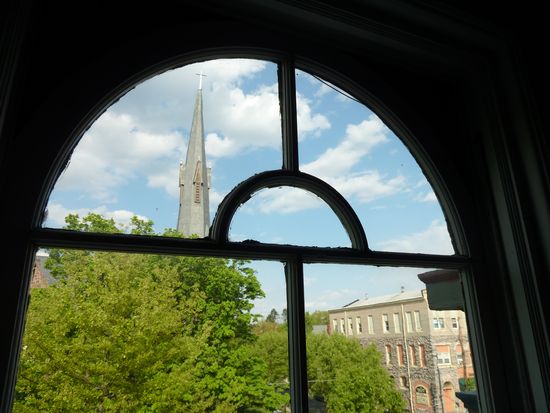
Bloomsburg, Pennsylvania, 4.08 pm
Bloomsburg, Pennsylvania, 4.08 pm
Henry Olsen has some advice. Anthony Wells sizes up the exit polls:
In terms of past accuracy, the exit poll last time got the Labour majority exactly right (though they were slightly off with Conservative and Lib Dem seats). Unless something goes terribly wrong, we should have a broad idea of the result a couple of minutes after 10 o’clock.
That's 5 pm our time. Stay tuned.
A reader writes:
So those lucky bastards in Merry Ole England can vote drunk? At a pub, no less? While we poor unlucky bastards here in Indiana (who voted on Tuesday) can’t even BUY alcohol on election day
Alcohol is served in restaurants and bars on Monday through Saturday from 7 a.m. to 3 a.m. and from 10:30 a.m. to 12:30 a.m. on Sundays.
Alcoholic beverages can be purchased from private retail package stores, and beer and wine can be bought in grocery stores, convenience stores, and drug stores. No alcohol is sold on Christmas Day and Election Day.”
As I said, it's a civilized place.
A pair of Star Wars geeks are having a pair of kids:
Nate Silver sketches out various scenarios:
My intuition is that most of the risks are still to the downside on Labour's vote, given the history of overestimating their vote in the past and that some pollsters are distributing undecideds based on how people claimed to have voted in the last election — something which tends to help Labour because their voters seem the most indifferent about this election. On the other hand, our model is more aggressive than most others in taking away seats from Labour for a given vote share.
As of this writing, betting markets now give Conservatives about a 38 percent chance of claiming a majority. I don't know that there's much arbitrage either way there, but I'd be slightly inclined to take the Tories on those odds.
Ruffini, booster of conservative chances, predicts that the "Tories wind up with 328 seats and the chance to form a Government outright."
The earnestness and the silly walks … in one TV clip (yes, I miss my old home):
Via Greg Mitchell. And that's Andrew, not Andy, Greg.
Kevin Williamson skewers Supply Side dogma in his piece at National Review:
There is no evidence that the [Bush] tax cuts on net produced more revenue than the Treasury would have realized without them. That claim could be true — if we were to credit most or all of the economic growth during the period in question to tax cuts, but that is an awfully big claim, one that no serious economist would be likely to entertain. It’s a just-so story, a bedtime fairy tale Republicans tell themselves to shake off fear of the deficit bogeyman. It’s whistling past the fiscal graveyard. But this kind of talk is distressingly unremarkable in Republican political circles.
See the tea-party know-nothing here. Douthat applauded the piece (as did Nyhan, Yglesias, and Kain). Mark Levin responded in his usual talk-radio manner, which inspired Williamson to write:
When I first read Manzi's much-remarked-upon remarks re: Mark, I thought them unduly harsh. I am revising that opinion, just a little.
"Democrats tend to be more interested in legislating than in managing. They come to office filled with irrational exuberance, pass giant fur balls of legislation — stuff that often sounds fabulous, in principle — and expect a stultified bureaucracy, bereft of the incentives and punishments of the private sector, to manage it all with the efficiency of a bounty hunter. This has always been the strongest conservative argument against government activism. Traditionally, Republicans were more concerned with good management than Democrats — until the Reagan era, when the "government is the problem" mantra took hold. If you don't believe in government, you don't bother much with governing efficiently. You hire political cronies for jobs that professionals should be doing. Eventually, you wind up with the former head of the Arabian Horse Association — the infamous Michael Brown — trying to organize federal aid after Hurricane Katrina," – Joe Klein.
This is an indictment of the press as well. We are much more interested in the ideological fights and the horse race than we are with how new laws are actually implemented. Take health care reform. Much of what is good in the bill requires very careful enforcement, administration, cost-awareness, and fiscal vigilance. Will any of us – apart from Ezra Klein and Jon Cohn – be paying as much attention to the implementation as we did to the fooferaw of its actual legislative process?
I know it's boring. But government is boring – and necessary.

Jonathan Foreman has a strongly negative view of the Tory re-branding efforts over at FrumForum:
That the party leadership had absorbed the marketing men’s contempt for voters was all too obvious in the Conservatives wretchedly patronizing advertising campaigns. That Cameron and Co. had little apparent understanding of the needs of ordinary people – and were obsessively concerned with the good opinion of small but influential metropolitan elites – was reflected in their inability or unwillingness to engage boldly with issues like law and order and immigration that could well have won them many votes in the Labour heartland.
It is possible that the Tories, having squandered their lead in the polls earlier this year may still win a majority tomorrow. But if they do, credit is due less to their own efforts than to the failures of their opponents.
I don't think this is that far off-base, but I do know that the Tory brand was in such terrible shape five years ago that even if they had the best and clearest policies in the world, no one would have voted for them. That's why Cameron dedicated himself so passionately to a new image before new policies. The context of this election is three previous elections in which the Tories were creamed, when the rump of MPS had become almost as unhinged as today's GOP, when the Conservatives had begun to seem like an anachronism in a far more multicultural, diverse and restless society that Thatcherism had unwittingly spawned.
This in fact was the great irony of British conservatism in my lifetime.
Thatcher campaigned on smaller government, lower taxes and social conservatism. But the vibrant economy that followed did more to undermine traditional England than anything Labour could have done. Small towns became dependent on nationally branded super-stores, migrants and immigrants poured in, gays became mainstream, the environment became a consensus national issue, cosmopolitanism sank deep into even the most traditional of places. Re-branding was essential if the Tories were going to survive at all in the Britain they had themselves created.
Some of this led to mushy marketing nonsense. But the idea of a campaign that would have appealed mainly to Daily Mail readers and former Labour voters upset by the number of Poles in their neighborhoods was a non-starter. For a long time, I favored a strong Thatcherism as a vital formula. But it was tried three times and failed catastrophically. It made my friend, the immensely gifted and capable William Hagie, an electoral loser of historic proportions. The only reason the Tories have an uphill shot today is that the huge Labour majority that still endured after 13 years – a function of long Tory irrelevance – is such a steep hill to climb.
Besides, the Tories have offered the most credible commitment to fiscal sanity in the near future – and that, in this climate, is enough.
the greenest fix of all."
 The Dish