The Weekly Wrap

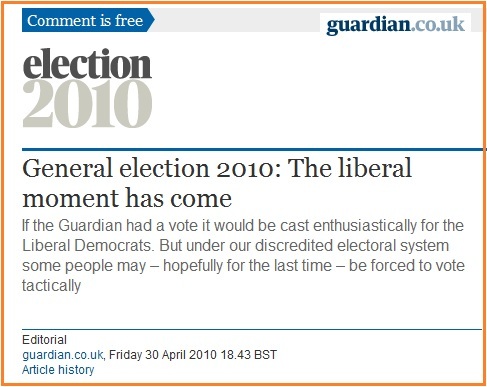
Today on the Dish, things continued to look grim for Labour, Andrew diagnosed the deep disconnect with their base, Cameron tried to seal the deal with a social contract, Tories took a stand on Afghanistan, Johann Hari compared Cameron to Bush, the Guardian endorsed Clegg, a reader took Andrew to task for his partisanship, Nate Silver sketched out the Lib-Dem dilemma, and Clegg had a bit of a laugh. Comprehensive election round-up here.

In immigration coverage, Andrew touted the gay provision in Reid’s proposal, Butters cautioned against swift border security, a congressman got ugly, Frum defended Arizona’s law, Fallows compared it to France, Chapman looked into its enforcement, McArdle and Welch sounded off, others bashed the idea of a border wall, and Schaller followed up on demographics.

Oil spill coverage here and here. Get your Palin fix here and here. Andrew hailed progress on the auto industry while Megan begged to differ. MSM bashing here and here. In other assorted coverage, Max Fisher surveyed the reaction to letting women serve on subs, Barlett said the VAT is ten years away, Louise Levathes looked at some cool new technology, Jonah Weiner praised South Park, A.C. Grayling and a reader philosophized on brains, and another pointed to a history of sensory deprivation.

Caption fun here, Gaga in the military here, and our daily profanity here.
6a00d83451c45669e20133ed050e3f970b-550wi

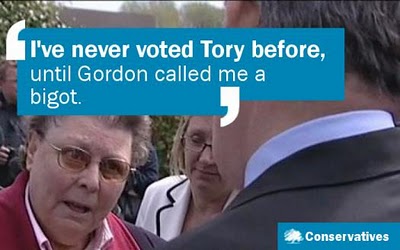
Thursday on the Dish, Andrew live-blogged the last election debate. Both he and the viewers gave it to Cameron. Reax here. We also rounded up the fallout over Bigot-gate, Cameron sniped Brown, a reader took a shot at Gillian Duffy, another dissented over Andrew’s take on US vs British immigration, the Economist editorialized against Lib-Dem, and Andrew took a long look to the post-election environment. More Scottish profanity here and here.

In immigration coverage, Cowen combed through the Democrats’ new reform plan, Bill Clinton made the case that immigrants will cut the deficit, Duncan Hunter got pwned for wanting to deport American kids, Shikha Dalmia called out right-wing hypocrisy over capitalism, and readers responded to the immigration debate at length. Another agreed with Andrew about the Tea Party’s cultural crux, William Frey illustrated its demographic loss to young immigrants, and Andrew mulled over that struggle. Friedersdorf put forth his immigration plan, Leviticus came to the illegals’ defense, and Limbaugh pulled a Hewitt. You should vote for this kid if you can.

“Will she or won’t she run?” continued here, here, and here. Meanwhile, reporters continued to chicken out.

In other coverage, Ackerman relayed news that a Gitmo torturer may testify, the defendant neglected to show, Larison and Reihan assessed the Crist apostasy, Hank Cardello put forth a plan to cut America’s fat, and Edward Tenner delved into the dead chimp studies. Our South Park bleg didn’t get any major revelations, computer geeks gushed about their first loves, the Dish stalked Goldblog in the woods, and anti-fart blankets tried to save your marriage. This window and this MHB were particularly lovely.

W6a00d83451c45669e20134803cf8bc970c-550wi

Monkton, Vermont, 9.30 am

Wednesday on the Dish we homed in on Gordon Brown’s historic gaffe. Video here. The media jumped into action, Labour officials spun, the old widow reacted in shock, Alastair Campbell sounded off, his fictional doppelganger raged, Andrew Rawnsley saw a long pattern in Brown’s behavior, and the polls continued to look bad for his party. A big round-up of commentary here.

In immigration coverage, the Mexican ambassador warned his citizens to avoid Arizona, Sarah Palin spread a pernicious lie about the law, a congressional candidate called for implanting chips, Byron York didn’t see the problem with ID checks, Reynolds pandered and waffled, Andrew called out the hypocrisy of the tea-partiers, and Kos foresaw a huge backlash against the GOP among Hispanics in the state. And we rounded up commentary on the right.

As the stability of Iraq continued to slip, Bernstein worried about the media coverage and Musings On Iraq examined the country’s crime problem. Daniel Altman checked in on Haiti and Ezra Klein did so on HCR. Financial reform coverage here and here. In assorted coverage, Scott Morgan suggested revisions to DC’s pot law, Dreher talked epistemology, and Bartlett took stock of conservative dissenters.

Fly old guy here, crazy ballin’ here, naked-ish models here, preview of summer blockbusters here, and creepy ad here.

M6a00d83451c45669e20134802a281c970c-550wi

Tuesday on the Dish we rounded up commentary on the British election, Cameron reclaimed the online mantle from Clegg, and Massie and Silver nerded out to proportional representation. Economic indicators here and its political spin here. Media antics here, Twitter gaffe here, and a dose of pop culture here.

In Palin watch, DiA countered Josh Green over her presidential chances, Josh pushed back, and the Dish tallied yet another odd lie (though the perjury rumor was likely false). In immigration coverage, James Doty called the law unconstitutional, Kevin Johnson came up with a simpler solution, and an Arizonan posed an even simpler solution. Readers dissented over Andrew’s take on racism, Tim Wise backed his view, and a tea-partier flipped his shit.

In random commentary, Yglesias worried about the pace of financial reform, Gideon Rachman drew comparisons between the Northern Irish and Israeli peace processes, Steven Berlin Johnson spelled out the power of Twitter, TNC begged to differ with Henry Louis Gates over racial blame, John Gray targeted atheism, Drum didn’t, and Andrew tackled the “right-wing media-industrial complex.” State of conservatism round-up here.

Adoption discussion here, creepy ad here, and mesmerizing art exhibit here. A reader passed along the Muhammed episode from Chinese YouTube and another shared an emotional story of letting her dog go.

Aa6a00d83451c45669e20134802b8a4f970c-550wi

Forward Operating Base Todd, Murghab District, Badghis Province, Afghanistan, 12 pm

Monday on the Dish, Andrew assessed the sustained surge of Nick Clegg, polling continued to look precarious for Labour, Cameron played up civil liberties, the gay vote swung to the Lib-Dems, Massie considered a Lib-Tory deal, Martin Ivens impressed Andrew with his analysis, and a reader explored the need for electoral reform. Round-up of commentary here.

Andrew took a long look at a profile of Palin and her newfound fortune. Reader response here and here. Andrew also checked in on the difficult situation in Iraq. On the immigration front in Arizona, Fallows contrasted the situation with China’s and we put together a comprehensive look.

In other commentary, Reihan was pessimistic on the economy, Chait tried to understand the GOP on financial reform, Drum did the same, Farhad Manjoo sized up Facebook’s plan for WWW domination, and Dan Ariely explored the roots of hypocrisy. Frum interjected in the Manzi-Levin spat, Manzi shot back at McCarthy, and Ambinder picked apart Gingrich.

Andrew mused about the spiritual component of playing and shared some footage of his beagles and husband at play. The Simpsons stood with South Park, Thoreau struggled with his caffeine addiction, and R.L.G. at Democracy In America did the same with polling on Israel. Yglesias award here and cool ad here.

— C.B.

Immigration On Both Sides Of The Pond

An English reader writes:

As you recently mentioned, immigration is a growing concern in England especially. This is not due to intolerance of outsiders (although there is always a small intolerant minority). Most Brits recognize that our culture has largely come about over the last few hundred years due to the melting pot of different races, religions and ethnicities – especially from the Commonwealth.

The issue is simply one of numbers, leading to pressure on housing, welfare, health and education services – England (not the UK) is the most densely populated country in Europe. It has 50m of the UKs 60m population, in a size of about 50,000 square miles. That would make it smaller than 31 of the States in the US. Imagine putting the population of New York [state], Florida and Illinois in space smaller than Louisiana. Now suggest adding the population of Nevada over ten years….this is what people are reacting to.

If the underlying problems (e.g. jobs, housing, education etc) are resolved, then the concerns would likely dissipate (except for the intolerant minority).

An American reader's thoughts:

You wrote:

In three critical areas the Labour Party is seen among significant layers of working class people to have ignored their anxieties and denied them a voice: economic globalization, European integration, and mass immigration. Each subject has been declared off political limits.

In the US, the white working class has been affected mainly by the first but not the second and third.

Obviously not by the second, but if your policy is to deliberately import large number of manual laborers (blue collar) you will of course lower the cost of that labor. If you don't believe this to be the case please come and visit me in Columbus, Ohio, and we'll do a quick tour of the ruins, on my nickel. (You can even bring the dogs). Huge number of jobs (construction comes to mind) that were once overwhelmingly done by working class whites (and blacks, I might add) are now done by illegal immigrants from Mexico and Central America.  Employers can pay them less, treat them like dirt, and know that they won't have to deal with unionization or safely complaints, as these employers can always threaten to report them to the authorities.

Two big reasons why our political class is disinclined to do anything about this:

1. The right side of our.political ruling class enjoys its fat checks from the corporations that profit by the lower labor costs.

2. The left side of our political ruling class gets a steady stream of new voters.


A Country Fighting For Its Freedom

Women Without Men – Trailer from IndiePix on Vimeo.

Lauren Collins reviews Iranian film maker Shirin Neshat's "Women Without Men":

The world is a different place than it was three years ago, especially in the eyes of Iranians and those who care what happens to them. Neshat used to say that she was not a political artist, or, for that matter, an especially political person. The events following last summer’s contested election in Iran changed that. Neshat organized hunger strikes by mass e-mail. She and the cast of “Women Without Men” wore bright green on the red carpet in Venice, and flashed the V-sign. Neshat’s film begins with an image of a suicide: a girl named Munis, forbidden by a devout brother to leave the family compound, jumps off the roof, her shirtwaist billowing against a blue sky. She floats to the ground like a feather, landing on her back. Munis, for Neshat, became a Neda. The film was done by June of last summer, but, at the end, Neshat added a message:

This film is dedicated to the memory of those who lost their lives in the struggle for freedom and democracy in Iran, from the Constitutional Revolution of 1906 to the Green Movement in 2009.

Minds vs Brains, Ctd

A reader writes:

Grayling is very correct, but neglects to mention that even the physical component of the mind is not restricted to the brain. Hormones play a huge role in how we feel, as well as are vastly influential in how we process information. I would argue that the mind does not physically reside in that spot behind the eyes, but it is merely concentrated there. There are diffuse components throughout; feeling something in your gut, loins, or heart aren't merely figures of speech. Ask a post-operative transgendered individual whether the new reproductive organs and hormone therapy are a part of a change in thought, or an ophidiophobe whether adrenal glands matter to logic and reason when a snake is encountered.

Minds are a diffuse thing, most heavily concentrated in our brains, but with diffuse components that extend throughout our bodies, into our friends and neighbors, into our libraries and interwebs, and even into pets and inanimate objects. They are like gravity wells, where the lines are blurred and matter (or thought in this case) is largely considered to be in one well, but is really influenced by many at once.

Ladders, Shovels And Vacuum Cleaners

E.D. Kain would like to have real immigration reform:

Unlike Conor, I think building a wall is a very bad idea, doomed to failure. A ladder is a simple enough solution to the problem of a wall. A shovel is nearly as good. Opening up legal immigration to many, many more immigrants is the only thing that will reduce the influx of illegal immigrants.

To combat the problem of drug smugglers we need to rethink our policies on drugs, and begin to dismantle our enormously foolish war on drugs – beginning with the truly insane approach to marijuana.

Lexington had related thoughts a few days ago:

[It] is impossible to secure a 2,000 mile land border against economic migrants. So long as there are jobs to come to, they will find a way. The only way to relieve pressure on the border is to allow a realistic number of migrants into America, ie one that bears some resemblance to the demand for their labour. When demand falls, (as in the current recession) fewer come, and many go home.

In the medium term, trying to secure the border before you address immigration reform is like trying to stop dust flying into your vacuum cleaner without turning off the suction.

Election Round-Up

Guardian
Reacting to the Guardian endorsement of the Lib Dems over Labour, Tim Montgomerie hopes:

Gordon Brown may end up with only The Mirror's backing. The FT is also certain to jump ship after four successive endorsements of Labour.

Massie warns Clegg:

There's danger for Clegg in all this jockeying for position and influence too. One way to become just like the "two old parties" he lambasts might be to behave just like any other horse-trading, in-it-for-his-own-advantage politician. Novelty, like any other sheen, can wear off quickly.

Michael Tomasky thinks this happened in yesterday's debate:

I think the thing that happened here is that – and this, lo and behold, is something I did predict accurately after the first slugfest – the novelty of Clegg wore off by round three. And since most people are tired of Brown anyway, and especially in the Duffy aftermath, the post-glow Clegg support went to Cameron not Brown.

Jacob Weisberg has the same take:

Clegg's act wore thin in the third. He did not succeed in establishing himself as a responsible choice, as opposed to a protest vote. He avoided further swithering on the question of a hung Parliament only by evading the issue entirely. What on previous occasions came across as a Bill Clinton-like gift for engaging with ordinary people felt too slick. "Tonight's debate is about you," he announced a little too giddily at the outset. And Clegg's sucking up to every questioner was smarmy enough to elicit laughter and groans in the press room.

So does Rachman:

I thought some of the gloss came off Clegg tonight. In the first debate, he seemed affable, cheerful and above-it-all. In this debate he was clearly riled by the attacks on the Lib Dem policy of a partial amnesty for illegal immigrants – and got aggressive with Cameron. Regardless of the merits of the argument, that was a tactical mistake. Voters seem to be turned off by Westminster-style point-scoring.

James Forsyth looks at tactical voting:

Labour supporters in Lib Dem Tory seats will vote for the Lib Dems to try and keep the Tories out. But, interestingly, I hear that Lib Dem supporters tactically voting in Labour in Labour-Tory marginals is unwinding. Lib Dem supporters who have voted tactically in the past are now conscious of how significant it would be if the Liberal Democrats finished second in the popular vote and so are backing their own party.

Contract
Nick Wood loves Cameron's Contract With Britain:

Right now the strongest reason for voting Conservative is a negative: Cameron is not Brown. That has long been the main source of Cameron's political strength. But as polling day nears, he needs to ensure that the public go to the ballot box with a few big but simple reasons for switching to the Tories. They need to know why they are backing Cameron.

That's why his Contract with Britain is essential.

People won't vote for a Big Society. But they will vote for concrete policies that bring the Tory manifesto to life.

Tim Montgomerie has more details:

Two million copies of the contract will be distributed to households in battleground seats – three-and-a-half million people in total. Another one million will be distributed at railway stations and on the campaign trail. Key components of the contract will be highlighted on each day of what's left of the campaign.

Peter Mandelson, Labour’s Head of Election Strategy, isn't as pleased:

With days to go it's vital that voters take a close look at the small print behind the Tories' PR. David Cameron is trying to sell people something without revealing that his plans mean cuts to tax credits, cuts to Child Trust Funds, cuts to schools, cuts for manufacturing, and cuts to the police. David Cameron might think he can fool the voters with a glossy leaflet but he should give them more credit than that.

Massie explains why Cameron's task is so difficult:

it's the failures of the past and that he inherited that make Dave's task so difficult. If 2005 hadn't been such a ghastly failure perhaps the Tories wouldn't need to win an extra 130 seats to win a majority. In other words, they essentially need a landslide just to win a small victory. That's what Cameron inherited and his critics might care to remember the abject failure of their kind of Toryism. If three thumping defeats don't demonstrate that the Tories "own original and successful coalition" has disappeared then I don't know what does.

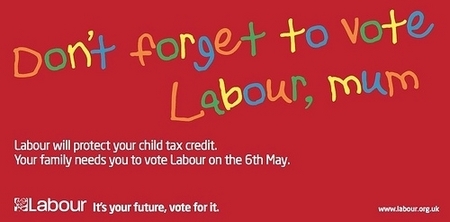
Labourad
Mike Smithson analyzes the above Labour poster. Dizzy's feelings about last night's debate:

The general feeling was that Clegg got hammered on immigration by the other two, personally, I thought that whilst he did get hammered by them his argument was actually the most sophisticated because it essentially comes straight out of the drug decriminalisation playbook about how the criminal gangs rely on prohibition or illegal immigrants by operating in a black economy – starve the black economy, solve the problem.

Whilst I say it's the most sophisticated of the arguments, it doesn't really play well with most people, just as the decriminalisation of drugs argument doesn't play well either. The other two rightly hammered him on the assumed logical conclusions of an "amnesty" that you just send a message that if you come to Britain illegally then disappear for long enough you'll be allowed to stay eventually.

Labour strategist Alastair Campbell -surprise!- calls yesterday's debate for Brown:

The polls are not great for Labour. True. But the sheer number of undecideds is good news for Labour. It means despite all they have seen and heard, despite all the posters, despite Murdoch, the Mail and the rest, they are still holding out against a Cameron premiership. And last night [Gordon Brown] did a very good job of giving them the very good reasons why they are right to hold out, and right to keep asking the questions Cameron and Clegg don't want to answer.

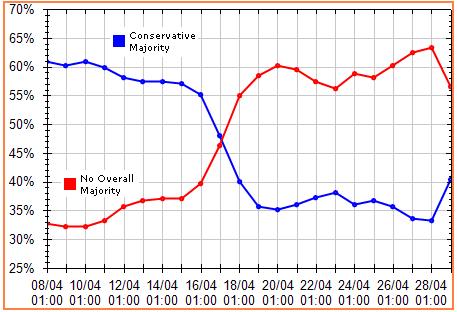
And the betting markets are predicting a greater chance of a Tory majority after last night's debate:

ToryMajority

The Role Of DC Journalists

I wrote that Laura Bush was "the most decent person in the White House for eight long years." That inspired Mistermix at Balloon Juice to complain about "the journalistic elite who justify their shitty journalism by saying that some monster is actually decent 'in person'." Julian Sanchez searches for a middle ground:

I think there’s a real problem of source capture in D.C. journalism, even bracketing the shady quid-pro-quos involved with high-level access. But I doubt a press corps composed largely of snarling misanthropes would be much better. If you want to really understand a particular beat, and be good at covering it, you ultimately have to spend a lot of time socializing with the people you cover. A good reporter isn’t going to become best buddies with the folks he’s writing about, but some minimum level of amiability is going to be required if you expect to get wind of scuttlebutt or know what people in a particular industry or agency are thinking.

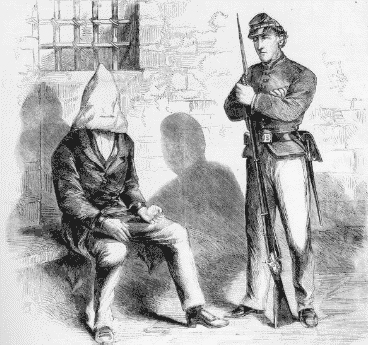
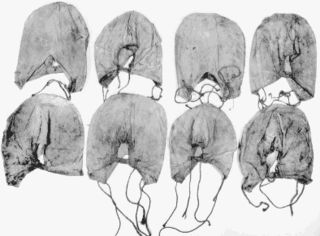
A History Of Hooding

Powellhooded

A reader writes:

I've never seen you reference this before and so I'm not sure you're aware of it, but the sensory deprivation of prisoners was used by the United States before with those who were charged with conspiring with John Wilkes Booth to assassinate Abraham Lincoln. You can rather readily Google this information via Wikipedia and other articles on the assassination, treatment of the conspirators and, most notably – and regrettably, since we're related – the actions of Secretary of War Edwin Stanton.

The actual hoods used were sufficiently sadistic – putting physical around-the-clock pressure on the eyes and ears, since they were hooded all of the time – that there were concerns that Hoods some of the prisoners were driven mad. It was Stanton who pushed for harsh treatment and military commissions and a rather weak-but-new President, Andrew Johnson, who pushed in the other direction.

Intriguingly, Johnson is the one who has been consigned to obloquy: he tried to treat prisoners, and the South generally, the way Lincoln likely would have, but his motives were too mixed up with sympathy for the racism of the South for him to receive any moral benefit from his approach.

On the other hand, Stanton was confirmed to be a Supreme Court Justice (dying before he could actually join the Court).

The use of hooding in this case certainly seems to me to be an example of gratuitous abuse -  stigmatizing, dehumanizing and revenge-driven – that is founded on a particularly emotional crime against the state. In my view, that's what history's judgment will be on the Bush administration and its largely superfluous acts of sadism against already defenseless prisoners.

Images taken from a resource site by the University of Missouri – Kansas City.