Thin Skin Deep

1400383770284.cached

As summer-camp season approaches, Alyson Krueger reports from Eden Village, a Jewish organic farming program that has a “no-body-talk” rule for kids:

“The specific rule is while at camp, we take a break from mentioning physical appearance, including clothing,” said Vivian Stadlin, who founded the camp six years ago with her husband, Yoni Stadlin. “And it’s about myself or others, be it negative, neutral or even positive.”

On Friday afternoon, when the campers, girls and boys from 8 to 17, are dressed in white and especially polished for the Sabbath, they refrain from complimenting one another’s appearances. Rather, they say, “Your soul shines” or “I feel so happy to be around you” or “Your smile lights up the world,” Ms. Stadlin said. Signs posted on the mirrors in the bathroom read, “Don’t check your appearance, check your soul.”

Marcotte is wary:

It sounds wonderful on paper to live in “this wonderful, utopian kind of place where you’re not judged on anything except your spirit,” as one parent described Eden Village. But in the real world, there are plenty of legitimate reasons to include the body as part of your overall judgment of a person, such as when you are picking people to be on your tug-of-war team or auditioning potential sex partners. Doing things like covering up mirrors, which one camp does, treads a little too far in the direction of treating the body like it’s a source of shame instead of helping campers embrace their bodies for what they are and what they can do for them.

She offered similar criticism of a New York City ad campaign last year featuring the slogan “I’m a girl; I’m beautiful the way I am”:

No doubt it satisfies adults to pat little girls on the head and tell them they’re perfect and beautiful just the way they are, but kids often have better BS detectors than adults give them credit for. A handful of slogans on local ads will not change the fact that, in the real world, girls and women do suffer relentless judgment about their looks and are, whether they like it or not, frequently treated as if how they look matters more than anything else about them. For kids already picking up on this grim reality, having adults tell them that they’re perfect just the way they are has a strong chance of being read like yet another bit of adult wishful thinking.

Katy Waldman also criticized the campaign:

[W]hat’s with the slogan? As Kat Stoeffel at the Cut notes, “There’s something slightly contradictory about the NYC Girls Project message—‘Don’t worry about how you look. You look beautiful!’ ” Isn’t the point of the program to encourage girls to disassociate their sense of worth from their physical appearance? Why couldn’t the slogan simply be, “I’m Awesome the Way I Am?”

Beating Back the Distortions Of Gay History

While the p.r. juggernaut behind the deceptions and distortions of Ted Olson, David Boies, Jo Becker and Chad Griffin grinds relentlessly forward to mainstream applause, there’s been an extraordinarily gratifying pushback from countless people who actually know something about the subject. We had Mark Joseph Stern weighing in at Slate. Alyssa Rosenberg filets the Becker and Olson books in the Washington Post here. Jamie Kirchick takes a good whack in the Wall Street Journal here. Hank Stuever got the true measure of the documentary here.

Alyssa’s review is particularly strong and I recommend it if you haven’t read enough about this controversy. She rightly sees this egregious p.r. campaign as turning the actual story of this remarkable civil rights struggle into something “less true and less interesting.” And she has a good eye for the motives of Boies and Olson:

Much is made of the fact that Olson and Boies opposed each other in Bush v. Gore, but little of the alternative legacy each man might want to build for himself, Boies as a winner rather than a loser, Olson as a man above politics rather than a partisan operative.

It goes to show that there is, in the end, a riposte to public relations. It’s called journalism. And the rumors of its death – at the hands of Jo Becker – are mercifully exaggerated.

The Poet Laureate Of Hell

Jang Jin-Sung, author of Dear Leader: Poet, Spy, Escapee – A Look Inside North Korea, describes the unpoetic realities of writing verse for the DPRK:

I worked in Section 5 (Literature), Division 19 (Poetry) of Office 101. Despite the uncanny and unintended echo of Orwell’s Room 101, this office was, ironically, so named precisely in order to avoid any hint of the nature of our work. When it was first set up, the department specialized in conducting psychological warfare operations against the South through cultural media such as the press, literary arts, music and film. After the 1970s, it strove particularly to amplify anti-American sentiment and foster pro-North tendencies among the South Korean population, exploiting the democratic resistance movements that had risen against the then military dictatorship.

My task, like all other writers in the system, was to express an institutional line, not an individual message. No writer in North Korea is permitted to act beyond a bureaucratic affiliation that controls the process – from the setting of the initial guidelines for each work to the granting of permission for publication – through strict monitoring, evaluation and surveillance. Our main task was to transform ourselves into South Korean poets who supported Kim Jong-il. … Because I worked under an assumed South Korean identity, I did have some license to experiment with straying from the legal bounds of North Korean art – at least in the exercise of style. This provided the “freedom” in which I composed my work; which, paradoxically, stood out from writing by my more careful and devout peers and led to my being admitted into Kim Jong-il’s inner circle.

Judging By The Book

800px-Antonin_Scalia_2010

Jeff Shesol spots a fascinating detail in Bruce Allen Murphy’s new biography, Scalia: A Court of One – his obsession with dictionaries, especially those from the 18th and 19th centuries. Scalia’s penchant for parsing the meaning of words “is apparent—often ostentatiously so—in nearly every opinion that Scalia has put on paper over the past three decades”:

Sometimes, this has yielded a comical result, as in Scalia’s dissent in Edwards v. Aguillard, a 1987 decision overturning a pretty plainly labelled Louisiana law called the Balanced Treatment for Creation-Science and Evolution-Science Act on the grounds that it advanced a particular religious belief.  Scalia, having considered very carefully the phrase in question, insisted, presumably with a straight face, that the term “creation science” had no religious meaning whatsoever. “The Act’s reference to ‘creation,’” he wrote, “is not convincing evidence of religious purpose…. We have no basis on the record to conclude that creation science need be anything other than a collection of scientific data supporting the theory that life abruptly appeared on earth.”

In other instances, Scalia’s word games have had profound, societal implications, leading to—in at least one case—a dramatic shift in constitutional law.

In District of Columbia v. Heller, which Scalia considers his greatest achievement, he relied not on one but on three eighteenth-century dictionaries to “clarify” the Second Amendment, which reads, “A well regulated militia being necessary to the security of a free state, the right of the people to keep and bear arms shall not be infringed.” By the time that Scalia had finished his exegesis, the “prefatory clause” about a militia had been clarified into irrelevance, and “bear arms” had been so scrutinized and squinted at and worked over that Americans awoke to find that they had a new, individual right to carry a handgun—a right that cannot be found in the language, plain or otherwise, of the Constitution. Michael Waldman, who has just published a book on the Second Amendment, observes that Scalia, in his opinion, “has the feel of an ambitious Scrabble player trying too hard to prove that triple word score really does exist.”

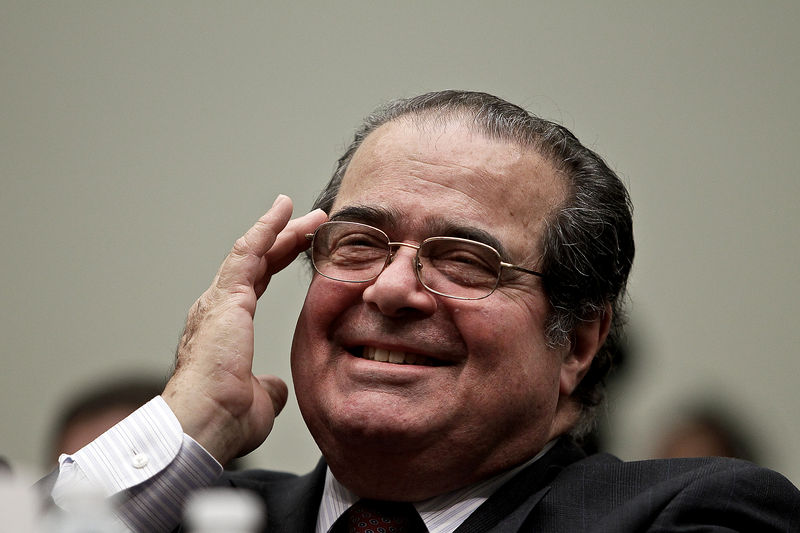
(Photo: Supreme Court Associate Justice Antonin Scalia testifies before the House Judiciary Committee’s Commercial and Administrative Law Subcommittee on Capitol Hill May 20, 2010 in Washington, DC, by Stephen Masker via Wikimedia Commons)

Another Bag-And-Forth, Ctd

Readers pile on Katherine Mangu-Ward for overstating the “yuck factor” for canvas grocery bags:

You know what’s gross? Not washing your reusable bags when you put things into them that leak. You know, like any vaguely hygienic person would do. Note that Reason failed to mention that washing bags essentially eliminates bacteria.

On the other hand, you know what isn’t gross?  Being able to bike down the side of the Anacostia and Potomac Rivers and not see huge accumulations of plastic bags.  Not having random bags blowing down the street in front of my house.  Not having a grocery bag full of other grocery bags that “I swear I’ll reuse these someday” that I then throw away.

Wash your damn reusable bags, people. But use them.

Another agrees – using a GIF:

As to Mangu-Ward’s imaginative anecdote regarding a “leaky package of chicken” – two comments:

1)

tumblr_mltm2fN8DO1qaw9gto4_250

2)

Where does she purchase her incredibly loosely packaged chicken and why wasn’t it placed flat on the bottom of the bag so it doesn’t move around? I’ve never had this leaky meat problem. If I did, I would just throw them in the washing machine.

Another reader lacking a leaky meat problem:

You know what’s gross? Clothes. Think about it: you put pieces of cloth on your body and sweat on them, or get food all over them. Then you take off your clothes, crumple them up, and toss them on the floor in the corner of your closet to fester. A week later, you go wear them again and stick your junk right against the same cloth. Ew.

Oh, what’s that? You can wash clothes? They even have “washing machines” that will wash clothes for you? That’s brilliant. I wonder what else you could wash in a washing machine …

Another dissents:

cartman-hippieI live in Austin, home of hippies who love these bag bans. When these people can’t even wash themselves, how can we expect them to wash the bags? And here in Austin, the bags from the most popular grocery store become useless when you wash them because the cardboard that makes the bag bottoms rigid is destroyed. I see the people in line next to me and they aren’t washing their bags – or their pits.

Update from a subscriber:

love hanging around your readers. They teach me things. But something they just crack me up. It’s like a really good Thanksgiving dinner with relatives you can actually stand and are even proud to be seen with.

Will Uber Pop The Medallion Bubble?

medallions

In a lengthy report, Emily Badger explores what the rise of Uber and Lyft means for taxi medallions, whose value has risen astronomically in recent years:

In New York, taxi medallions have topped $1 million. In Boston, $700,000. In Philadelphia, $400,000. In Miami, $300,000. Where medallions exist, they have outperformed even the Standard & Poor’s 500-stock index. In Chicago, their value has doubled since 2009.

Now, however, a market built on restricted supply is showing cracks with the arrival of start-ups that turn anyone with a car into a driver for hire. In Chicago, those cracks have triggered fears that medallion values are tottering. They have given rise to a high-stakes lawsuit, tentative new regulation and a glimpse of how this same clash between old power and new technology could play out in other cities. Throw open the market — to amateurs, part-timers and the underemployed (and whatever they drive) — and medallions lose their exclusivity. Without which, they lose their value, too. …

That, Uber says, is precisely the point. The five-year-old San Francisco tech company — and the envy of Silicon Valley — has rapidly and strategically infiltrated taxi strongholds by enabling consumers to hail rides electronically from their smartphones. Uber and companies like it argue that regulations intended for taxis don’t apply to a service no one could have envisioned when the laws were written. And consumers don’t seem to care what those laws say. They are piling in and leaving cities to chase after a fast-expanding business.

Meanwhile, Eric Goldwyn considers the conflict between traditionally trained drivers and disruptive tech:

Startups like Uber argue that technology can transform the casual driver into a professional. With G.P.S., anyone can navigate efficiently. Real-time passenger feedback means that drivers who consistently receive low ratings can be dropped from the service. “Tech tools have changed the whole environment,” Josh Mohrer, the general manager of Uber’s New York office, told me. The upstarts can provide a range of ride options at different price points, improve driver efficiency by matching drivers with rides more quickly, and weed out bad drivers. …

There is now talk within the taxi community of developing mobile applications to compete with the T.N.C.s. [transportation network companies like Uber]. [Taxi union leader Bhairavi] Desai sees this as a viable strategy, one that could stitch together the obvious benefits of technology and professionalism. “In cities where ride-share has grown, it’s because professional taxi drivers have switched to the other side,” Desai explained. “The Uber model isn’t sustainable without professional drivers.”

Previous Dish on Uber here and here.

Raging Against Obama – And History, Ctd

A little due diligence on Walter Russell Mead’s sweeping declarations of utter policy “disaster”. He said the same thing in March 2003 about containing Saddam’s Iraq:

We’ve bought the continuing presence of U.S. forces in Saudi Arabia, causing a profound religious offense to a billion Muslims around the world, and accelerating the alarming drift of Saudi religious and political leaders toward ever more extreme forms of anti-Americanism. What we can’t buy is protection from Hussein’s development of weapons of mass destruction. Too many companies and too many states will sell him anything he wants, and Russia and France will continue to sabotage any inspections and sanctions regime.

Morally, politically, financially, containing Iraq is one of the costliest failures in the history of American foreign policy. Containment can be tweaked — made a little less murderous, a little less dangerous, a little less futile — but the basic equations don’t change. Containing Hussein delivers civilians into the hands of a murderous psychopath, destabilizes the whole Middle East and foments anti-American terror — with no end in sight. This is disaster, not policy. It is time for a change.

And we’re all living in its wake, aren’t we?

The Architecture Of Confinement

Panopticon

Jeremy Bentham’s utopian prison design appears to have been a big mistake – and its consequences are still being felt after more than two centuries:

Though many scholars focusing on penitentiaries suspect that staff-prisoner relations are molded by institutional architecture, little empirical work has been completed on the topic. Now, a new study led by [researcher Karin] Beijersbergen and published in Crime & Delinquency has concluded that building styles, floor plans, and other design features do indeed have a significant impact on the way Dutch prisoners perceive their relationships with prison staff. …

After controlling for age, ethnicity, intimate relationships at the time of arrest, education level, personality traits, criminal histories, and officer-to-inmate ratios, the authors discovered that their hunch was correct. If the prisoners were housed in leaky dungeon-like panopticons, they tended to feel more estranged from guards. But if they were enjoying campus-style living arrangements or apartment-style high-rises, they perceived the relationships as more supportive.

On a similar note, architect Raphael Sperry – who is working to get the American Institute of Architects’ to change its code to “prohibit the design of spaces that inherently violate human rights” – discusses the business of designing prisons:

A lot of large firms have a unit that designs prisons. Sometimes that expertise overlaps with other high-security business types – military facilities and some other government facilities – but prisons are pretty specialized. The group within a large firm might be five percent of their business, in some cases maybe 15 percent. There are some firms that specialize in prisons and those ones that I’ve encountered really try to be progressive. They are the most forward-thinking, and [are] using evidence-based best practices. …

We are not advocating that we put the firms that do prisons out of business; we would just like if they would foreground human rights in the work that they do, and I think it’s better if they do that collectively. That’s what the code is about. If one or two companies say, ‘We are not going to design prisons that violate human rights,’ those guys are going to go out of business and the product will still be built. It’s important to take a collective stance.

(Photo by Paolo Trabattoni)

Reality Check

Screen Shot 2014-06-24 at 12.13.38 PM

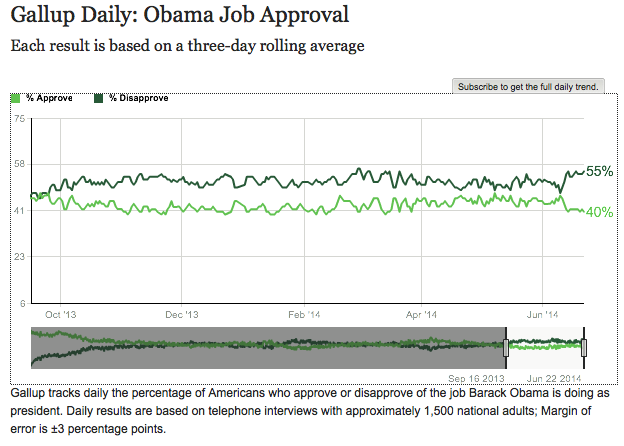
The Gallup daily tracking poll shows a sudden shift in appraisals of the president. On June 8, after a spring in which the gap between approval and disapproval was narrowing slowly, the public was evenly split – 47 – 46. Two weeks later, it’s 55 – 40. That’s one of the more sudden shifts yet in his two terms of office. It puts him close to GWB at this point in his second term:

Screen Shot 2014-06-24 at 12.16.41 PM

The light green line is Obama’s approval ratings; the darker one Bush’s. They look remarkably similar, apart from Bush’s much higher support from Democrats for a long time. That dotted line is the average of all presidents across the years since Truman. On that score, Obama is doing slightly better now than he was for much of his first term, ironically enough. The closest analogy to either of them is Truman’s approval rating (he finished out his presidency at 32 percent), which might give one some hope for a future historical assessment.

Why has this shift occurred so suddenly?

Multi-determined, as my shrink would say. But it has to be Iraq most of all. You can see a fledgling Obama recovery to an even 47-46 split until the Sunni/ISIS insurgency took off. And I think that’s understandable. One of Obama’s great and singular achievements was the withdrawal from Iraq without catastrophe. If that is now in doubt, especially if there is any chance of our getting involved again, then a core step forward looks in hindsight like a chimera. And Iraq is such a nightmare in American minds that any notion that we might be headed back there is abhorrent. Who do you blame for such a situation? The president, of course. What can he do about it? Between a metastasizing, regional sectarian war and US military intervention, it’s a pretty nasty dilemma. But my advice, such as it is, remains: stay out. Let it burn out; let’s see what emerges from the chaos; let’s concentrate on protecting our borders and improving our intelligence. If Obama could muster that message, I think it could resonate. As long as he wrings his hands, and the punditaraiat screams daily about What Must Be Done, and the State Department insists on more and more involvement, he will suffer.