Of Course She’s Running For President, Ctd

Razib Khan thinks GOP elites will kneecap Palin at some point:

I have always been relatively unimpressed by the arguments of those on the Left and Right who view her as a potentially transformative figure in American politics. I have too great of a faith in the power of elites to squelch populism on the whole (this doesn’t mean that populists don’t sometimes succeed, it just means that you have to generally bet against populism all things equal). As an empirical matter it does seem like that she’s becoming the conservative equivalent to Al Gore, someone beloved within their own partisan faction, and able to maintain their celebrity and have some influence, but ultimately constrained in their reach because of their polarizing personality.

What GOP elites?

The Long Game

Kos predicts:

Arizona Latinos have gone, literally overnight, from being perhaps the most pro-GOP in the nation, to joining California as the most anti-GOP ones in the nation…Within a decade, Arizona will be as reliably Democratic as California is today. And when that day arrives, we'll be able to trace it all to last Friday's passage of SB 1070.

I think he's right. More importantly, Obama now has a real opportunity to get the Latino vote out this fall.

The Tea Party Agenda

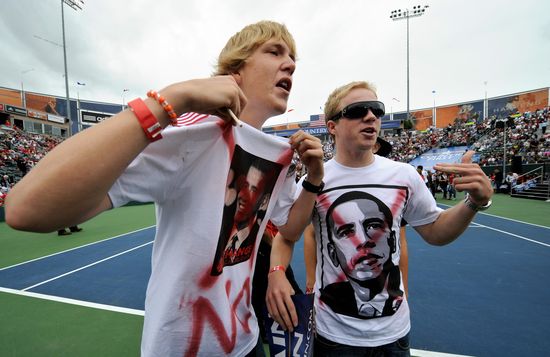
PALINITESJewelSamad:AFP:Getty

Balko is uneasy:

I’d have no problem if the Tea Parties were merely silent on issues like foreign policy, law enforcement, and the war on terror—that is, if people who disagree on those particular issues had come together for the purpose of rallying against government debt, bailouts, spending, and so on. But it’s increasingly looking like the right’s favored big government policies are a fairly important part of the agenda of a fairly large portion of the Tea Party crowd. Advocating for more police power, more foreign policy imperialism, and more power for the federal government to detain, torture, and abrogate basic civil liberties sort of misses the entire message of the original Tea Party.

It also makes a mockery of the media narrative that these are gathering of anti-government extremists. Seems like in may parts of the country they’re as pro-government as the current administration, just pro-their kind of government.

I couldn't agree more. And how many tea-partiers favor the Arizona law? Almost all of them, you betcha.

Worse, on the fiscal front, they're total frauds. They have yet to propose any serious cuts in entitlements and want far more money poured into the military-imperial complex. In rallies, the largely white members in their fifties and older seem determined to get every penny of social security and Medicare. They are a kind of boomer revolt – but on the other side of that civil conflict, and no longer a silent majority. In fact, they're now the minority that won't shut up.

More and more, this feels to me like an essentially cultural revolt against what America is becoming: a multi-racial, multi-faith, gay-inclusive, women-friendly, majority-minority country. The "tea-party" analogy is not about restricting government as much as it is a form of almost pathological nostalgia. That's why there's much more lashing out than constructive proposals. And yes, a bi-racial president completes the picture. And no, that doesn't mean they're all racists. Discomfort with social and cultural change is not racism. But it can express itself that way.

(Photo; Palinites at a 2008 campaign rally by Jewel Samad/Getty.)

Quote For The Day II

“In 2004 the social question that animated the campaign was gay marriage. Before the election season had unfolded, I had talked to George about not making gay marriage a significant issue. We have, I reminded him, a number of close friends who are gay or whose children are gay. But at that moment I could never have imagined what path this issue would take and where it would lead," – Laura Bush, the most decent person in the White House for eight long years.

Yglesias Award Nominee

Bill Frist suddenly sounds sane:

Frist, a thoracic surgeon, told Time magazine back in October that if he were still in Congress, he would vote for the bill. And his support apparently hasn’t wavered. On Monday afternoon he said he would give an “A” grade to the provisions in the law aimed at expanding insurance to an additional 32 million people. Cost, however, is another matter. While most Republicans would likely slap a failing grade on the cost aspect of the law, Frist said he’d rank it a “C.”

“I like the bill,” Frist said during a panel discussion with former Democratic Senate Majority Leader Tom Daschle at the American Hospital Association’s (AHA’s) annual meeting. “I think it’s got lots of positive stuff in it, other than the costs.”

Frist also praised President Obama’s second health summit, saying the President had “persuasive charisma” and “command of the subject.” “You have a president there who got his hands dirty, but still looked presidential,” Frist said.

Wall Street Casinos

R.M. at DiA makes an excellent point:

It's important to distinguish between the SEC allegations and the allegations being aired in Congress, which I believe some senators are intentionally trying to confuse.

The SEC is alleging that Goldman broke the law in a very specific way. Binyamin Appelbaum of the New York Times explains, "Rather than asserting that Goldman misrepresented a product it was selling, the most commonly used grounds for securities fraud, the Securities and Exchange Commission said in a civil suit filed Friday that the investment bank misled customers about how that product was created. It is the rough equivalent of asserting that an antiques dealer lied about the provenance, but not the quality, of an old table." That type of misrepresentation or misleading is illegal, no doubt about it. On the other hand, the accusations emanating from Congress—that Goldman took the opposite side of its clients' bets on the housing market—are certainly not. As we say in our leader on the subject, "the idea of willing counterparties, with full and accurate disclosure, each seeking to profit from the other's inferior grasp, is central to financial markets."

James Surowiecki illustrated this idea yesterday:

No one on any side of this debate appreciates the casino analogy, but I think it’s still the most useful way to think about this question: when you place a bet on the Super Bowl, the casino is taking the other side of that bet. In many cases, it’ll balance the bets it makes on both sides of the trade, so that it’s exposed to no risk and it collects the certain profit from the spread. Regardless, though, any individual bettor knows that if he wins, the casino loses, and vice versa. That is, he knows the casino is on the other side of the trade. Levin seems to be saying that this means there’s a conflict of interest between the casino and the bettor, and that it’s illegitimate for the casino to take the bet. But there’s no conflict, because everyone knows what the deal is. And as long as the bet’s honest, and as long as the price is fair, the casino is doing right by the customer, because the customer is getting exactly what he wants: a chance to speculate. Now, we can argue about whether we want investment banks to be facilitating speculation (or investment, depending on your perspective), but as long as that’s legal, it’s hard to see why it’s unethical to make those trades possible.

Yglesias picks up the metaphor and runs with it.

The Biggest Moment Of The Campaign

Fraser Nelson weighs in:

We have just witnessed the biggest moment of the 2010 election campaign. It wasn't that Brown let off steam: it was that he instinctively described as "bigoted" a woman who represents what should be Labour's core vote. Sure, she mentioned immigration – but just said "where are they coming from"? Her main concern was the national debt, and what her grandchildren will have to pay. Neither Cameron or Clegg would have thought these points bigoted – and neither would Tony Blair.

Alastair Campbell, who worked as Director of Communications and Strategy for Tony Blair (and was the model for the insane, profane handler in The Thick Of It) shares his thoughts:

It is of course manna from heaven for the media. A new character. An encounter that will be played again and again on TV, not just in Britain but around the world. And something which absorbs all the space in the debate that Labour had been hoping might move to policy, and moves the focus to questions of character.

…I saw [Brown] at his Manchester hotel, where we are preparing for tomorrow's debate, when he returned from Rochdale. To say he was mortified is an understatement. I don't think I have ever seen him so angry with himself. And he was angry less about the obvious frenzy he had unleashed than the fact that he said what he did. She was so clearly not a bigot, and he knew that.

Meep Meep Watch

As the right huffs the glue-bag of epistemic closure, voters are noticing who actually gets things done:

The public trusts Democrats more than Republicans to handle the major problems facing the country by a double-digit margin, giving Democrats a bigger lead than they held two months ago, when Congress was engaged in the long endgame over divisive health-care legislation.

A majority continues to see Obama as “just about right” ideologically, despite repeated GOP efforts to define the president as outside the mainstream.

Those polled also say they trust Obama over Republicans in Congress to deal with the economy, health care and, by a large margin, financial regulatory reform. And the president continues to get positive marks on his overall job performance, with, for the first time since the fall, a majority of independents approving.

The independent shift is worth keeping an eye on.

The Pernicious Lies Of Sarah Palin II

“There is no ability or opportunity in there for the racial profiling,” – Sarah Palin on Arizona's new immigration law. She went on:

“It's shameful, too, that the Obama administration has allowed…this to become more of a racial issue by perpetuating this myth that racial profiling is a part of this law."