9 Days To Go

Previewing a possible future, Massie posts this video of Ukraine's hung parliament:

Iain Dale bids good riddance to Tory candidate Philip Lardner, who was suspended for homophobic remarks:

Tory Rascal has written a heartfelt post about how it makes him feel, being in the same party as dinosaurs like Mr Lardner. I sympathise with him, but he knows, and I know that people like Lardner are increasingly rare. The party has changed, and it's in no small matter due to David Cameron's leadership. He's called Lardner to account and I hope any Conservative does the same if they encounter people in the party who hold similar distateful, and profoundly unconservative views. They should be chucked out of the party for good – not just suspended. Mr Lardner already had one strike. He's just had his second. I wouldn't bother allowing him a third.

From the post that Dale flags:

I don’t doubt that David Cameron genuinely wants shot of the party’s homophobic legacy, to turn us into a party that more accurately and fairly reflects our modern society. It’s not for nothing that we have 20 openly gay PPCs standing throughout the UK, who, if elected, would give the Conservatives more gay MPs than any other party. Cameron has been consistent in voicing the party’s support for civil partnerships, and has apologised publicly for his past support of Section 28. A sincere recognition of the importance of equality should be our Clause IV moment. Has it really happened, though? Aren’t we still a bad choice for gay people?

I don’t subscribe to the arrogant assumption, seemingly common on the left, that gay people are single-issue voters. My sexuality – although important to me – is only a part of my world view. I believe in the importance of low taxes, in secure civil liberties, and in genuine freedom of speech – even, or especially, if that means protecting the right to offend. I believe in the importance of reducing the pettifogging bureacracy and state-sponsored interference that Labour has shoehorned into our daily lives…I believe that strong armed forces, and a nuclear deterrent, play a vital role in maintaining our influence on world affairs. You might disagree with those views, and I’ve expressed them, deliberately, in simple terms; but they are conservative values.

David Denver looks at turnout:

Examining turnout in general elections since 1950, two important points can be made. First, there is an overall downward trend, and the last two elections have been especially bad. Second, within that trend turnouts have been higher when elections are considered likely to be close and when there have been clear policy differences between the parties. The long-term trend is explained by a steady decline in the proportion of voters – especially younger people – who think that voting is a duty. It will be pretty sensational news if this is reversed in 2010. We are left, then, with the two short-term factors – the closeness of the contest and the differences between the parties.

Martin Kettle asks who will lead the opposition should the Lib Dems come in second in the popular vote but third in seats. Katharine Quarmby profiles the Greens, who are trying to elect their first MP:

I arrived to meet the Tory candidate, Charlotte Vere, dripping wet. She was kind enough to make me a cup of tea and talk me through her strategy for the seat. She believes that she can tempt voters in the wealthier north of the constituency, and is campaigning hard in the swing wards in Brighton. Her campaign literature, however, betrays the effect of a serious Green challenge on the other parties. Labour and Lib Dems alike–both of whom are also fielding strong female candidates–are forced to greenwash their politics and their literature, because green issues are raised constantly on the doorstep and the parties can’t sidestep the issue.

Anthony Wells explains hung parliament procedure:

Formally Cameron and Brown have a free hand in negotiations, Clegg does not. The Southport Resolution in the Lib Dem rules requires him to get the support of 75% of the Parliamentary Liberal Democrat party, and 75% of the party’s Federal executive (and failing that the support of two-thirds of the wider party) in order to enter into any agreement that “could affect the party’s independence of political action” – taken as meaning a coalition agreement. While all the leaders would in practice need to take their parties with them, only Clegg would have such a formal process to deal with somehow.

A Labourlist writer also brushes up on hung parliament strategy:

[If] there’s a hung parliament after May 6th, whatever the result in terms of votes or seats, Gordon Brown would have not only the right but also the duty not to resign before he had faced the new parliament and submitted a programme for government in the Queen’s Speech, being careful to ensure that his programme was one which the Lib Dems would find it virtually impossible to vote against. In other words, the decision that the Lib Dems will need to take is not (as the media pundits all seem to assume) “whether to support Labour or the Conservatives as the new government” but rather whether to defeat or support a Labour government’s Queen’s Speech that promises a referendum on electoral reform, tax reform to take the poorest out of tax, restructuring of the banks, a new approach to civil liberties, re-examination in the defence review of the decision to replace Trident, provision to bring illegal immigrants who have been here for 10 years into the legal economy and the tax system, and a cornucopia of other Lib Dem shibboleths.

Andrew Grice notes that all the political parties are shying away from difficult but necessary fiscal rebalancing:

There wasn’t a secret deal but Labour and the Tories arrived at the same point: austerity isn’t working. George Osborne, the shadow Chancellor, tested the market by spelling out some cuts at the Tory conference last October – including a pay freeze for some public sector workers and restricting tax credits and child trust funds for better off families. Mr Osborne won plaudits for bravery in the City of London. But the Tories took a hit in the opinion polls and – surprise, surprise – Labour accused them of clobbering middle income families. The Tories are still committed to these cuts but have been reluctant to add to the list.

To drive that point home, here's a paragraph from the Institute for Financial Studies report that came out today: 

The Conservatives want to start tightening earlier and proceed more quickly. They plan an additional £6 billion tightening this year and would aim to get almost all the repair job done a year earlier than Labour and the Liberal Democrats in 2015–16.

The Conservatives’ greater ambition would make a relatively modest difference to the long-term outlook for government borrowing and debt. The Conservative plans imply total borrowing of £604 billion over the next seven years, compared with £643 billion under Labour or the Liberal Democrats. Assuming no further change in borrowing beyond 2017–18, we project that the Conservative plans would return government debt below 40% of national income in 2031–32, the same year as it would under Labour or the Liberal Democrats.

And here's how Labour is exploiting the Tories' relatively minor cuts:


Iain Dale objects to the ad and gets an email from doctor.
At Least Arizona Is Doing Something

Heather Horn has a good round-up of push back against the immigration law backlash. The LA Times editorializes:

Thank you, Arizona. Despite our strong condemnation of a new law that will likely promote racial profiling of Latinos in your state, we must acknowledge that you have accomplished what many others–including senators, committed activists and a willing president–have failed to achieve. You put immigration back on the national agenda.

Dusty Finds Her Rock, Ctd

A reader writes:

This past week the dog-related posts have been unexpectedly relevant for our family. Last week was the post about the ex-addict having to put his beloved dog to sleep. I watched that video w/ my 7-year old son, and of course it made me cry–then I had to explain to my son why someone would choose to help their pet die.

How strange then, that only a few days later, we found ourselves in the exact same situation. Our beloved Peanut, a 14-yr old rat terrier who had been battling numerous health issues, went suddenly stiff and paralyzed. After a few days at the vet it was obvious there was nothing we could do, and had to make the excruciating decision to euthanize her. We brought her home for a few days of lap time, love, and tears. After two days of this, and seeing her decline in that short time, we knew it was time.

We had it done this morning. We are each of us a wreck. It’s such an excruciating decision to have to make, yet we know it was the best for her. So seeing the posts today–mere hours after watching our dog expire– about your dogs romping happily at the beach was a salve for my distraught soul.

The Beginnings Of Accountability?

Ross is hopeful:

Last Wednesday, the Vatican formally accepted the resignation of Bishop James Moriarty, the third Irish prelate to step down over his role in sex abuse cover-ups. The next day, a German bishop, Walter Mixa of Augsburg, offered his resignation over allegations that he’d been involved in physical abuse at an orphanage in the 1970s and ’80s. Then on Friday it was Belgium’s turn: The bishop of Brugges resigned after publicly admitting to having sexually abused a minor two decades ago. And over the weekend, Sweden’s lone Catholic bishop announced his willingness to resign over a woman’s claim that he’d failed to respond to an allegation of sex abuse against one of his diocese’s priests.

You could call this an awful week for the church, but I’d call it a relatively good one. The crimes and cover-ups aren’t new; what’s new are the resignations, and the sense that bishops as well as priests are facing accountability for things done and left undone.

Countdown To June 12

Scott Lucas has the latest from the Greens:

We’ve known for days that opposition figures have been building up their challenge to the Government, but it’s today, with the revelation of the meeting between Mir Hossein Mousavi and Mehdi Karroubi on Monday, that you know the wave has hit.

One of our Iranian readers writes:

Karoubi and Mousavi's call for a protest on June 12 defiantly surprised the regime, forcing it to go back into the high alert again, which disproves the false sense of normalcy they are so eager to impose. They will surely do everything to stop it but it increases the pressure on them.

Beautiful, Pointless Graphs

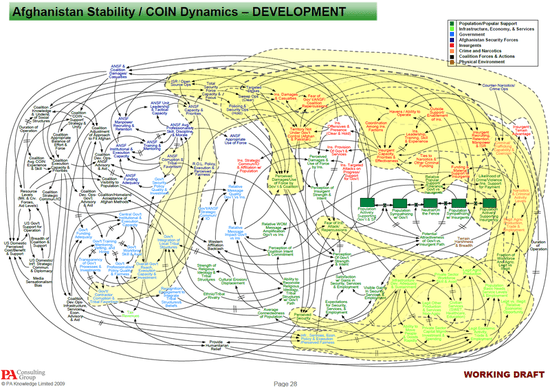
AfghanistanCOIN

Apparently the military hates Powerpoint:

“PowerPoint makes us stupid,” Gen. James N. Mattis of the Marine Corps, the Joint Forces commander, said this month at a military conference in North Carolina. (He spoke without PowerPoint.) Brig. Gen. H. R. McMaster, who banned PowerPoint presentations when he led the successful effort to secure the northern Iraqi city of Tal Afar in 2005, followed up at the same conference by likening PowerPoint to an internal threat.

“It’s dangerous because it can create the illusion of understanding and the illusion of control,” General McMaster said in a telephone interview afterward. “Some problems in the world are not bullet-izable.”

Andrew Gelman's contribution to the debate:

This connects, I think, to my debate with Nathan Yau on the topic of pretty but impossible-to-read data visualizations. I didn’t like the pretty visualizations because, judging them as statistical graphics, they didn’t do a good job of displaying information; Yau liked the visualizations because they grab your interest and motivate you to explore the topic further. The “data visualizations of the year” really are impressive if you think of them as super-cool illustrations (replacements for the usual photos or drawings that might accompany a newspaper or magazine article) rather than as visual displays of quantitative information.

How Power Increases Hypocrisy, Ctd

A reader writes:

When you tick off a litany of powerful figures who have abused their own authority, you're focusing on just half the equation. What's most interesting about Ariely's post is that the powerful are also more judgmental of others' failings, even as they excuse their own. It explains how a liberal senator can live in a mansion and fly in a Learjet while decrying environmental waste, or a conservative senator can take a mistress and then defend family. Half of that is the corrupting effect of power. But the other half is more complicated, and perhaps even desirable – would we be happier with leaders who extended their private failings to public policy?

I suspect that many people who climb their way into positions of responsibility really feel the weight of their office, and take public positions of probity, particularly when their own conduct falls short of those standards. Suggestively, Ariely describes another study that found that people role-playing gaining positions of authority illegitimately were "stricter in judging their own behavior and more lenient in judging the others." Without that sense of public trust, in other words, people may be less likely to excuse their own failings, but they're also less likely to pursue any version of the public good.

That, to me, is a better description of Dick Cheney – self-selected, not directly elected, and wielding amorphous authority. Or of the present generation of bankers, schooled to think of the pursuit of profit as their principle responsibility. We need hard-nosed journalists not mostly to expose private acts of hypocrisy, but to fulfill an even more important function – pointing out when people in positions of public authority are acting without any sense of public responsibility. We can often afford the costs of hypocrisy; the price of acting without social restraint is far higher.

Measuring Epistemic Closure

Brenden Nyhan says it can't be measured directly:

The problem is that misperceptions are not necessarily the result of a closed information loop. Someone with a relatively balanced media diet can still end up with false beliefs — it all depends on how they interpret the news that they receive (i.e., the extent to which they are willing to accept information that is inconsistent with their preferences).

A better approach would be to measure (a) to what extent ideological elites on the left and right are failing to engage with outside sources of information and (b) to what extent their adherents are consuming political news largely or entirely from like-minded elites.

Henry Farrell counters:

Data on divergent patterns of media and information consumption is valuable in figuring out what people think. But people interested in this question aren’t so much worried about the actual patterns of consumption as about its putative consequences for political beliefs. So I think that first cut research to identify whether epistemic closure is a problem should focus on consequences, contra Brendan, looking at the extent to which individuals with different ideologies tend towards closure across a variety of politically salient issues. But it would be nice to see a second wave of research, extending the stuff that Brendan talks about to look at how variation in patterns of media consumption intersected with false political beliefs. And a third body of research could do some experimental work to figure out more precisely the underlying causal mechanisms …

A Liberal, Right-Wing Progressive?

Noah Millman wants a new political taxonomy system. William Brafford summarizes Noah's three political axes:

liberal vs. conservative (attitudes toward the individual and authority)

left vs. right (attitudes toward social/economic winners and losers)

progressive vs. reactionary (attitude toward past and future)

Millman applies his system to me:

To start placing people in my defined space, let’s take a fellow like Andrew Sullivan. I’d call him basically a liberal, right-wing progressive. He calls himself a conservative, but I don’t see a lot of evidence that he’s deferential to authority nor that he’s skeptical of individuals’ capacities. And that’s consistent across his career; these things were true when he was cheering on Margaret Thatcher and they are true today when he’s cheering on Barack Obama. But he’s also basically right-wing; he is generally more animated by the need to reward success than by the need to ameliorate the consequences of failure. His “move to the left” over time represents a change in emphasis on his part and a response to a change in the political landscape – where once he considered himself a member of a right-wing coalition of liberals and conservatives against the left, he now sees himself as a member of a liberal coalition of left- and right-wingers against conservative reactionaries. (Oh, I’m sorry – he’s of no party or clique. Never mind.)

Actually, that's as smart and succinct an analysis of my politics as one can get. Thanks, Noah. And yes, these things are complicated, and "conservative" is a label – and one that seems increasingly quixotic for an Oakeshottian in America now. I'm a meritocratic Whiggish Tory really, in love with modernity.

The British Election Online

Image001

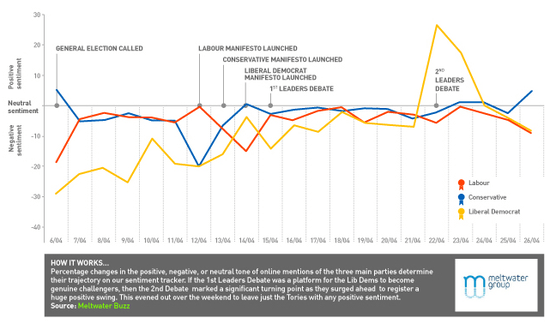
Meltwater, by some algorithm or other, tracks online sentiment with respect to the British parties. The Twitter account #nickcleggsfault  boosted the Lib-Dems support online. But since then and the second debate, the Tories are doing better online. There's still a chance, I think, that fear of re-electing Brown may cause a last minute defection to the Tories by some Lib-Dems.