Bernstein counters Kain.
The Conservative Civil War
A minor correction: I wrote yesterday that Manzi's latest post wasn't up at the Corner, when it was cross-posted. Meanwhile, Goldberg uses me to attack Manzi:
I remain mystified how he can make this myopic and tendentious case for maintaining a “tactical alliance” with Andrew Sullivan — on the grounds that Sullivan (once?) opposed socialized medicine — but be so enthusiastic for ripping into Mark Levin and a book that came out a year and a half ago. If tactical alliances in the name of beating back bad policies are the order of the day, Mark Levin is a far more valuable ally in that cause than the Atlantic’s gynecological sleuth.
Oh, please. I still oppose socialized medicine – and the healthcare reform was not socialized medicine. I favor reforming the bill to expand its free market potential, but do not believe it was right to oppose the entire bill rather than engage and reform it. And there is no "tactical alliance." There is an intellectual overlap. That's all. Manzi persuaded me, for example, to oppose cap and trade and to be more skeptical even of a carbon tax. Because he offered reasoned arguments based on solid evidence. E.D. Kain adds:
First of all, I can sympathize with Goldberg’s view of Sullivan – especially since Obama took office, Sullivan has moved increasingly to the left, to the point where much of his writing on conservatism these days really feels forced and – if not insincere – less meaningful than before. I have no problem with Sullivan tacking left whatsoever, but it’s fair to see why movement conservatives would not want any sort of alliance with him.
That, however, is all beside the point. Goldberg uses this to illustrate why an alliance with Levin makes far more sense than an alliance with Sullivan – as though they are mutually exclusive, or that one should be desirable simply because the other is not. While in the short term, the right’s alliance with an increasingly wide swath of political entertainers – Levin, Beck, Limbaugh, etc. etc. etc. – might make sense, in the long run I see this strategy as nothing more than self-destructive.
Me too. But please look at my record. I have never been a "movement conservative". I've always been a deficit hawk and prepared to raise some taxes if necessary. I backed Clinton in 1992 as the most effective candidate for the times we lived in. I loathed Clinton but defended him from the far right. I have always been opposed to the religious right's conflation of politics and religion. I've long favored the kind of immigration reform Bush II offered. I've always been a skeptic of executive power – from Iran-Contra on. I insist I haven't "moved left' at all. I have stayed where I always was. But the movement right has gone so far over the cliff I want nothing to do with them. And I don't regard Obama as an old-style leftist. I see him as a pragmatic centrist liberal – and talented and sincere as well. I may be wrong, but it's a sincere belief, held since the beginning of the campaign and, I believe, confirmed by his first fifteen months.
Jonah's second post has more meat on it:
I have to chuckle when I hear so much nostalgia for what Ross calls the “lost early-1970s world of Commentary and The Public Interest.” Indeed, to listen to Sam Tanenhaus this was a golden age for conservatism. As someone who has a collection of old issues of the Public Interest and Commentary going back to around that time, I am as sympathetic to such nostalgia as anyone. But that’s what it is: nostalgia. For while conservative intellectuals were having a rip-roaring time back then, conservatism itself was at arguably its weakest point. The Republican Party had crushed the Goldwaterites, the Republican President loathed the Buckleyites and the Reagan-revival still seemed like a pipe dream. It seems to me that what many of these nostalgists really miss is a time when conservative intellectuals were more esteemed by liberal intellectuals and liberal institutions – a climate made possible solely by conservatism’s political impotence.
The Closing Of The Conservative Mind, Ctd
Ambers observes:
Can anyone deny that the most trenchant and effective criticism of President Obama today comes not from the right but from the left? Rachel Maddow's grilling of administration economic officials. Keith Olbermann's hectoring of Democratic leaders on the public option. Glenn Greenwald's criticisms of Elena Kagan. Ezra Klein and Jonathan Cohn's keepin'-them-honest perspectives on health care. The civil libertarian left on detainees and Gitmo. The Huffington Post on derivatives.
I want to find Republicans to take seriously, but it is hard. Not because they don't exist — serious Republicans — but because, as Sanchez and others seem to recognize, they are marginalized, even self-marginalizing, and the base itself seems to have developed a notion that bromides are equivalent to policy-thinking, and that therapy is a substitute for thinking.
On cue, Jonah flies off the handle. I believe that the core argument of The Conservative Soul, which the right establishment ignored, holds up very well.
The British Horse Race
Summary of last night's insta-polling from Political Betting, which remind us that the "big question is what this will do to the voting intention polls and we’ll need to wait until Saturday before getting a full range." Labour party partisan Hopi Sen also discounts the post debate polls. Andrew Brown notes how God factored into the latest debate. A bit different than American politics:
Cameron and Brown are both privately devout Christians. Neither mentioned this in the debate; it won't win votes. Clegg is an atheist and said so, presumably because there are some votes in that; but he said it in a very moderate way ("I'm not a man of faith") and balanced it immediately with the information that his wife and children are Catholics.
Michael Tomasky on the TV effect:
[U]ntil Clegg caught fire, Cameron was the handsome young guy. Now, he's
like the other middle-aged guy who just isn't quite as old.
You are now fully entering an age American politics entered long ago. Television rules. It's about magnetism, the smile, the tie (a point I think Clegg also won, with the gold). How one stands at a podium. Just remember this: since the advent of television in America, the clearly shorter candidate (more than a couple inches) has won one presidential
election, George W. Bush over John Kerry in 2004.
David Blackburn makes the same point:
Despite expectations, television doesn’t come naturally to Cameron. There’s nothing wrong with the content of his statements, but he could express them more clearly (clarity of delivery is Clegg’s premier talent). Equally, Cameron’s stage craft is excruciating – the metronomic looks to and from camera particularly so. Clegg’s direct approach, no matter how sanctimonious, reaches beyond the artificial setting.
[T]hat Brown is the wrong leader for Labour is surely now clear to anyone who still harboured any doubts about it. From an electoral point of view he is – it seems irredeemably – a liability. Having watched both of the debates between the three party leaders from beginning to end, I don't think Brown has done at all badly – on the substance, as his supporters keep insisting. Certainly not badly enough to bear out the differential in some of the post-debate polls, where he lags as much as six points behind Cameron and/or Clegg. But, whatever Brown says, he's not going to win in any of those polls, because he just hasn't got it – the likeability, the capacity to present himself and his party as if he weren't performing the task of an undertaker.
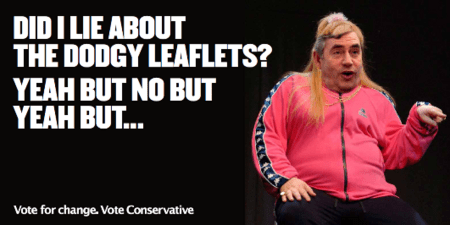
Image via Coffee House, which also gets a shot of Brown's notes. Leaflet controversy parsed here. It helps a voter decide her vote:
I don't think I can trust Cameron to bring about real change. He, personally, may be a different kind of politician, but the interests powering his party haven't changed. They belong to the tired old world and are insufficient to the demands of the present.
I feel bad. I think Cameron is probably a well-intentioned and intelligent man; I even believe he might work well with others. But a leader who thinks it is worth wasting time confronting Brown on election leaflets during a national debate on the urgent issues facing our country today cannot win my confidence.
So I have made up my mind. I shall be voting Liberal Democrat.
For the next two weeks, Cameron has to convey the same freshness and urgency as Clegg, all the while suggesting he is the more substantial vehicle for change. There are some signs of encouragement for him in the details of the post-debate polling. Populus for the Times found that Clegg's high scores of a week ago – for example on having the right ideas to take the country forward – fell by some 16 points yesterday. Inevitably the Lib Dem's novelty value is fading, allowing Cameron to reassert himself as the agent of change.
Iain Martin speaks to Clegg:
Your attack on David on Europe, saying he hangs out with nutters in the European parliament, sounded shrill. Dreadful undergraduate stuff. For now, your reputation is Nice Nick. But quite a few people I know suspect that there’s a Nasty Nick too. And your new fans won’t like that side of your personality at all when they see it. Be careful. You’re just the vehicle for this anti-politics movement. Don’t get carried away, thinking that the country loves you.
New figures have shown that the economy grew by just 0.2% in the first quarter of 2010. This is weaker than expected. But at least the economy has not slipped back into recession. David Cameron said: "They are disappointing figures for the economy because we have had the very long, very deep recession and we need to get the economy moving." Gordon Brown said the growth figures were what the government predicted in the budget.
There were no particularly startling announcements or arguments, but I thought the debate did give an interesting snap-shot of what global issues matter in the British debate. There were five big questions raised: the European Union, Afghanistan, the war on terror, nuclear deterrence and climate change. Russia, China and India were barely mentioned – even though Britain has had a terrible relationship with Russia in recent years and the rise of China and India is the most important long-term global development. If this debate had taken place in the Bush years, you might have expected an agonised debate about Britain’s relationship with America. As it was, Gordon Brown made a half-hearted attempt to lable Nick Clegg, anti-American. And Clegg responded with a sprited defence of a more independent attitude to the US. But the argument over America never really caught fire.
Massie thought Brown won:
The insta-polls disagree with me of course, splitting the decision between Cameron and Clegg and so I suppose it would be nice if they were right and I am wrong. Perhaps my perspective is too skewed from having watched and participated in hundreds of debates over the years. The chaps at Election Debates also think Brown won. Three give him the win and one plumps for Clegg. Cameron is the unanimous choice for third.
We have some of the most detailed research on the country's social attitudes. It shows that on only two of the seven key indicators, the Liberal Democrat approach reflects the national mood.
This means that much of their newfound popularity may actually be more of a popularity vote for Nick Clegg in the wake of the first television debate. It may also confirm suspicions that the public are moving towards the Liberal Democrats as a result of the "anti-politics" mood sweeping this country – rather than an endorsement of the party's policies.
Politics Homes' current projection (via Political Betting):

[It] seems to me quite heartening that there are quite a few voters ready to be influenced by what in total will be four and a half hours of reasonably serious political debate between the three leaders. That seems to me, at the least, no worse a basis for deciding how to vote than some others, such as tribal party allegiance, voting the way your dad tells you to, etc: the sort of explanations for political choices that you often hear when talking to voters around the country. And it is certainly better to chose in this way than not to vote at all.
This is not “X-Factor” politics. It is modern democracy. The debates are indeed a Good Thing. And they are a Good Thing regardless of their outcome.
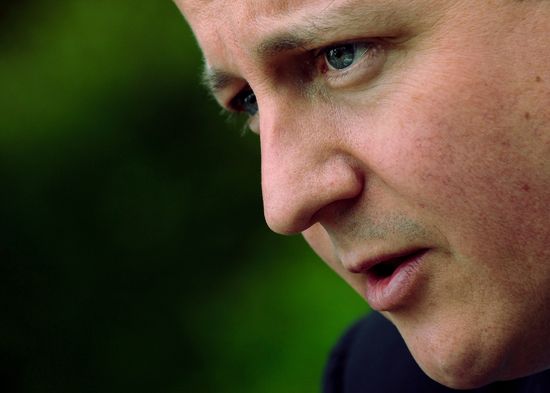
(Image: Conservative Party Leader David Cameron listens to a question during a breakfast meeting with servicemen and women on April 22, 2010 in Exeter, in south-west England. By Adrian Dennis WPA Pool/Getty Images)
“History Happened” Ctd
A reader writes:
Thanks for putting into much finer words than I could muster some reasoned reaction to Brooks’s column. His basic argument that the opposite ends of the “government wars” have moved farther apart is just wrong, in my view. The right has moved farther to the right – there is no doubt about that. And, yet, I think the Democratic approach to cleaning up the myriad and pervasive social and economic issues we face now has been essentially moderate, by historical standards.
These are not the Democrats of the 1960s and 1970s with a kind of knee-jerk approach that government is the only way to cure our social ills, crowding out all other options. Instead, the Democrats of 2010 are using government as the moderating force of – and definitively not the replacement for – the private sector. From healthcare to financial reform to climate control, the “liberals” are actually acting much more closely to the Burkean ideal than the so-called “conservatives” of the GOP.
Brooks might feel abandoned in the middle, but only because he has somehow bought into the rhetoric of those hailing from the party more associated with conservatives. Indeed, he essentially falls into the same “more government vs. less government” binary trap that he complains about. By simplifying the Democratic measures to be “more government,” offering no further nuance of what is really taking place, he fails to acknowledge that these recent efforts to expand the use of government are fundamentally different than the old trope of the Left. I was hoping Brooks would know better.
Looking Down The Barrel Of A Gun
Dan Zak profiles the Appleseed Project, a group that teaches Americans to shoot:
Some people at Appleseed just like to shoot. It's fun. Simple as that.
Some volunteer to explain why pulling a trigger makes them feel better. We're borrowing money from China and giving it to Haiti, they say. The health-care bill controls citizens who've worked to build their own lives, they say. The Second Amendment should probably be the First Amendment, they say, because if you can't defend yourself from tyranny, you can't open your mouth. Someone or something will be coming for us once "the bottom falls out" or the "poop hits the fan." Regardless of its form, the threat will be met by citizens who are confident in their firing skills, who are buoyed by collective memory of heritage, who know what we were and what we've become. You need only look down the barrel of a gun to see the difference, they say.
Whatever's going on out here, it's a shadowy target, tough to draw a bead on.
Raising Your Clone As Your Son, Ctd

A reader writes:
It seems to me that your commenters are being rather harsh on Mr. Caplan. Granted that the clone would, in fact, be a separate individual, with his own tastes, passions and life experience. But isn't Caplan's impulse rather similar to that of people who wish to have genetic children rather than adopt? The desire to see familiar traits appear in a new person, to recognize Uncle Albert's chin and Aunt Tilly's sense of humor? And for a narcissist, having a clone turn out completely differently would be fascinating all on its own — look at all the variation he'd find he's capable of!
I'm not planning on cloning myself, or freezing myself, or any other avant garde methods of staying on this earth past my due date. But I do understand Caplan's motivation.
Another writes:
We do a monthly item in Wired magazine where we present a full-page image of some hypothetical object that gives a glimpse of what the future might look like. The latest happens to be a children's book about raising your clone as your child. Higher-res version here.
Another:
If you haven't seen the "Reality Check" episode of This American Life, you should. Act One is about a cloned bull who grew up and behaved very differently from his original.
Defending Obama From The Gays
Ambers gets on the phone:
Is Messina the secret enemy of gays? Far from it. Messina was the staff member who convinced the military to start the process to end the gay ban; the staff member who orchestrated the compelling testimony of Gates and Mullen; the staff member who worked with the Pentagon to relax the rules until the ban is ended; the staff member who coordinated the drafting of the executive order preventing hospitals from banning gays from visiting their partners; the staff member who made sure that the HIV immigration ban was rescinded. And so on.
He predicts:
By this time next year, [DADT] will be gone. Gay people will be openly serving in the United States Armed Forces.
For this to happen the Congress would have to act. Would a possible Republican House vote down the Joint Chiefs' recommendation? You bet your bottom dollar they would. That's the worry. And it's a real one.
The Real Insult To Muslims
Aunt B. nails Viacom:
[T]his large media conglomerate is regularly and repeatedly signalling that, even if they’re willing to stand up to angry Baptists or Jews with hurt feelings, pissed off Muslims are so scary and weird and “other” that they have to be handled with kid gloves. I know plenty of fucked-up Christians who I’m sure have sent angry letters and phone calls to Comedy Central about South Park. So, what Comedy Central is saying is that some death-threaty, angry, fundamentalist kill-joys, if they’re Christian, obviously don’t reflect the opinions of all Christians or warrant changing programming to accommodate. But some death-threaty, angry, fundamentalist kill-joys, if they’re Muslim, will be treated as if they are the legitimate authority on their religion and Comedy Central will respond in fear to them. And fear is just the submissive expression of hostility.
Malkin Award Nominee
"According to the Times, it all started with a kiss. Let me be very clear about this: if some guy tried to kiss me when I was 17, I would have flattened him. I most certainly would not go on a retreat with the so-called abuser, unless, of course, I liked it. Indeed, Hamilton liked it so much he went back for more—20 years more. Even after he got married, he couldn't resist going back for more," – Bill Donohue, blaming the victim in this story.
 The Dish
