Global Warming = Mobile Phones?

Over at The Climate Desk, Clive Thompson reports on how businesses are preparing for global warming:

Politicians or pundits can distort or cherry-pick climate science any way they want to try and gain temporary influence with the public. But any serious industrialist who's facing "climate exposure"—as it's now called by money managers—cannot afford to engage in that sort of self-delusion. Spend a couple of hours wandering through the websites of various industrial associations—aluminum manufacturers, real-estate agents, wineries, agribusinesses, take your pick—and you'll find straightforward statements about the grim reality of climate change that wouldn't seem out of place coming from Greenpeace. Last year Wall Street analysts issued 214 reports assessing the potential risks and opportunities that will come out of a warming world. One by McKinsey & Co. argued that climate change will shake up industries with the same force that mobile phones reshaped communications.

Felix Salmon finds less evidence of forward thinking:

In the mainstream business world, climate change adaptation strategies are scant. The reasons for inaction are sometimes simple, but also counterintuitively complex.

Start with the superficial: Adaptation strategies have essentially zero PR value. They have nothing to do with saving the planet. Instead, they’re all about trying to thrive if and when the planet starts to fall apart. That’s not something any savvy company wants to trumpet to the world.

Then there is the mismatch of time horizons. Climate change takes place over decades, and corporate timescales generally max out in the five-to-seven-year range. Businesses typically won’t spend significant money planning beyond that period, especially because the effects on business models and future profitability are so difficult to predict.
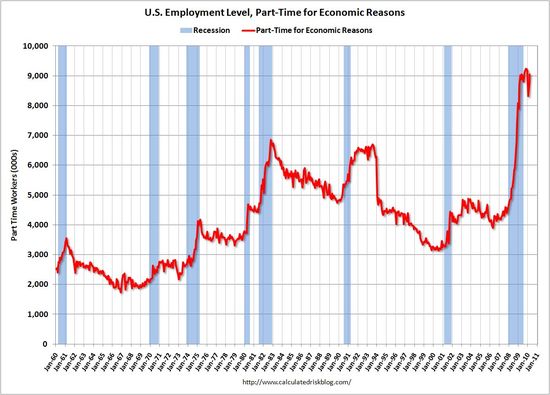
Part-Time Employment Is The New Black

PartTimeMarch2010

Part-time work is booming. Derek Thompson gulps:

Independent workers rarely qualify for unemployment insurance, health insurance, or wage theft laws. So when freelancers go out on their own, they are, rather literally, out on their own. In economy where the marginally attached are truly marginal, perhaps that's a government failure one can ignore. But as the gigs go mainstream, policymakers will have to think about counting and providing for this shadow labor market. Even intrepid independent workers need a net when they fall.

(Image: Calculated Risk)

The Daily Wrap

Today on the Dish, the president got heckled for the delay on DADT. Over in the UK, polling continued to plague the Tories and we continued to shine a spotlight on Clegg here, here, and here. Andrew elucidated more on class warfare and Douthat worried about the implications of the election on the American right. In Vatican watch, a whistleblower priest recanted and sex scandals continued to spread across the globe.

In various other coverage, David Freed profiled the guy wrongly pegged as the anthrax killer, Drezner doubted Obama's soft power, Laura Rozen examined the Gates memo on Iran, Ambinder figured subsidies might stem obesity, Manzi took on K-thug over climate change, Eric Barker studied virgins, Andrew checked in on the success of the surge, and readers revolted over his post on Epicurus.

Islamists had a hissy fit over South Park (not) showing Muhammed, and a reader followed up. Info on the Eyjafjallajökull's economic impact here and here. Hot lava action here. Big Palin update here and a dose of David Foster Wallace here. Readers sent in a flurry of rap and rock remixes, a diver romped with an octopus, and an ibex scratched his butt.

In honor of 4/20, Reason made the case for legalization, a working mom came out of the cannabis closet, Marie Myung-Ok Lee talked about treating her autistic son, Lebowski tried to get his carpet back using a paper clip, and we played a classic toker song. Also, I thought this window resembled some nugs.

— C.B.

The Wrong Man

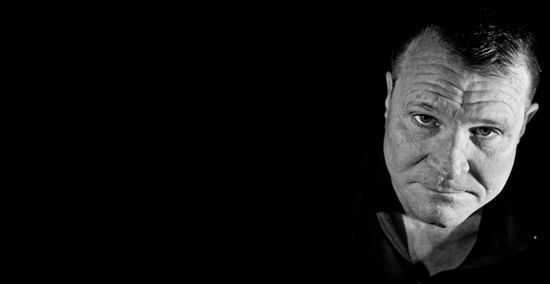
Hatfill

This David Freed story on Dr. Steven Hatfill deserves more press. Here's a taste:

On the day al-Qaeda struck the World Trade Center and the Pentagon with hijacked jetliners, Hatfill was recovering from nasal surgery in his apartment outside the gates of Fort Detrick, Maryland, where USAMRIID is housed. We’re at war, he remembers thinking as he watched the news that day—but he had no idea that it was a war in which he himself would soon become collateral damage, as the FBI came to regard him as a homegrown bioterrorist, likely responsible for some of the most unsettling multiple murders in recent American history. His story provides a cautionary tale about how federal authorities, fueled by the general panic over terrorism, embraced conjecture and coincidence as evidence, and blindly pursued one suspect while the real anthrax killer roamed free for more than six years. Hatfill’s experience is also the wrenching saga of how an American citizen who saw himself as a patriot came to be vilified and presumed guilty, as his country turned against him.

(Image: Melissa Golden/Redux)

That Gates Memo

Laura Rozen tries to decode the weekend leak of a Gates memo on Iran:

Discussing the matter with former senior Pentagon and State Department official and columnist Leslie Gelb yesterday, Gelb said it’s no secret that there were no great options on Iran, and he had pointed that out in a February piece that is worth looking at. Gelb’s piece benefits from discussions he was having with friends and former colleagues in the Pentagon and elsewhere, who seem informed by the thinking the administration was doing on its Iran options, even if they hadn’t seen or known about Gates's memo…[Gelb said to] slow down their program, protect regional allies, pursue targeted sanctions against the Revolutionary Guard — and be willing to go back to the negotiating table with Iran if the opportunity arises.

If I had to guess, this would be closer to Gates's thinking on Iran than the way his memo was portrayed.

“Dimly-Understood Dangers”

Manzi has a series of responses (one, two, three) to Krugman's big climate article from a couple weeks back. Manzi's strongest argument, in his third post, rests on the other challenges we face:

In the face of massive uncertainty, hedging your bets and keeping your options open is almost always the right strategy. Money and technology are the raw materials for options to deal with physical dangers. A healthy society is constantly scanning the horizon for threats and developing contingency plans to meet them, but the loss of economic and technological development that would be required to eliminate all theorized climate change risk (or all risk from genetic and computational technologies or, for that matter, all risk from killer asteroids) would cripple our ability to deal with virtually every other foreseeable and unforeseeable risk, not to mention our ability to lead productive and interesting lives in the meantime.

Face Of The Day

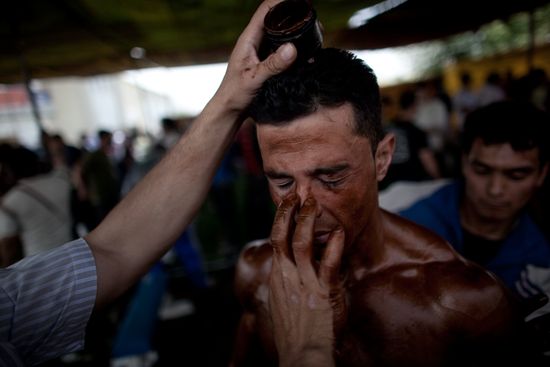
AfghanBodybuilderMajidSaeediGettyImages

Afghan bodybuilders compete in a regional bodybuilding competition on April 19, 2010 in Kabul, Afghanistan. Bodybuilding is a very popular sport in Afghanistan in a country where men like the image of being physically strong. It is affordable for most Afghans and it's popularity is growing in many provinces. Photos of Arnold Schwarzenegger are still hanging in many local gyms as their iconic image of a muscle bound male. By Majid Saeedi/Getty Images.

The Obama Effect, Ctd

In response to this survey, Drezner asks:

I do wonder just how much leverage this kind of soft power carries with it.  Consider the ability of the U.S. to enact multilateral economic sanctions.  The Bush administration, at the depths of its unpopularity, was still able to get the UN Security Council to pass three rounds of sanctions against Iran, as well as measures against North Korea.  The Obama administration, despite a serious effort to open a dialogue with Iran, is encountering resistance from China, Brazil, and Turkey in its efforts to craft another round of sanctions. 

All else equal, it's better to see these numbers going up.  I'm just unsure of how much this translates into usable leverage.

More Subsidies?

One of Amber’s recommendations for battling obesity:

Unless we convert Congress to a unicameral legislature, we’re not going to get rid of corn subsidies and sugar price supports anytime soon, and the market will remain distorted in a way that promotes obesity. So as long as we’re going to be distorting this market, let’s distort it in a way that promotes healthy eating: add subsidies for farmers’ markets, fruits, vegetables, etc. 

One of his readers asks:

[T]he stance on food subsidies is a little puzzling. The idea is that it’s easier to have more subsidies for healthy foods rather than cease existing subsidies. But aren’t other items in the list of 10 just as hard if not harder than ending the subsidies? If so, why give up so quickly?