Crowdsourced Art

100

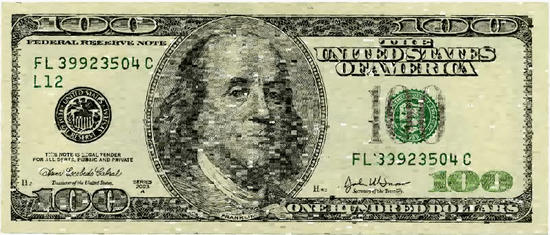
Aaron Koblin uses micro-payments to crowdsource his art projects. Here's a description of one of his projects (an interactive version of the above image is here):

Ten Thousand Cents is a digital artwork that creates a representation of a $100 bill. Using a custom drawing tool, thousands of individuals working in isolation from one another painted a tiny part of the bill without knowledge of the overall task. Workers were paid one cent each via Amazon's Mechanical Turk distributed labor tool. The total labor cost to create the bill, the artwork being created, and the reproductions available for purchase are all $100. The work is presented as an interactive/video piece with all 10,000 parts being drawn simultaneously. The project explores the circumstances we live in, a new and uncharted combination of digital labor markets, "crowdsourcing," "virtual economies," and digital reproduction.

Another of his projects asked participants to sing a song, piece by piece:

Bicycle Built for Two Thousand from Aaron on Vimeo.

More on this project and more audio tracks here. His newest project asks participants to draw a frame from a Johnny Cash video to be included in an ever-changing animation. Participate and watch the video here. Artist's website here.

(Hat tip: Flowing Data)

The Evolution Of Cussing

John McWhorter on the history of taboo words:

In our society, the main taboo is no longer sex, but race. Such things evolve: the big taboo for medievals was religion, and thus evasions like “Egads” for “Ye Gods.” Then came sex; that time is all but gone. Now even the edgiest satire tiptoes around using the N-word — and if a comedian like Michael Richards slips up on it, he is burned in effigy for weeks.

We consider racial slurs an offense against human beings for concrete reasons — but would be harder pressed to express why Joe Biden’s use of an expletive makes him a bad human being.

Chart Of The Day

2012
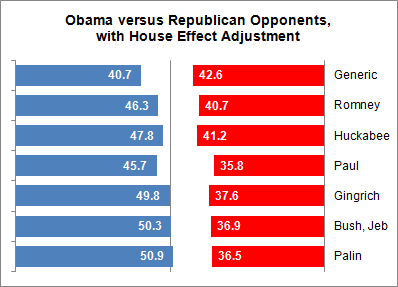
It's much too early to begin predicting 2012, but Nate Silver's analysis of possible 2012 match ups demonstrates the weakness in the Republican field:

[It] is a problem for Republicans that no actual Republican can approach the performance of the generic candidate, probably because the generic candidate is Rorschach blot that allows each respondent to create what amounts to their fantasy candidate.

Cutting The Cable

Niraj Chokshi sums up our changing TV habits:

Almost one fourth of people under 25 now watch most of their TV online. The authors of a new survey estimate that 800,000 U.S. households got rid of their cable subscriptions last year, and expect the number to double by the end of 2011. The loss is still small, given the 101 million subscribers nationwide, writes TechCrunch's Erick Schonfeld, but cord-cutters "are a leading indicator of the shift to TV viewing on the Web."

Counting Beans

ExpensiveCoffeeGetty

Henry Farrell asks why so many Libertarians are opposed to fair trade coffee. Jim Henley piles on. Jacob Grier provides a partial defense:

If you’re shopping at Costco and debating between a big bag of Procter and Gamble’s regular coffee or their Fair Trade beans, you’re probably making some farmer marginally better off by choosing the latter. Fair Trade may play a useful role in mass market coffee. However if you want to pass the maximum of your purchase price onto coffee farmers, your best bet is to buy the highest quality coffee you can from roasters like Counter Culture, Intelligentsia, or Stumptown (to name the usual three, though there are many others).

In fact, it doesn’t even matter whether you care about coffee farmers or not. If you selfishly pay for quality in the cup you’re very likely buying beans that brought more revenue to them than Fair Trade would have. Adam Smith was right and so, sometimes, is the libertarian’s ironic intuition.

(Image: An employee handles the coffee which is the result of civet dung during the production of Civet coffee, the world's most expensive coffee in Bondowoso on August 11, 2009 in East Java, near Surabaya, Indonesia. The coffee, also known as Kopi Luwak, is produced by the civet (a small squirrel-like arboreal mammal) which eats the coffee berries or red coffee cherries, the beans inside which pass through its digestive tract, expelling them undigested as feces. The feces are then cleaned, dried and lightly roasted to make the coffee. Coffee from Indonesian civets is considered to have the best aroma, and it is the unique enzymes in the civet's stomach which give coffee its bitter taste. It retails for USD 100 to USD 600 per pound but only around 1000 pounds make it to market each year and supply is very limited. By Ulet Ifansasti/Getty)

“Activist Judges”

John Cole thinks Republicans generally "care about what they want right now, and if they don’t get their way, you are an activist judge":

For me, the clearest example of the lie regarding judicial activism is the way that Republicans treated Judge Greer in the Terri Schiavo case. The Republican Judge Greer made the fatal mistake of actually calling balls and strikes and correctly according to Florida law, ruled against the fringe right and the Schiavo dead-enders, and for doing what conservatives claim they want- strict interpretations of the law, Greer was subjected to a smear campaign so fierce that included his being asked to leave his church.

In other judge news, Lexington examines the case against Elena Kagan.

The Daily Wrap

Today on the Dish, Hitchens kept up his campaign to arrest Benedict, theocon Mark Stricherz turned on the pontiff, and Austen Ivereigh discussed pedophilia and homosexuality. In election coverage, we checked in on the polls, Renard Sexton accused Cameron of failing to unite the Tories, and Wife In The North vouched for Cameron and Brown to discuss their deceased kids.

Ambinder's Atlantic cover story addressed American obesity. Ezra chimed in. Ambers also updated us on detainee policy. Torture defender Steve Kappes quit the CIA, Friedersdorf fisked Thiessen's response to Jane Mayer, and Jonathan Bernstein preferred to pardon Bush. Andrew highlighted the disconnect between Congress and Jewish-Americans on Israel.

In other coverage, Brian Doherty profiled the pot capital of the US, Evgeny Morozov and Clay Shirky talked Twitter and Iran, Nick Baumann and Freddie DeBoer discussed Colbert's WikiLeak interview, and Janelle Weaver reported on kids who can't see race. Joe Carter complained of a bias towards covering white, politicized evangelicals.

Gabe and Max taught you a little something about filing taxes. More gendered cannabis commentary here and canine coverage here. RNC hathos here and Yglesias nod here. Another rock remix here, a cool app here, and kick-ass kangaroos here.

— C.B.

“A Herd Of Unicorns” Ctd

We've had some very welcome pushback from readers. One notes:

Chaves misses and Carter obscures the nature of white political evangelicalism. The referenced study examined "congregations" without grasping that for white evangelicals, the Sunday morning "service" represents a much smaller percentage of total religious activity than for the mainliners, blacks and Catholics. The hours spent listening to Dobson and "Christian radio," or reading Family Research Council mailings and "Going Rogue," or meeting in "small groups" that assume assimilation to the echo chamber, greatly outweigh the politics-free hour on Sunday morning. The "congregation" is not the appropriate unit of measure, and Carter is entirely disingenuous in calling the herd of Fox-watchers on which he has made his living a "herd of unicorns."

And, of course, the political outreach from the GOP to evangelicals is absent from Chaves' analysis, as is the religious injunction to favor certain specific policies (and parties). Another reader:

I would like to see Nate Silver dig into that study on political

activism in churches. Something tells me the sheer volume of white protestant churches is doing a lot of skewing.

 I live in a standard-issue mid-western town of 20,000 or so in Indiana.  We have 20 white protestant churches, one catholic (the only one in any of the 5 nearest towns), and zero "black" churches.  The fact that our one church-o-plex (a massive, monolithic building with a regular Sunday congregation of a couple thousand and which utilizes several members of our on-duty police force for their security on Sundays) is intensely political, while the other 19-plus churches in the area are either unable or unwilling to muster much political ambition, does not come as a surprise to me.

That means that my town is very Christian, very protestant, and almost entirely non-political.  Unless you count the biggest and most influential church in town, which is easily ten times larger than its closest competitor.

Another:

Chaves carefully avoids the kind of conclusions that Douthat and Carter draw from the survey, because I suspect he knows it's not a sufficient basis of comparison. Hence the emphasis on how over how much. The survey asks what percentage of attendees belong to a congregation that participates in a political activity, not what percentage of attendees participates.

One more:

Interesting data here, but not surprising to me, as I spent many years in a "white evangelical" church. The church with which I was involved is non-denominational, fundamentalist, almost entirely white middle and upper middle class and located in a major metro area in the Mid-Atlantic. A majority of the congregants are politically engaged, very conservative, and certainly organize together in many ways. However, there is a distaste for outward or obvious politics coming from the church itself.

Many evangelicals in this country are not institutionalists (they leave that to Catholics and the mainline Protestant churches) — they don't produce "voter guides" because they don't bother with that kind of centralized messaging. The radicalism in religious groups like that (both political and theological) is forged on a much more grassroots level.

People outside this world like to think that the Joel Osteen/Rick Warren/Ted Haggard megachurch model neatly explains how fundamentalists worship, but that's not an accurate picture. Smaller, decentralized groups of people in quasi-non-denominational settings proliferate, and these types of organizations often lack a church hierarchy or governing body, and therefore also miss the often moderating influence of those kinds of structures.
America The Overweight, Ctd

Ezra Klein responds to Ambers:

Obesity is much more structural than it is personal. That's why it's so depressingly predictable. It afflicts certain communities, with certain socioeconomic characteristics, and it has only really emerged across a certain time period. Those communities contain a lot of different individuals, but their environments and their time and money stresses and their transportation and grocery options and their street safety and exercise opportunities are broadly similar. How we live has changed much more quickly than who we are, and no effort to turn back the tide on obesity will succeed without an accurate understanding of what's made us obese.