Proof that I'm still a Zionist, according to the Catholic old guard. More here.
Face Of The Day
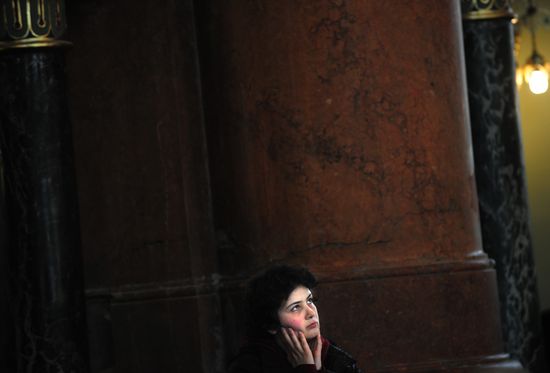
A Bulgarian Jewish woman attends a memorial service to mark Yom Hashoah in Sofia's synagogue on April 11, 2010. Jews mark Holocaust Remembrance Day from sundown. By Dimitar Dilkoff/AFP/Getty.
The Revolution In Zanesville, Ohio
A snapshot of the mood out there among the older and the whiter crowd, as the race for the Republican Congressional nomination intensifies:
On a night when the U.S. Constitution was king, the Second Amendment was praised, and abortion and the separation of church and state were scorned, candidate Dave Daubenmire of Newark threw the most fireballs and received the loudest applause.
Best known because of a bitter battle with London High School officials over his religious activities while teaching and coaching football, Daubenmire said he didn't want to "just go occupy Zack Space's seat. I want to lead a revolution." "I don't know about you, but I want my country back," he said.
From all I can see, the Tea Party movement is not simply about the size and scope of government. If it were, it could be a useful force in our politics, if it only spelled out honestly how to balance the budget without raising taxes. (Even Rand Paul won't be drawn on specifics.) It is a movement about identity politics, in which the US Constitution is an emblem of a certain demographic, and that demographic is as much about the Christianist right as it is about fiscal responsibility. Gingrich hit the two pillars of what they hate: "secularism" and "socialism."
Secularism isn't atheism; it is the principle that religious disputes and political disputes should be regarded in separate categories, for fear of unresolvable sectarian conflict (i.e. culture war). Anti-"socialism" means … well I'm not sure what exactly. Abolition of social security? Medicare? More tax cuts? I wish I knew.
I don't think it has any real traction or coherence apart from a cultural revulsion against modernity, a majority-minority country, separation of church and state, and an abstract loathing and suspicion of anything to do with government. When they offer us some concrete proposals or policy options, I guess we can make a judgment as to the impact on the GOP. But right now, it feels like a primal. and somewhet elderly, scream.
Mental Health Break
“Mirko Faienza documented a tiny, amazing world in his father’s front garden.”
Quote For The Day
"While the continuity-of-teaching argument might have contributed significantly to [Pope Paul VI's] thinking [on reaffirming the Church's birth control prohibitions during Vatican II], it is also true that over the centuries the Church changed other long-standing teachings like those about slavery, usury, the earth's relationship to the sun, the use of the vernacular during Mass, and the theory that unbaptized babies went to limbo rather than heaven if they died. What seems to have differentiated the birth control debate from other changes in doctrine wrought by Vatican II were the accompanying implications for power relationships within the Church. What was different about birth control?
Had Pope Paul VI lifted the ban on artificial birth control, there also would have been an imperfect decentralization of power within the institutional Church. Once sex was disconnected from procreation, individual Catholics and individual priests would have to be trusted to work separately and together to evaluate the spiritual soundness of the sex lives of Catholics. Power and authority regarding sexual matters necessarily would become democratized with influence and wisdom moving up from the laity as well as downward from the hierarchy," – Mary Gail Frawley-O'Dea, Perversion of Power: Sexual Abuse In The Catholic Church.
The Third Strike, Ctd
My take on Ratzinger's reluctance to defrock a 38 year old priest even knowing the "grave significance" of the crimes of child-rape committed by the priest is here. This AP time-line is also very helpful in cutting through the hair-splittingly ludicrous defense the Vatican is now attempting. They are now claiming that this was about defrocking, not abuse.
But why was the defrocking being demanded by the local bishop – and the priest himself? "Grave significance" is the critical admission by Benedict that he knew full well what was wrong with this priest but still wanted to retain such a young recruit given the shortage of vocations. And he wanted to keep him as a priest to avoid scandal. It's as clear as day.
There is no concern expressed for the tied-up and raped boys at all. From a moral leader. His sympathy is entirely with the emotionally-arrested, child-rapist. I mean seriously: what is the real defense of Ratzinger in this?
Here's the AP timeline:
– 1972: Ordained at St. Francis De Sales, Oakland.
– 1972-1975: Associate pastor at St. Joseph's Church in Pinole.
– 1975-1978: Assigned to Our Lady of the Rosary in Union City.
– August 1978: Kiesle is arrested and pleads no contest to lewd conduct, a misdemeanor, for tying up and molesting two boys. Sentenced to three years probation, record is later expunged.
– 1978-1981: Takes extended leave of absence, attends counseling and reports regularly to probation officer.
– July 1981: Oakland Bishop John Cummins sends Kiesle's file to the Vatican in support of the priest's petition for laicization.
–
November 1981: Vatican asks for more information.
– 1982: Kiesle moves to Pinole.
– February 1982: Cummins writes to Ratzinger providing additional information and warning of possible scandal if Kiesle is not defrocked.
– September 1982: Oakland diocese official writes Ratzinger asking for update.
– September 1983: Cummins visits Rome, discusses Kiesle case with Vatican officials.
– December 1983: Vatican official writes Oakland to say Kiesle's file can't be found and they should resubmit materials.
– January 1984: Cummins writes a Vatican official to inquire about status of Kiesle file.
– 1985: Kiesle volunteers as a youth minister at St. Joseph's Church in Pinole.
– September 1985: Cummins writes Ratzinger asking about status of Kiesle case.
– November 1985: Ratzinger writes to Cummins about Kiesle case.
– December 1985: A memo from diocese officials discusses writing to Ratzinger again to stress the risk of scandal if Kiesle's case is delayed.
– 1987: Kiesle is defrocked.
– 2002: Kiesle is arrested and charged with 13 counts of child molestation; all but two are thrown out after U.S. Supreme Court ruling invalidates a California law extending statute of limitations.
– 2004: Kiesle pleads no contest to felony charge of molesting a young girl in 1995 at his Truckee vacation home.
– 2004: He is sentenced to six years in prison for the 1995 molestation.
– 2010: Registered as a sex offender living in Walnut Creek.
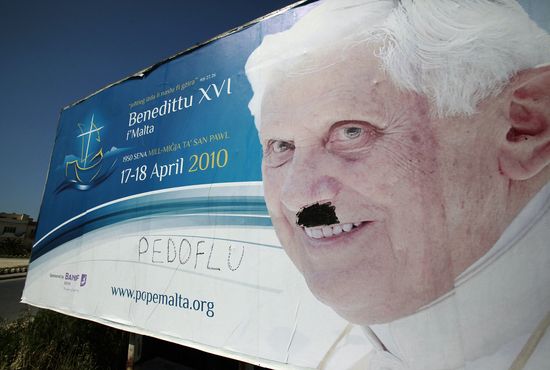
(Photo: A Hilter-style mustache had been drawn and 'Pedoflu' (paedophile) had been written on a placard announcing the visit of Pope Benedict XVI on April 10, 2010 in Bahar ic-Caghaq on the island of Malta. The pope will visit the predominantly Catholic island on April 17 and 18 in his first foreign trip since the paedophile priest scandal recently exploded. By Ben Borg Cardona/AFP/Getty Images.)
The Church’s Deeper Failure
A reader writes:
I’ve been following the sex-abuse scandal(s) in the press and on your blog for quite some time and would like to share with you a story that, for me, captures the real failure of the Catholic Church.
My grandfather, a devout Catholic who attended Mass every morning at 7 am, died late in the afternoon on Easter Sunday after a brief, unexpected illness. While he was truly at peace with the coming end, for our family those few days (Holy Week) were filled with sadness and uncertainty.
Early Sunday morning, my mother and some of her sisters were invited to attend Easter Mass in the hospital chapel. They did so gratefully. During the homily, rather than offer words of comfort and hope, the priest launched into a tirade about how the Church was under attack from those looking to destroy it, how the Pope must be protected at all costs, how the birth control pill destroyed American society and threatens the future of the Church because Catholic women are not having enough children, and how Evangelical Christians
must be supported and revered because they alone are trying to save the unborn.
Not one word of his homily was dedicated to the physical or emotional pain of the hospital’s patients and their families.
One can possibly argue the merits of the man’s statements, depending on a particular point of view; no defense can be made, however, of the choice of time and place to make them.
Here was a family facing the loss of the only parent they’ve known for forty years, looking to the Church for compassion and strength, for kindness and the promise of renewal. And this priest turned his back on their suffering, more concerned with defending the Church hierarchy than with ministering to those in need. I was first appalled, then deeply saddened when my mother recounted the priest’s words.
Though not particularly religious myself, I respect the significant role of the Catholic faith in my grandfather’s life and his death. And I saw firsthand the great comfort it offered my family as he slipped away. Their faith deserved better than this priest’s pathetic revisionism.
There is no comparison between the tone-deaf homily of this priest and the crimes committed against the children at the heart of this tragedy. But his message underscores the central failure of the Catholic Church. The Vatican, in an effort to protect it’s own interests and influence, lost sight of the mission to tend to the faithful. It was the responsibility of the Church to protect those children; instead, it protected the men who abused them.
The View From Your Window
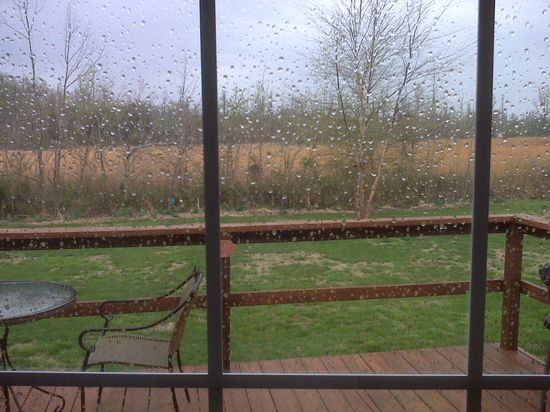
Madisonville, Kentucky, 12 pm
Quote For The Day
"Contrition cannot be reserved for the few and purity attributed, like a kind of moral income, to those who say they have been humiliated. For too many countries in Africa, the Near East, and Latin America, self-criticism is confused with the search for a convenient scapegoat that explains all their misfortunes: it is never their fault; the fault always lies somewhere else (in the West, globalization, capitalization).
But this division is not exempt from racism: when tropical or overseas peoples are at the same time deprived of all freedom and plunged into the condition of infantilism that obtained under colonialism. Every war, every crime against humanity among the damned of Earth is supposed to be somewhat our fault and ought to lead us to confess our guilt, to pay endlessly for being a member of the bloc of wealthy nations.
This culture of apologies is above all a culture of condescension. Nothing authorizes us to divide humanity in the guilty and the innocent, for innocence is the lot of children, but also that of idiots and slaves. A people that is never held accountable for its acts has lost all the qualities that make it possible to treat as an equal. Thus we must enlarge the circle of repentance, open it to all continents, and not confine it to Northern Hemisphere alone," – Pascal Bruckner, The Tyranny Of Guilt
(Translated from French by Steven Rendall). Publisher's Weekly called the book both "fascinating and repellent."
The Third Strike

The AP's story on Joseph Ratzinger's direct involvement in delaying for six years the defrocking of a priest who had confessed to tying up and raping minors ends any doubt that the future Pope is as implicated in the sex abuse crisis as much as any other official in the church.
The facts are as clear as they are damning. From the documents, the priest fits exactly the model of arrested development I sketched out here. He seems to have been pressured by a bossy mother to become a priest, and was interested only in hanging out with children around the ages of 11 to 13 (the age of the boys he raped). He had no genuine impulse to ordination, but the church was so desperate for priests he was acceptable.
When confronted with the charges, the priest pleaded no contest to tying up and raping two pre-teen boys in 1978 in the rectory of Our Lady of the Rosary Church in Union City. There were, apparently, several more victims. There was no dispute as to his guilt. The priest, Stephen Kiesle, personally requested he be defrocked. His legacy is horrifying:
Kiesle, now 63 and recently released from prison, lives in the Rossmoor senior community in Walnut Creek and wears a Global Positioning System anklet. He is on parole for a different sex crime against a child. Numerous accusers have said he abused them as children at Our Lady of the Rosary, Santa Paula (now Our Lady of Guadalupe) in Fremont and Saint Joseph in Pinole, where he served in the mid-1970s, then returned in 1985 to volunteer as a youth minister.
Yes, this rapist was subsequently allowed back into the parish where he tied up and raped children seven years later as a volunteer youth minister. Even after his eventual defrocking, in 1987, he continued to work with children at the parish for another year.
Whose fault was this? In this case, it is absolutely clear that his remaining a priest was entirely the fault of the Vatican, and the person directly responsible for the delay in defrocking him was Joseph Ratzinger, now Pope Benedict XVI. Kiesle himself requested he be defrocked. The local bishop desperately wanted him to be defrocked and petitioned Raztinger first in 1981 that it happen expeditiously. The bishop, knowing that what the hierarchy cared about was bad press, not the protection and welfare of children, argued that there would be more "scandal" if the priest were kept in ministry than if he were fired:
"It is my conviction that there would be no scandal if this petition were granted and that as a matter of fact, given the nature of the case, there might be greater scandal to the community if Father Kiesle were allowed to return to the active ministry," Cummins wrote in 1982.
Despite several appeals from Cummins, Ratzinger's office delayed any resolution for three years and then proposed more time to process the case because of two things:
This court, although it regards the arguments presented in favor of removal in this case to be of grave significance, nevertheless deems it necessary to consider the good of the Universal Church together with that of the petitioner, and it is also unable to make light of the detriment that granting the dispensation can provoke with the community of Christ's faithful, particularly regarding the young age of the petitioner.
It is necessary for this Congregation to submit incidents of this sort to very careful consideration, which necessitates a longer period of time.
In the meantime your Excellency must not fail to provide the petitioner with as much paternal care as possible and in addition to explain to same the rationale of this court, which is accustomed to proceed keeping the common good especially before its eyes.
This is signed by Ratzinger himself. It reveals several key things.
It is a document designed to prevent dismissing a priest as young as 38. Perhaps the fast-aging priesthood was a concern and dismissing such a young priest was to be avoided. But it's clear that the age of the priest is of far more importance to Ratzinger than the age of the minors he raped. All the sympathy and concern is with the rapist, not the raped. This is a document about protecting the powerful even when they rape the powerless.
Ratzinger also seems to believe that there would be more outrage among the faithful about defrocking such a young priest than about keeping a known child-rapist in the employ of the church. It seems clear that this is not a routine dismissal letter, as the Vatican is trying to spin this morning. It specifically acknowledges the "grave significance" of the charges. Not even the most reactionary of Vatican apologists can muster a coherent defense on this one.
My only lingering question is why this case went to Ratzinger before he assumed formal responsibility for all these abuse cases in 2001. But it reveals his – and the Vatican's mindset – in the early 1980s.
The Pope cannot blame the local bishops this time – they desperately tried to get the priest fired.
He cannot claim he was out of the loop: his signature is on the letter.
He cannot get an underling to take the fall: it's his name and his office behind the unconscionable delay and behind the actual, despicably callous and self-serving reasons to protect a man who tied children up and raped them.
It's over now.
When we look at this Pope we see a man who knew that one of the priests he had authority to fire had restrained and raped children. Yet he did nothing for years, and finally sided with the priest. He had more sympathy for the relatively young age of the rapist, rather than the innocence and trauma of the raped children.
We see a man utterly corrupted by power and institutional loyalty.
So when does he resign?
 The Dish