“Jersey Shore On Ice.” Yay!

We may have not one but two Palin reality shows coming up!:

Levi has described his idea for a show with the horrifying comparison “Jersey Shore on Ice.”  When he found out that Sarah Palin wanted to “own Alaska,” he found the idea so distasteful that he and his people decided to try to beat them to the punch.  And while many Alaskans are cringing and pulling bags over their heads at the thought of Palin “owning Alaska” they really don’t feel much better about the idea of Levi Johnston “owning Alaska.”   It’s kind of like saying, “Don’t worry, we won’t hit you on the side of the head with a 2×4…  We’ll hit you on the side of the head with a skillet!  Feel better?”

And so the rest of us sit helplessly and watch the two Wasilla Warriors duke it out for ownership in the minds of the general public.  In a state that would reach from coast to coast of the Lower 48 states, why must our two most famous spokespeople both come from the same town of 7000 people that makes the rest of the state roll its eyes.  (I’m sorry Wasilla…  You have some residents that I truly love, but you gotta know…)

Can they all just get on Judge Judy and sort it all out?

I've said it once and I'll say it again: The only person in the national media capable of really interviewing Sarah and Todd Palin is Judy Sheindlin.
News From A Parallel Universe

I confess to not watching that much cable news any more. The polarization of both MSNBC and FNC has made me feel as if I'm tuning into talk radio, not actually getting news and opinion. CNN remains by far the most balanced – but maybe the general atmosphere of cable has so alienated middle-of-the-road viewers that their position is impossible. It's like you're selling cup-cakes and safer sex advice while operating in a brothel, where your competitors get to sell Spitzer-style sessions with a Dominatrix.

And then I read Ed Morrissey and wonder if we live on the same planet:

CNN picked up Erick Erickson of Red State as an analyst, and they do better at balancing points of view in prime time than MS-NBC, which has become a lunatic asylum after about 11 am ET.  But Fox has done a better job over a longer, consistent period of incorporating serious left-of-center analysts like Juan Williams, Mara Liasson, Kirsten Powers, and more in both its talking-heads shows and its news analysis than any of the other cablers.

Fox is more ideologically balanced than CNN? Seriously?

Is The GOP Abolishing Itself?

Bernstein muses:

"[U]nity" might well be best seen in the abstract not as a potentially good strategy, but as an effect of a party that is shrinking, especially a party that is shrinking because it has become dangerously divorced from normal electoral incentives.  Is that what's actually happening to the Republicans right now?  I don't know!  I do think, however, that it's rapidly becoming probably the biggest current question worth exploring in the empirical or theoretical study of American political parties. 

Sarah Hearts Bibi

The selfproclaimed Esther accuses Rozen's administration source of "slanderous attacks."

The Obama administration has their priorities exactly backwards; we should be working with our friend and democratic ally to stop Iran’s nuclear program, not throwing in the towel on sanctions while treating Israel like an enemy. In a week when events in the Holy Land thousands of years ago are on the minds of millions, we would all do well to include Israel’s security in our prayers as we encourage our government to do all it can to ensure there is never a nuclear Iran able to threaten our interests or our allies.

Steady there, NPod. Neoconservatism has a future. And it comes from Wasilla.

Tolerance For Happiness

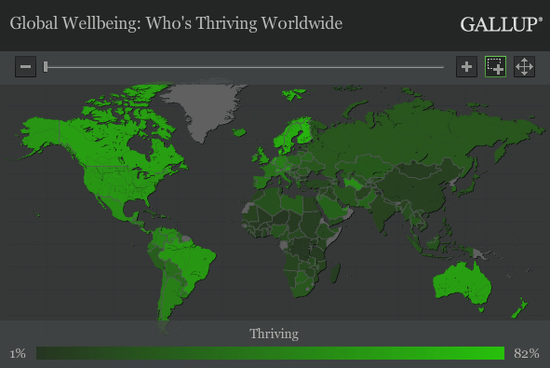
GallupWellbeing

Richard Florida compares happiness levels across nations:

[W]hile income and the level of economic development play an important role in the happiness of nations, well-being is also related to the type and nature of economic development and the values it engenders. There is something in the nature of post-industrial economies and in their values that appears to affect the happiness of their people over and above the effects of income.

Perhaps it is that people with higher levels of education have more flexibility or choice in pursuing their dreams, building families and social relationships that are more fulfilling, or simply in their ability to adjust to misfortune or bad times. Perhaps it is that knowledge-based jobs are more challenging and fulfilling. It's also clear that the most troubled societies — those with the highest reported levels of suffering — also, generally speaking, face the highest levels of intolerance. While income and the level of economic development certainly need to be top of mind considerations when we think about or attempt to act on the happiness of nations, one simply cannot neglect the effects of economic and social structure and of values in social well-being.

(Image from Gallup. Interactive version here.)

What The Public Thinks

Drum grants that "polls do give us a general idea of where we're starting from," but also argues public opinion isn't hardened on a subject until it is the center of debate:

[W]e often take a look at polls and think they tell us what the public thinks about something. But for the most part, they don't. That is, they don't until the issue in question is squarely on the table and both sides have spent a couple of months filling the airwaves with their best agitprop.