The Theocons Dig In, Ctd

Commonweal’s Paul Moses counters Weigel:

To say that sexual abuse in other churches or other sectors of society does not get the same media attention misses the point. The issue isn’t that Catholic priests are allegedly prone to commit sexual abuse, but that a small percentage of them were freed to do so, again and again, due to gross mismanagement, secrecy and lack of accountability on the part of church authorities. However dated most of the sexual abuse cases are, this story still calls out to be covered because some of those who failed to stop repeat abusers remain in positions of authority.

It’s not just the crime – about the most horrific there is and treated as the most despicable by most prison inmates – it’s the cover-up! And the fact that the men who concocted the cover-up were never held truly accountable, never prosecuted, and, in one case, elevated to the papacy!  This is why the developments of the last two weeks have been so earth-shattering. Because they reveal that one of the countless bishops and archbishops who treated child-rape as a possible embarrassment for the church and a problem for the priest – rather than as a horrifying betrayal, crime and danger to children and families – now runs the whole show. So not only is he part of the problem, his refusal to concede that he was part of the problem compounds the problem.

This is about trust and minimal moral accountability. Minimal. What responsibility does the Pope have for the subsequent child rapes committed by the priest he reassigned? How many violated children does he have on his conscience? And how can responsibility for and complicity in those crimes – those indelible wounds in the souls of children – be dismissed, however many years later, as “petty gossip”? 

Catholics are being asked move on from the fact that the Pope himself personally let a child-molester go on to rape other children. Personally, I can no more move on from that fact without some accountability than I can from the fact that the president of the United States authorized the brutal torture of human beings.

Hiding Behind Double Standards

Archbishop Timothy Dolan complains “that the sexual abuse of minors is presented as a tragedy unique to the Church alone.” Douthat counters:

Call out bad reporting, by all means; defend yourself against unjustified allegations, definitely. But don’t spend too much time complaining about a double standard, or griping about being unfairly targeted. Because, after all, the church is the church — not the public school bureaucracy, not the Boy Scouts or Girl Scouts, not the American juvenile detention system or the Scientologists or any other organization that you might not be surprised to discover has a problem with sexual abuse. Catholic scandals are worse even when they’re the same as everybody else’s, because it’s Catholicism’s business to be better. And the church is a target because it asks to be a target — because it aspires to set a higher standard, and answer to a higher master, than princes, governments and civic institutions.

Of course, I’m with Ross on this. But from his last column, I’m left to wonder: does he think this abuse of children didn’t occur before the 1960s? There does seem to be an explosion of cases in the mid to late twentieth century. But couldn’t that just be because sexual abuse became mentionable in the 1970s and 1980s – and the victims finally gained the courage to ‘come out’ so to speak?

What haunts me is the fear that this went on for centuries, and we would never have known about it.

Don’t Let Them Steele Your Money

Friedersdorf draws a lesson from the latest RNC scandal:

Like a conservative candidate? Give him or her money. Favor a specific legislative change? Donate to a targeted campaign. But keep your money away from the Republican Party and most established organs of movement conservatism. The corruption of these entities isn’t just depressingly common, it’s inevitable. It’s time to stop enabling an ideological apparatus that pretends to abhor coastal elites, even while using their finest faux lesbian strip clubs as recruiting venues.

Leave NCLB Behind? Ctd

R.M. at DiA interviews Diane Ravitch. Her view of Obama's proposed changes to NCLB:

They are too deeply rooted in the flawed assumptions of NCLB. There is no evidence that closing schools, firing principals and teachers will magically produce better schools. There is no evidence that there are 5,000 outstanding principals waiting to be called to lead these schools, or that hundreds of thousands of "great" teachers will leave their jobs to teach in stigmatised schools. This is the same punitive approach embedded in NCLB. It rests on a fundamental belief that schools need incentives and sanctions, a whiplash to improve. It is based on test scores, and it will do nothing to lift education in those schools or in any other schools.

Church vs Prison Rape

A reader writes:

A while ago you linked to a devastating NYRB article on prison rape. Your recent posts about the horrifying reports of sexual abuse in the church have gotten me thinking about that article again. I know it's ridiculous to compare horrors, but it seems to me that the church abuse gets far more press than does the prison abuse, and that this might be another example of how prisoners are forgotten in our society. Their abuse implicitly condoned, because most of them are criminals, and therefore it seems to the public that they deserve to suffer and that their rape and abuse cannot be helped. I think that we might find it more outrageous for a member of a religious order to abuse a free child than for a corrections officer to abuse a juvenile offender; but why should this be so?

Alex Eichler highlights the most salient aspect of the authors' work:

In a January 7 blog post … Kaiser and Stannow focus on the sexual abuse of minors, and make the scope of the problem clear.

Some 3,220 juveniles, or 12.1 percent of those in custody, reported being sexually abused in prison in the past year, but in all likelihood this number "represents only a small fraction" of the abuses taking place. "What sort of kids get locked up in the first place?" the authors ask. "Only 34 percent of those in juvenile detention are there for violent crimes." Meanwhile, a number of minors are simply trapped in a system that doesn't care about them.

More than 20 percent of those in juvenile detention were confined for technical offenses such as violating probation, or for "status offenses" like disobeying parental orders, missing curfews, truancy, or running away–often from violence and abuse at home. Many suffer from mental illness, substance abuse, and learning disabilities.

On Blogging

Thomas P Barnett reflects on six years of daily work. It's a very sage and sobering summary, and I think he's right in understanding that blogging, by forcing a blogger to keep up with so many things, both leads to inevitable misjudgments in real time but also what he calls his

professional "RAM," or random-access memory storage capacity.

Then he writes something after my own heart:

I remain somewhat old-fashioned in my blogging, mixing in a portion of personal posts with the professional flow. I have always blogged under my own name on my eponymous website, and like it that way, which explains why I've turned down a lot of offers to blog on group sites or to expand my own site into a multi-voiced brand. Truth be told, I still enjoy the pure F-U! element of a personal web log, or diary.

I believe the honesty and freedom that accompanies that sole-proprietor approach is crucial to making sure the material takes me where I need to go, and not the other way around.

I've been lucky to have been able to retained such a "F-U! element" even when writing under the umbrella of Time or The Atlantic.  But I also have to say, as I approach my tenth anniversary of daily blogging, that the exposure and constant labor is grueling a decade in. Without Chris and Patrick and you, the Dish readers, I'd have ground to a halt a long time ago.

Punishing Renters

Keith Hennessey doesn't believe the Obama administration should use tax dollars to subsidize underwater homeowners with fixed rate mortgages. He highlights a program that would help homeowners with mortgage balances up to $729,750. An illustration of his point:

Imagine twin brothers, each with $180K of annual income.  One rents, and the other has a $700,000 mortgage on a home that declined from $800,000 in value to $600,000 in value.  Both brothers lose their jobs.  Why should the renter pay higher taxes to subsidize his brother’s mortgage payments?

Losing a home due to financial hardship is tragic.  Does that make it someone else’s responsibility?

Chart Of The Day

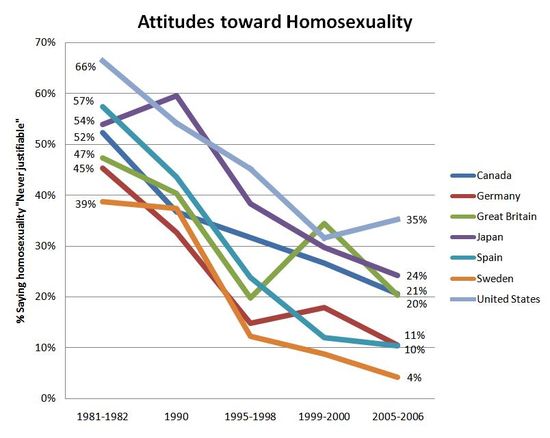
HomosexualityAttitudes

From Will Wilkinson (click to enlarge). Will is wading through World Values Survey data. He contrasts this chart showing greater tolerance for gays and lesbians with relatively steady views on prostitution. He asks:

In the space of about 25 years, the proportion of the population in all these countries saying homosexuality is never justifiable drops precipitously. However, the overall trend in attitudes toward prostitution is not so clear and generally less dramatic. What accounts for the difference?