"Media requests to deal with this subject make it difficult to provide an adequate response to today's article by Laurie Goodstein. But the time has come to ask some serious questions about why the Times is working overtime with wholly discredited lawyers to uncover dirt in the Catholic Church that occurred a half-century ago. Those questions will be raised in an ad I am writing that will be published in next Tuesday's New York Times; a rejoinder to the article will also be made. All I can say now is that this is the last straw," – Bill Donohue, digging in to defend a church that became a criminal conspiracy to protect and enable child rapists.
The View From Your Window

Ivins, Utah, 7.28 am
Google.cn
In the wake of Google's decision to stop censoring their search engine in China, co-founder Sergey Brin both called on the US government to fight Chinese censorship and called out Microsoft for continuing to censor. Danny Sullivan cries hypocrisy:
Google surrounded [its decision to enter China in 2006] with all types of statements that censorship was really something it was doing to help a large population find good, non-politically sensitive information that wasn’t subject to censorship. […] But bottom line, it was still a business move, to me. If Google just wanted to help people in China get good information, it could have spent the past four years helping to construct ways for people in China to bypass their government’s firewall. Or the past four years arguing that the US government and US-based businesses should follow its lead in staying out of China.
John Hudson rounds up more commentary. Fallows has been all over the story. Here he interviews David Drummond, Google's chief legal officer:
I then asked Drummond about something that has always puzzled me. If the original occasion for the shift of policy was (as generally reported) a hacking episode, why did it lead to a change in the censorship policy? What's the logical connection? He explained the reasoning in a way I hadn't seen before.
His partial reply:
[The hacking] was almost singularly focused on getting into Gmail accounts specifically of human rights activists, inside China or outside. They tried to do that through Google systems that thwarted them. On top of that, there were separate attacks, many of them, on individual Gmail users who were political activists inside and outside China. There were political aspects to these hacking attacks that were quite unusual. ?That was distasteful to us. It seemed to us that this was all part of an overall system bent on suppressing expression, whether it was by controlling internet search results or trying to surveil activists.
Quote For The Day
“Yes, I am quite a conservative bloke. I do have a traditional background but it doesn’t mean I’m incapable of understanding the complexity of modern life," – Australian Opposition leader and devout Catholic Tony Abbott, voicing his support for same-sex unions.
Gates Relaxes DADT
Ambinder reports.
How Serious Is The Vatican’s Crisis?
One litmus test of mine is to see whether a story on the front pages of every global newspaper is being discussed at National Review Online. Sure enough: not a word that I can find. When NRO cannot defend the Benedict hierarchy, it's totally serious. And I'm totally serial about that.
Dissent Of The Day, Ctd
A reader writes:
You say you're tired of the kind of calculations that say Dan Choi chaining himself to the gates was a bad choice. Andrew, aren't you the guy who advocates for gays to explain that they are "virtually normal" – that they deserve the same rights as everybody else, because outside the bedroom they're the same as everybody else? The best way to advocate for the rights Dan Choi deserves is for him to stand up and speak to people, in Congress, in public – to show them he's just as good as anyone so that folks, no matter where they're from, can understand the depth of the injustice done to him. Chaining yourself to a gate isn't relatable; it's a stunt.
Another writes:
You, HRC, Dan are already converts. He deserves to be treated as the competent soldier he always was, and to do less is to violate his dignity, the dignity of the military, the dignity of this country. Yet he presented the image of a soldier hanging on a fence. In uniform. It fed every argument made by the opposition to his argument – that gay soldiers don't uphold the dignity of the military. It was a bassackward move on his part. Well meant, done from understandable passion and it took guts. But all it did was let a gay guy hang the revered uniform of the US military on a fence like some rainbow flag. That's how it will play to the opposition. That's who you're trying to defeat. Right?
Another:
With DADT in its last year, Choi is young enough to wait it out and be welcomed back to his honorable service when it is gone. I would not and do not expect that to be the case now that he has used the uniform in this stunt. Our military’s tradition is to stay out of the streets and political passions, and Choi has to be very aware his actions last week would be frowned on as unprofessional in the eyes of the officers he professes to want to rejoin. Not long ago you had stories that conveyed the attitude of many gay service members who want to stay away from gay activism and politics and only want to serve quietly but free of the fear of a career ending incident such as the outing of the Air Force sergeant in Iowa. This stunt was the opposite of that desire.
I too am a gay veteran, one whose service spanned the time before and after DADT came into effect. The military was the career I had dreamed of growing up, but the service ironically instilled in me the maturity and self-confidence to embrace my sexual orientation and chose to voluntarily leave the service at the end of my commitment rather than serve in the closet. The impending repeal comes achingly close after I have become too old to return to the career I had wanted. It is incredibly frustrating to see Choi choose throw away the chance to return to a respected career for a little melodrama and personal fame that will not influence the outcome of this debate.
Well his "stunt" certainly isn't impeding progress on DADT.
Aping Churchill
A reader writes:
"That last metaphor"? The whole thing is a Churchill ripoff.
Republicans really see themselves this way? And we’re supposed to, like, listen to them?
Another writes:
Ironically, Churchill himself supported and helped create Britain's NHS.
Getting Scary Out There
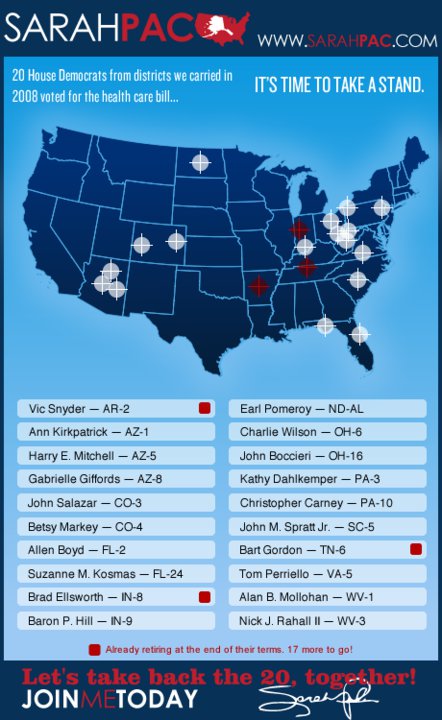
Ezra Klein comments on the recent spate of vandalism and intimidation against Dem officials across the country:
I don't want to exaggerate the importance of the death threats being made against congressmen who voted for health-care reform. Nuts are nuts. But there is a danger to the sort of rhetoric the GOP has used over the past few months. When Rep. Devin Nunes begs his colleagues to say "no to socialism, no to totalitarianism and no to this bill"; when Glenn Beck says the bill "is the end of America as you know it"; when Sarah Palin says the bill has "death panels" — that stuff matters.
And the stuff on talk radio, of course, was worse. So take the universe of people who really respect right-wing politicians and listen to right-wing media. Most of them will hear this stuff and turn against the bill. Some will hear this stuff and really be afraid of the bill. And then a small group will hear this stuff and believe it and wonder whether they need to do something more significant to stop this bill from becoming law. And then a couple will actually follow through. And one will cut the gas lines leading to house of Rep. Tom Perriello's brother after seeing a tea partyer post the address online.
Max Fisher rounds up more reaction to the violence.
(Palin's map was pair with the tweet, "Don't Retreat, Instead – RELOAD!")
AIPAC Responds, Ctd
A reader writes:
Diehl is unbelievable. He describes the reason for the ejection of Mossad's top officer in Britain as a "flap"? Using British identities in an international assassination?
This was the second time Mossad used British passports, and the last time Britain made it crystal clear that this should never be done again. It is also a direct insult to Britain and the other nations, since it is telling that no US passports were used, as far as we know.
Since these were taken from the identities of dual citizens of Israel by the Israeli government, the biggest opportunity for use was American passports. Yet Israel was worried enough about an American reaction that they avoided using US passports. That may be lonely evidence that Netanyahu doesn't think the U.S. will put up with anything he does. But it is also evidence of complete Israeli disdain towards the governments of Britain, France, and Germany, and a cavalier willingness to endanger the lives of all those who hold those passports.
A "flap"?
 The Dish