Victory

OBAMA08ChipSomodevilla:Getty

Obama's historic breakthrough just passed 219 – 212.  My take here. Stay tuned for reax. Now watch the narrative shift again. Sprung:

The flip side of Obama's perhaps naive belief that he can win Republicans over is his ability to show them up. Americans are confused about the plan, but they are not confused about the man.  By large margins they trust Obama more than they do the Republicans to produce rational solutions to the country's problems. In the past month, he exploited his mastery of policy detail, his pragmatism, his focus on effectively alleviating the suffering he spotlighted, and his willingness to stake his political future on getting this bill passed to the utmost. The full eloquence and passion of the campaign came back to

his lips in forum after forum and speech after speech. 

To Democratic legislators, his message was that this bill epitomized why they had sought public office and why they were Democrats; it was the raison d'etre for their careers; in effect, passing it was worth their careers (and would make or break his own).  In the bipartisan summit, he framed a core contrast: the Democrats would rein in the health insurers' worst practices; the Republicans would further enable them by weakening existing regulations. In rallies, he emphasized human suffering caused by leaving people uninsured and underinsured and enumerated the bill's benefits for ordinary people.  As noted before, too, he presented the effort as a litmus test as to whether the Federal government was capable of taking meaningful action to solve national problems. He moved the needle of public opinion enough to move enough House Democrats to "yes."

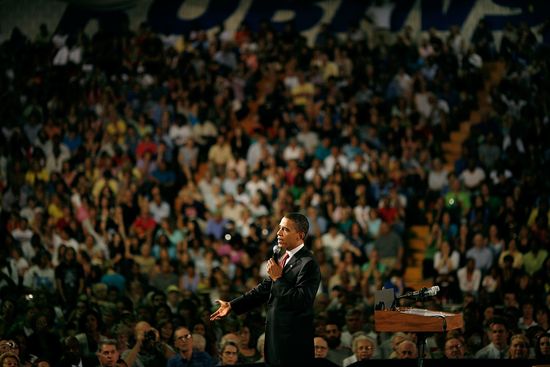
The process may have been frustrating, and long, and ugly, as Obama told the crowd at George Mason on Friday.  But it was also glorious.  Obama has been telling crowds since 2007 that change wasn't going to be easy, but that it was possible with focus and persistence and courage. He just proved it.

(Photo: Chip Somodevilla/Getty.)

Stupak: “John Dingell Had A Piece Of Me”

From Patrick O'Connor:

The deal came about after a personal appeal from Stupak’s longtime ally, fellow Michigan Rep. John Dingell, the former chairman of the House Energy and Commerce Committee whose father first offered legislation creating universal health care back in 1943. Dingell helped broker negotiations between an angry Stupak and party leaders at both ends of Pennsylvania Avenue when all looked lost. "John Dingell had a piece of me yesterday for quite some time," Stupak said. "He kept me well informed of what I should be doing."

Bibi: Israel’s Dick Cheney

Fareed explains why:

After watching Netanyahu's government over the past year, I have concluded that he is actually not serious about the Iranian threat. If tackling the rise of Iran were his paramount concern, would he have allowed a collapse in relations with the United States, the country whose military, political, and economic help is indispensable in confronting this challenge? If taking on Iran were his central preoccupation, wouldn't he have subordinated petty domestic considerations and done everything to bolster ties with the United States? Bibi likes to think of himself as Winston Churchill, warning the world of a gathering storm. But he should bear in mind that Churchill's single obsession during the late 1930s was to strengthen his alliance with the United States, whatever the costs, concessions, and compromises he had to make.

Obama’s Victory Of Persistence

Yes, in the end, he got all the primary delegates House votes he needed. Yes, he worked our last nerve to get there. But, yes, too, this is an important victory – the first true bloodied, grueling revelation that his persistence, another critical Obama quality, finally paid off in the presidency. He could have given up weeks ago, as the punditry advised (because they seem to have no grasp of substance and mere addiction to hour-to-hour political plays). But he refused. That took courage. And relentlessness. Fallows puts it well:

For now, the significance of the vote is moving the United States FROM a system in which people can assume they will have health coverage IF they are old enough (Medicare), poor enough (Medicaid), fortunate enough (working for an employer that offers coverage, or able themselves to bear expenses), or in some other way specially positioned (veterans; elected officials)… TOWARD a system in which people can assume they will have health-care coverage. Period.

The biggest shift in social policy since welfare reform – but involving far more people. My view is that it will also empower Obama abroad, because there is a linkage between domestic success and foreign policy clout. From my column today:

Watching the various whip counts going back and forth reminded me of the agonising, delegate-counting path to primary victory that Obama took. It works your last nerve. It’s like England in extra time at the World Cup.

Imagine the narrative shift if this bill is passed. Obama will not have imposed this monstrosity on the country from on high; he will have ground it through the bloggers, and the pundits will declare a resurrection. The narrative will be about his persistence and his grit, rather than his near-divinity and his authority. And suddenly it will appear — lo! — as if this lone figure has not just rescued the US economy from the abyss, but also passed the biggest piece of social legislation in decades.

There is only one story better than Icarus falling to earth; and it’s Icarus getting back up and putting on some shades.

The media will fall for it. The public will merely notice that the guy can come back and fight. Even when they don’t always agree with such a figure on the issues, they can admire him.

Again, the real parallel is Ronald Reagan.

People forget how unpopular Reagan was at the same point in his presidency — and passing a big tax cut was legislatively a lot easier than reforming a health sector the size of the British economy. But like Obama he persisted and, with luck and learning, aimed very high.

Obama has bet that this is his destiny. He is extremely cautious from day to day, staggeringly flexible on tactics, but not at all modest when you look at the big picture.

He still wants to rebuild the American economy from the ground up, re-regulate Wall Street, withdraw from Iraq, win in Afghanistan, get universal health insurance and achieve a two-state solution in Israel/Palestine in his first term. That’s all. And although you can see many small failures on the way, and agonising slowness as well, you can also see he hasn’t dropped his determination to achieve it all.

Meep, meep.

Under The Microscope

TNC's commenters have been having Oakeshottcaius conservative "movement" 1970s and 1980s, but obviously no longer. I'm very candid about this in The Conservative Soul. And one thing I'd ask of those who want to know how I understand conservatism is, well, to read that book. Or download it on your Kindle. I know that sounds corny and commercial, but look,  it's why I wrote it. The argument needs a book-length treatment. And the philosophical underpinnings of that book are in my dissertation on practical wisdom, Intimations Pursued.
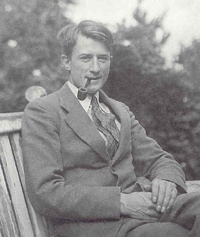
I've been thinking about these things for a long time, and I appreciate that it all looks absurdly esoteric or simply solipsistic to many. My conservatism is not today's American conservatism, although it could easily find a place in Cameron's Toryism. I have a libertarian streak as well – which puts me at the right end of Toryism. But I hold, following Oakeshott and Burke, that the critical conservative virtue in politics is coherence and balance and practical, prudential openness to change and reform. Remember that Burke, as a Brit, favored American independence. If you cannot see that as conservative in some sense then my arguments will be lost on you.

And yes, it's wrapped up in religion, my inability to lose my faith and my attempt to grapple with what that means in today's increasingly fundamentalist world. That's why the core issue in the book is really Christianity, and why I increasingly feel I want to take some time out to explore these theological and spiritual questions with the time and silence they deserve.

As for conservatism in America, my own belief is that this, at the deepest level, is a philosophical struggle between the worldviews of Leo Strauss and Michael Oakeshott.

I respect Strauss a lot (and a lot more than some of his followers), but I am an Oakeshottian. We Oakeshottians – skeptical, non-violent, fickle, tolerant, but in love with individual freedom – will never be a political party. But I think at the deepest level, we're right and the Straussians are wrong. And that only Oakeshottians are capable of reconciling conservatism with modernity. At some point this is about whether conservatism is in the service of power or resistant to it.

For the rest, "cynic" gets it best:

Sure. He's prone to excess. Some of what he writes is misinformed, ill-considered, or flatly wrong. And all his views, positive or negative, are intense. I'm not claiming that he's the platonic ideal of a pundit.

But it's important, I think, to grapple with the ideas that undergird his particular stances, because it seems quite clear to me that his positions flow from his ideas.

In the same post to which I linked above, he approvingly cites Oakeshott to the effect that "the two deepest impulses in Western political thought – the individualist and the collectivist – need each other to keep our polities coherent." Andrew identifies as a conservative, because of where he would prefer to establish that balance, more toward the individualist than the collectivist. But the point is that the goal is not ideological purity. It is balance, above all, that he pursues.

Politicians are, in this scheme, tools for achieving balance. Which explains, I think, how Andrew can first extoll a politician, and then turn on him a few years later. That's a mark of consistency, not hypocrisy – a politician who pursues the same goals without respect to shifting circumstances will first offer a necessary corrective, and then go increasingly too far. The exceptions are those rare politicians whose views evolve substantially in office, as the solutions on which they campaigned get placed into effect, and they adapt accordingly.

One way to think about Andrew's views is to imagine the ship of state moving quickly downstream. Steer too far in either direction, and it runs aground on the banks. Andrew, I think, has a tendency to see this happening, and to overcorrect – to push the tiller too hard, first one way and then the other. And he would prefer that the ship keep a steady course closer to the right-hand shore, and I to the left. But the basic view – avoiding the perils of steering too close to either extreme, keeping a steady course, adjusting it with the bends in the river – is one I wholeheartedly endorse.

Action, Not Apologies

Barbara Blain, of Survivors Network of those Abused by Priests (SNAP), waves off the pope's letter:

The church’s first priority, however, should not be “repentance, healing and renewal,” as the Pope maintains:  Child safety comes first. Wounded adults can heal themselves, with or without the Pope’s help. Vulnerable kids, however, can’t protect themselves without the Pope’s help. That help must involve action, not words. No apologies or explanations or letters or excuses or promises. So far, the Vatican has only talked, not acted. That must change.

Map Of The Day

AmericaChristian
Via Richard Florida, Floating Sheep has mapped Christianity globally and nationally:

Catholics are most visible in much of the Northeast and Canada, with Lutherans taking the Midwest, Baptists the Southeast, and Mormons unsurprisingly taking much of the mountain states. Methodists, interestingly, seem to primarily be most visible in a thin red line between the Southern Baptists and everyone else.

Click to enlarge.