Ranking Sufferings, Ctd

DiA counters Mead:

[C]riticism of Israel's human-rights record has less to do with anti-Semitism than it does with the opposite. Western countries hold Israel to a different standard than they do Congo because they see in Israel a rich, Western-like, European-descended country. We in Europe and America judge Israel harshly not because Israelis are the Other, but because they're unusually like us. Does Israel really want to be judged by the same standard we use to judge Omar al-Bashir? Now that would be anti-Semitism.

The Daily Wrap

Today on the Dish, Andrew tried to read Netanyahu, Biden bit back, and we compiled commentary over the latter's embarrassment. More debate over Israel here. And we heard some good news out of Iran. Friedersdorf continued the exposure of McCarthyism, Chris Blattman assessed the scene in Uganda, and we rounded up reaction to Paul Ryan's budget. Megan defended Rasmussen and Andrew countered Megan. Alex Koppelman exposed the emptiness of Kucinich.

More cannabis commentary here. Dissent of the day here (Greenwald backlash here). Video of the day here (reader response here). And this ad was cool.

— C.B.

Quote For The Day

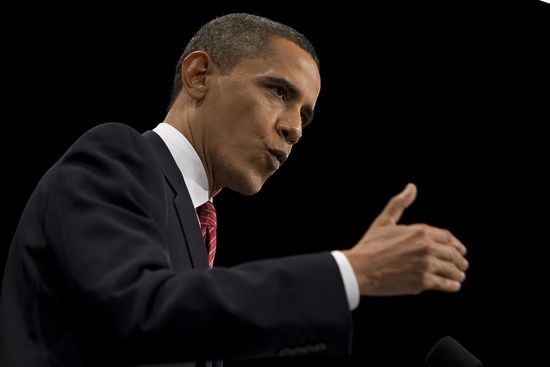
OBAMAWESTPOINTJimWatson:AFP:Getty

"When the conduct of men is designed to be influenced, persuasion, kind, unassuming persuasion, should ever be adopted. It is an old and a true maxim, that a "drop of honey catches more flies than a gallon of gall." So with men.

If you would win a man to your cause, first convince him that you are his sincere friend. Therein is a drop of honey that catches his heart, which, say what he will, is the great high road to his reason, and which, when once gained, you will find but little trouble in convincing his judgment of the justice of your cause, if indeed that cause really be a just one.

On the contrary, assume to dictate to his judgment, or to command his action, or to mark him as one to be shunned and despised, and he will retreat within himself, close all the avenues to his head and his heart; and tho’ your cause be naked truth itself, transformed to the heaviest lance, harder than steel, and sharper than steel can be made, and tho’ you throw it with more than Herculean force and precision, you shall no more be able to pierce him, than to penetrate the hard shell of a tortoise with a rye straw.

Such is man, and so must he be understood by those who would lead him, even to his own best interest," – Abraham Lincoln, address to the Washington Temperance Society in 1842.

(Photo: Jim Watson/AFP/Getty.)

The Reality Of The Ryan Budget, Ctd

Douthat defends the plan and proposes a few modifications. Ambinder notices few Republicans are willing to officially attach their names to the plan:

This isn't a non-serious plan. But Republicans don't seem to be ready to risk the accusation that they want to end Medicare (a very popular program), privatize Social Security (a non-starter), raise taxes on the middle class (by proxy) — by affixing their name to a specific plan that does just that. So the question for Republicans is: yes, Paul Ryan has a plan. But if you don't support it, then what, specifically, would you do to reduce the deficit over the long-term?

Was Ugandan Homophobia Imported? Ctd

Matt Steinglass finds an article by Philip Jenkins:

It sounds as though Mr Jenkins's focus has evolved a bit over the past few years; when he wrote this article in the New Republic, he wasn't exactly saying that Western evangelicals were irrelevant to Ugandan homophobia. It was more that such influence had been over-emphasised. He situated African homophobia in the rising tide of evangelical Christianity in Africa, and noted that first- and second-generation converts to any faith tend to be more literal in their interpretations of its holy texts.

He did argue that competition between Christianity and Islam helps drive homophobia, but he did so in a way that highlights how values are shaped dynamically by the discourse generated in religious competition, including missionary discourse. He also placed African antipathy to homosexuality in historical context, recalling a fascinating angle to the history of Uganda's 19th-century Catholic martyrs. (Apparently some of them were Christian pages who refused to take part in the pederasty adopted by the Arab-influenced Muslim king of Buganda.) "For many Africans," Mr Jenkins wrote, "sexual unorthodoxy has implications that are at once un-Christian, anti-national, and oppressive."

Against Sanctions

James Joyner is against putting further sanctions on Iran. He argues that "sanctions make those enacting them feel like they're doing something but wind up hurting the very people we're ostensibly trying to help, the ordinary citizens suffering under repressive regimes." They are also hard to repeal:

As [Kenneth Katzman] explained in his talk, some sanctions fade easily.  He gave the example of those that come with being listed as a state sponsor of terrorism by the State Department.  The president can simply take a country off the list if its government changes.  Otherwise, as was the case after Libya agreed to abandon its WMD pursuit, the president can order the removal pending a 45 day response period.  Conversely, sanctions put on by the Congress or the United Nations can take years to untangle.

Playing Israel’s Game

Room For Debate argues over the Israeli-American relationship. Amjad Atallah's take:

The United States has been sending its messages with carrots and great diplomatic restraint. The current Israeli government, in stark contrast, has been responding like a petulant child, outraged that it hasn’t been able to get U.S. acquiescence to its own short-term political strategy.

There is a great deal at stake in this public and private dispute between Israel and the United States. President Obama should consider responding in a similar manner, by creating his own facts on the ground, and ending all forms of U.S. cover and support of the settlement enterprise and other policies that sustain the occupation.

Amen. Cut off loan guarantees, suspend aid, threaten to remove the UN veto. But none of this has a chance to happening except the latter. The Congress won't allow it – because the GOP's Christianist wing wants a greater Israel to hasten Armeggedon and because the Democrats are so scared of AIPAC.

Chart Of The Day

SatisfiedGallup

Gallup finds that American satisfaction has dipped:

Gallup has tracked Americans' satisfaction with national conditions since 1979. Since that time, there have been three other periods of sub-20% satisfaction ratings, all during difficult economic times for the United States. These include 1979 to 1981, when the nation dealt first with an energy crisis during the latter part of the Carter presidency and high unemployment in the early part of the Reagan presidency; 1992, as the U.S. was coming out of a recession; and 2008 to early 2009, during the economic downturn and the financial crisis, including a record-low 7% reading in October 2008.