Map Of The Day

Alone

Stephen Von Worley pits the country's 12,000 McDonald's restaurants (black) against the 24,000 other major fast-food joints (non-black):

[E]ach individual restaurant location has equal power.  The entity that controls each point casts the most aggregate burger force upon it, as calculated by the inverse-square law – kind of like a chart outlining the gravitational wells of galactic star clusters, but in an alternate, fast food universe. By far, the largest pocket of resistance is Sonic Drive-In’s south-central stronghold: more than 900 restaurants packed into the state of Texas alone.  Sheer density is the key to victory!

Click here to enlarge. (Hat tip: TDW)

The Gutter McCarthyism Of Liz Cheney, Ctd

Julian Sanchez makes a strong point:

The central, celebrated cases that have established the boundaries of our most cherished civil liberties often involve bad people who are, in fact, guilty of whatever crime they’re accused of.

Weigel writes up the whole affair. Bill Kristol, who had his shame surgically removed years ago, feigns confusion.

One Of Countless Ways Iraq Might Fail

Larison sketches out a possible future:

[O]ne of the last things fledgling democracies in countries with a history of authoritarianism need is a massively oversized military and security apparatus. It is often the case in developing countries that the military can serve as an institution that unites and integrates the nation. This will tend to make it the one institution most of the population trusts and respects. However, with greater prestige and respect comes a willingness to intervene in politics when the elected civilians prove themselves to be incapable of governing effectively and/or relatively honestly.

When experiments in liberalism, democratization and privatization go awry or are associated with extremely negative economic conditions, public confidence in these things disappears. If democratization is followed by dysfunction, corruption, misrule and lack of basic services, military or authoritarian government becomes very attractive. Given the extent of the sectarian politicization of Iraq’s military and police that already exists, and considering the harsh and arbitrary practices of security forces right now, the differences between an authoritarian and a democratic Iraq are not nearly as great as they are supposed to be.

Greg Scoblete follows up.

An Economic Peace

Bernard Avishai calls for it:

Israel should be inviting, not prohibiting, Palestinian entrepreneurs to come to the West Bank and invest. It should be greatly expanding the number of permits for businesspeople to come to Jerusalem. It should be allowing banks to operate here, thus stopping the city's brain drain to Amman and Dubai.

It should be assigning security forces to work with PA forces to expedite Palestinian supply chains. It should be authorizing the development of a secure, north-south transportation corridor linking Palestinian cities, perhaps picking up on the Rand Corporation's brilliant idea of an "arc" of bus and rail lines. It should be releasing more bandwidth for Palestinian telecom, and restricting Israeli competition in Area C.

Netanyahu could do all of this today without endangering Israelis or even removing settlers yet. With so many Palestinians under 20, the economic disparities so great, and the territory so small, what can be more dangerous than continued stagnation?

But as Avishai notes, Netanyahu's occupation continues to stifle Palestinian civil society and economic vibrancy, and he owes his power to those who wish to stifle it even more, to those who believe that Judea and Samaria should be in Israel forever, and that raw force and the immiseration of the Palestinians are the ways to achieve it. If Netanyahu cannot resist these forces even to freeze settlement construction for a year, what are the odds of his being able to grant these far larger concessions? It's like expecting Cheney to back civil trials for some terror suspects.

And with each year, the number of settlers grows and the fusion of religion and politics on the dominant Israeli right gathers momentum. And the pro-Israel lobby in Washington will work like crazy to prevent the US being able to pressure the Israeli government to move in any constructive way.

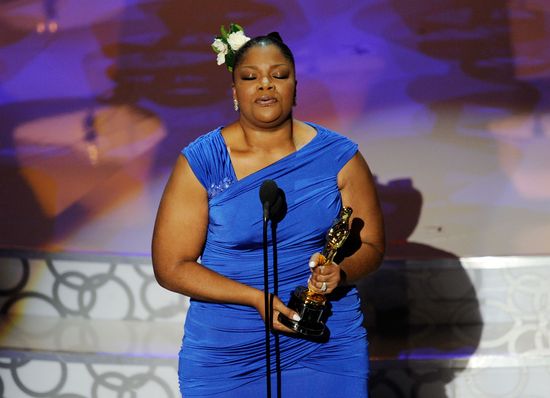
How Smug And Self-Righteous Was Mo’Nique?

MONIQUEKevinWinter:Getty
 
 A reader writes:

Your reader's defense of Mo'Nique was nice but erroneous.  Large black ladies have never been "vilified" in this country.  Made fun of and stereotyped, yes, but not "vilified." 

The notion of the strong Black Mammy is one of the most positive portrayals of Black folk in the US going back to slavery times.  And there was nothing "cringe-worthy" in Hattie McDaniel's portrayal in "Gone With The Wind" — she was in complete control. In fact, her portrayal was just about the only positive portrayal of Black people in that movie.  And, yes, Mo'Nique's award acceptance speech was extremely self-conscious, self-aware, and self-important.

Another writes:

I don't know about smug and self-righteous, but it certainly made me do a double-take when the first thing she said was that her win was about the performance and not the politics, and then almost everything that followed made her win all about the politics.

Not to mention a teeny bit arrogant and ungracious to assert that yes, she was better than the other nominees. Maybe that's what you meant by self-righteous. (Rule No. 1: you don't applaud yourself; Rule No. 2: smile, if wryly, when they call the other guy's name; and Rule No. 3: whatever you may privately think, it's very bad form to say that yes you were better than the people you beat.)

And maybe I'm too post-something-or-other, but why can't it be just about the acting, or the direction? Is it really so much based on the gender and the colour? I'm glad Barbra felt vindicated somehow for her Yenta loss, but I think it demeans Kathryn Bigelow to make her win about her gender and not her undoubted talent and skill, and to imply that somehow the Academy has decided to give a woman director a turn, and an African-American Best Supporting Actress a turn, etc. It's all contradictory anyway: it's either about the work or it's about the politics, and you can't have it both ways.

Another:

Your reader is wrong.  She's the fourth black woman to win Best Supporting Actress: Hattie McDaniel (1939 – Gone With The Wind), Whoopi Goldberg (1990 – Ghost), Jennifer Hudson (2006 – Dreamgirls), Mo-Nique (2009 – Precious).

Another:

I'll tell you what was wrong with her speech. And a quick survey of the comments on Bossip, a black gossip website, shows that there are plenty of blacks who agree with me. When she named Hattie McDaniel it was as if she forgot that black actors and actresses have been paving the way for her success for decades now; it's not like there was Hattie McDaniel and then all of a sudden Monique. I think that tells you a lot about her frame of mind.

Samuel Jackson's eye-roll said a lot.

Will It Pass? Ctd

Via Matt Steinglass, John Sides applies some simple game theory to the health care muddle:

[If] the representative wants to extract concessions from the Democratic leadership, it’s thus a good idea to signal uncertainty or even opposition to the bill — as many conservative Democrats have done. This raises the possibility, as one friend noted to me, that the prevalence of these signals in news stories may inflate the perceived chance that health care reform will fail in the House.

Along these lines, Stupak is sounding more optimistic.

The Walking Wounded, Ctd

Another comes out:

State Sen. Roy Ashburn (R-Calif.), the fierce opponent of gay rights who was arrested last week for drunk driving after leaving a gay nightclub, confirmed in a radio interview Monday that he is gay. "I'm gay," Ashburn told local radio host Inga Barks before returning to the Senate for the first time since his arrest. "Those are the words that have been so difficult for me for so long."

Here's how broken he is:

In 2005, Ashburn, who is divorced and has four children, co-hosted a "traditional values" rally in support of amending the state constitution to define marriage as between a man and a woman. The proposed amendment's language also likely would have nullified the state's domestic-partnership law.

Ashburn also opposed the state's proclamation of Harvey Milk Day, state laws that ban discrimination based on sexual orientation, a resolution supporting repeal of "Don't Ask, Don't Tell," and a variety of other measures supportive of gay people. He reportedly supported Proposition 8, the 2008 ballot measure via which voters amended the state constitution to repeal gays' right to marry …

Will he vote any differently now?

"I believe firmly that my responsibility is to my constituents," Ashburn said. "And so, on each measure that may come before me, I will take a careful look at it and apply that standard. How would my constituents vote on this? How would they have me vote on this?"

Interviewer: "What do you want us to do with this information, Roy?"

"I would ask people to pray for me," Ashburn said.

Interviewer: "Are you going to live this _way_ in your district? I don't know how to ask you the question."

"I pray to God that I can find peace," Ashburn said. "I want to go back to work in the Senate and work hard for the people who sent me to the Legislature. We have tough times in California, a lot to do, and I want to get back to work. … Now you know everything about me."

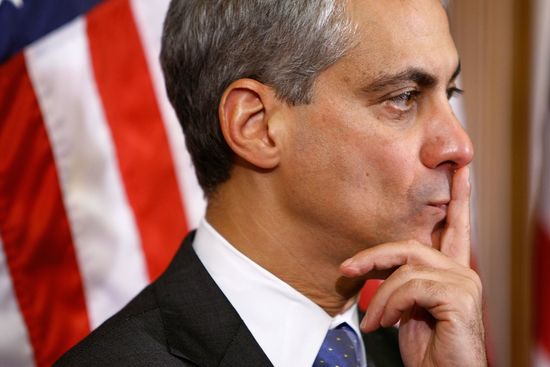
Creeping Clintonism; Or How Rahm Is A Scaredy-Cat

RAHMChipSomodevilla:Getty

The one thing you always knew about the Clintons and those who were close to them in the 1990s: they always, always reeked of fear. They suspected that white Americans could never vote for a black president; they believed you had to triangulate to the right of the GOP to survive; they believed that health insurance reform was political death; they held that standing up for civil rights for gay people was always stupid. And very few represent that kind of politics more than Jim Carville, Stan Greenberg and, yes, Rahm Emanuel, still traumatized after all these years.

Emanuel has a reputation for feistiness and God knows I'm not one to throw stones in my own glass House. But behind the thuggishness is a pathological fear of the right and a remarkably inept and crude set of human skills. He was hired to handle Congress; and yet his rank failure to pass a health insurance bill with a super-majority in the Senate and a big majority in the House for a full year – and the depth of the distrust between House and Senate that has emerged under his watch – reveals that his brand of cowardly principle and bullying practice is not what it is cracked up to be. Now his stupid posturing is also being used – naked in a shower no less – as a tool for Glenn Beck and the nihilist far right. 

But more disturbing is his classic Clintonian refusal to stand up against the Cheneyite right on critical matters such as national security and American values. No wonder he is so beloved of the Cheneyite rump now installed by Fred Hiatt at the Washington Post. All of which is to say: beware this poll from Greenberg on national security this morning.

The poll shows very strong credibility for the president in foreign policy and national security:

His handling of Afghanistan (58 percent), national security (57 percent), "leading America's military" (57 percent), "improving America's standing in the world" (55 percent), fighting terrorism (54 percent), and Iraq (54 percent), were all higher than his 47 percent overall approval rating.

But those numbers were down from levels in the 60s that were recorded by the same group last May. Fewer respondents now say they view Obama's handling of national-security issues as better than that of his predecessor George W. Bush — Obama's margin here has shrunk from 22 to just 5 percent.

Good Lord. Time to adopt torture and military commissions for all terror suspects; time to keep Gitmo; time to let Emanuel run rough-shod over Holder. Please. Of course these ratings are down from last May – what do you think happens to presidents over time? Of course his lead over his predecessor has declined. It's like gravity. The response is to reiterate just how successful Obama has been in prosecuting terror suspects, killing terrorist leaders abroad, restoring America's moral credibility. But, of course, the Carville-Greenberg-Emanuel trio think it's time to bring in Dick Morris. A reader writes:

Greenberg, now a kitchen advisor to Rahm, represents all his worst instincts–avoid conflict with the GOP at all costs, adopt their national security positions to avoid their being able to make headway on them.  He was an advisor to Gore in 2000, part of the clique urging him to wear earth colors and "be nice."  He was an advisor to Kerry in 2004, strongly advising against making an issue out of torture, lest the Dems be seen as "weak"–it was Greenberg who came up with the genius strategy of saying not a critical word about Bush at the 2004 Dem convention.  The subtext of this "poll" is the same that Greenberg had been peddling for years:  cede national security to the GOP, don't make an issue out of it.

“A Dunk In The Water”

Via Massie, Mark Benjamin describes how waterboarding worked in practice:

The CIA's waterboarding regimen was so excruciating, the memos show, that agency officials found themselves grappling with an unexpected development: detainees simply gave up and tried to let themselves drown. "In our limited experience, extensive sustained use of the waterboard can introduce new risks," the CIA's Office of Medical Services wrote in its 2003 memo. "Most seriously, for reasons of physical fatigue or psychological resignation, the subject may simply give up, allowing excessive filling of the airways and loss of consciousness."

Remember when we were told that it lasted just a few seconds and provided miraculous, accurate intelligence? And are still told by propagandists like Marc Thiessen and Cliff May that the victims were actually grateful for this and treated it as a religious liberation?

Now imagine what we still don't know about what Cheney and his band of incompetent and weak war criminals got away with.