Via David Luban, Colbert's farce becomes O'Reilly's reality. See if you can tell the difference between a parody of McCarthyism and the real thing.
The Mystery Of Depression
In last weekend's NYT magazine Jonah Lehrer pondered research finding an upside to depression:
To say that depression has a purpose or that sadness makes us smarter says nothing about its awfulness. A fever, after all, might have benefits, but we still take pills to make it go away. This is the paradox of evolution: even if our pain is useful, the urge to escape from the pain remains the most powerful instinct of all.
Ronald Pies counters. As does Therese Borchard. Leher follows up on his blog. Twice:
One of the most challenging aspects of studying depression is the vast amount of contradiction in the literature. Virtually every claim comes with a contradictory claim, which is also supported by evidence. I tend to believe this confusion will persist until our definitions of depression become more precise, so that intense sadness and paralyzing, chronic, suicidal despair are no longer lumped together in the same psychiatric category.
The View From Your Window
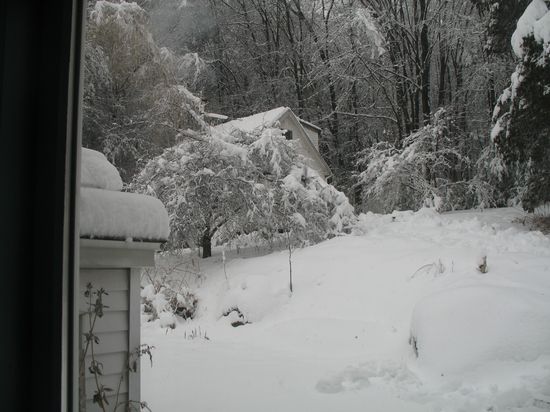
Easthampton, Massachusetts, 9 am. Not that long ago.
Good News From Africa
Tyler Cowen flags a study (pdf):
Not only has poverty fallen in Africa as a whole, but this decline has been remarkably general across types of countries that the literature suggests should have different growth performances. In particular, poverty fell for both landlocked as well as coastal countries; for mineral rich as well as mineral poor countries; for countries with favorable or with unfavorable agriculture; for countries regardless of colonial origin; and for countries with below or above median slave exports per capita during the African slave trade. Hence, the substantial decline in poverty is not driven by any particular country or set of countries.Building A Better YouTube
Now with auto-captioning:
Empire For Ever, Ctd
Tom Ricks replies:
What could be more imperialistic than invading a country pre-emptively on false premises and then leaving many years later in a selfish, callous and clumsy manner?
Staying forever, while your own country goes bankrupt. I guess it depends on whether we're talking about early-stage imperialism or late-stage neo-imperialism. But again, in some ways, I suspect this debate is immaterial. Whether Tom is reluctantly happy or I'm self-hatingly frustrated in the years ahead may make for some interesting debate, but it won't affect the outcome.
The US will not have fewer then 50,000 troops in Iraq under Obama.
And, if, as I fear, the sectarian divides get worse rather than better after these elections, we may have to keep even more there, under Tom's rationale. There's certainly no prospect of an actually functioning post-sectarian government in the wings, even if seven years of occupation, a trillion dollars, hundreds of thousands of Iraqi deaths, thousands of US and allied fatalities, and tens of thousands of servicemembers with brutal disabilities and PTSD have brought us a lively, if also corrupt, set of elections.
Cheerful, aren't I?
The Opening Lines Of Novels
Adam Wilson collects thirty great beginnings.
Why You Can’t Work At Work
(Hat tip: Barking Up The Wrong Tree)
As The Election Nears
This week Peter Wehner read Newsweek's Iraq cover story and declared victory. Kevin Sullivan counters:
The emergence of a democratic government in Iraq is a good thing and indeed, we should be grateful that the Iraqis are out from under Saddam's yoke. But it's important to distinguish between things that are good, and things that are worth spending 3 trillion dollars and thousands of American lives on. The invasion and occupation of Iraq cannot be justified solely on the basis of our love for democracy. The costs must be justified by gains to the security of Americans.
How many times has Pete Wehner declared victory? I'll be covering the elections this weekend with purple fingers crossed. But I remain a pessimist on Iraq, which is always a safe thing to be.
The Iran Debate, Ctd
A reader writes:
This is not the strongest argument against engagement, the strongest argument is regime stability. If you think that the regime will fall in a year if not months then engagement with the regime is just destroying US’s political capital among the Iranian public. What do you get in return? Do you expect the new government recognize all the deals that were made in the last days of the previous regime? This is why from the beginning the Leveretts dispute the idea that the election was stolen (well they say there is no hard evidence!), that the green movement has any force whatsoever or that the regime is in any immediate danger.
People tend to forget but regime’s problems are not contained to legitimacy and political issues. The far bigger problem is the finances of the Iranian government.
With the removal of subsidies and the devaluation of Rial (the Iranian currency) against the dollar you will have runaway inflation and an angry public. For example the Ahmadinejad government has already delayed the removal of gas subsidy for 3 months; now it is set to expire at the start of the summer instead of winter. Another example from everyday life in Tehran is that while the law to implement a 3% VAT was scrapped due to protests several years ago, the government owned have started to collect it these days. The Iranian government won’t survive this without a major spike in the oil prices or a military attack from Israel/USA.
My response to Mr. Leverett’s call for engagement would be “why now?” If you are right and US has not engaged Iran properly for the past 31 years then just wait another 6 months.
I enjoyed the lively debate here on this while I was gone. At this point, I feel we are at a moment when the benefits of being open to engagement – as a way to avoid the regime playing the Great Satan card against the Greens and to remind the international community that it is Tehran and not Washington that is the problem – are drawing to a close. We should now be focusing on targeted sanctions and getting the Chinese on board, with Russian help. This still won’t be easy.
But it’s the strongest hand we have to play (even though it’s not as emotionally satisfying as neoconning them with a megaphone); and it’s the last option before containment. Then we have to prevent Netanyahu giving Ahmedinejad exactly what he wants. And if you think getting sanctions in place will be hard …
 The Dish