
by Chris Bodenner
HuffPo is live-blogging early reports that a hazmat unit has been sent to deal with a "suspicious substance" at an IRS building in Ogden, Utah. Two stretchers were spotted by an NBC affiliate.
by Chris Bodenner
HuffPo is live-blogging early reports that a hazmat unit has been sent to deal with a "suspicious substance" at an IRS building in Ogden, Utah. Two stretchers were spotted by an NBC affiliate.
by Graeme Wood
The eroto-quants at OKCupid.com have produced a data-intensive argument that men should date older women. Specifically, they should target women who have moved into what Sanjay Gupta has called (on 30 Rock, anyway) their "dirty thirties":
There are two operative stereotypes of older single women: the sad-sack (à la Bridget Jones) and the "cougar" (à la Samantha from Sex In The City) and both, like all stereotypes, are reductionist and stupid and I've tried to avoid them. I hesitated beginning my case for older women with something about their sexuality, like I did in Exhibit A, because that territory borders right on cougar country. But the evidence there was too compelling to ignore.
by Chris Bodenner
A new poll from Anchorage-based GOP consultant Dave Dittman finds that only 17% of Alaskans want Palin to run for president. Mudflats doesn't seem shocked:
No Alaskan pollster has asked the question that I would ask – “If Sarah Palin were to run for governor of Alaska in 2010, would you vote for her?” That’s the one I want.
by Chris Bodenner
A good way to get hipsters to dig art history:
70 Million by Hold Your Horses ! from L'Ogre on Vimeo.
by Patrick Appel
A reader writes:
It seems likely that high IQ people are more likely than others to reject the religious outlook of their families and strike out on their own. As such, lower IQs will correlate with any society's dominant religion, and higher IQs will correlate with its minority religions insofar as those religions accept converts. Atheism is always recruiting, so in theistic, Christian societies like the United States, atheists will have, on average, slightly higher IQs than Christian theists. I recall reading that, in Japan, Christianity and high IQ are correlated, for similar reasons.
Jason Richwine made this same point last year in response to another study:
The correlation exists not because smart people have necessarily rejected religion, but because religion is the “default” position for most of our society.
This same principle works in places where the default and iconoclastic beliefs are reversed. Japan, for example, has no tradition of monotheistic religion, but the few Japanese Christians tend to be much more educated than non-Christians in Japan. By the logic of someone who wants to read a lot into the Stankov study, Christianity must be the wave of the future, perhaps even the one true faith! But, of course, the vast majority of educated Japanese are not Christians. Just as with atheism in the West, the correctness of Christianity cannot be inferred from the traits of the minority who subscribe to it in Japan.
To reiterate, people who subscribe to non-traditional ideas probably have above-average intellects, but that does not mean other smart people will like those ideas.
Ilya Somin thinks along similar lines.
By Andrew Sullivan
Megan chimes in:
I've been doing this nearly since the inception of the political blogosphere: I started the predecessor to this blog, Live from the WTC, in November 2001. And I know that a good many of you have been with me the whole time. The new design violates a lot of those conventions and I've heard a lot of angry pushback. Oh, boy, have I heard it.
There's been internal conversation about this, and like James and Ta-Nehisi, I'm optimistic. The internet is great precisely because it enables rapid experimentation, and failure, and change of the things that don't work. But there's no way of knowing whether something will work until you've tried it. Some of the new features are great–there are some hitches in the comment system, but overall, I think most of us agree that it's a huge improvement. The site as a whole has vastly improved navigation. But as with all new products, there probably need to be some tweaks.
The good news is: all this can be fixed and your suggestions and comments are enormously helpful in restoring what was lost while retaining some of the great new stuff. I'm just relieved that the Dish wasn't turned into a bunch of headlines. The sharpest analysis in my book comes from one of Megan's commenters (as so often). I had no input into any of this whatever – except for a final quick check of what my page would look like on a piece of printed paper. Big mistake on my part.
But I feel pretty confident we'll get the fixes you've all asked for so insistently since last week. I've certainly forwarded them all to the relevant parties. Maybe by the time I get back from vacation, all will be well again.
by Alex Massie
Question: What's the difference between Greece and Britain?
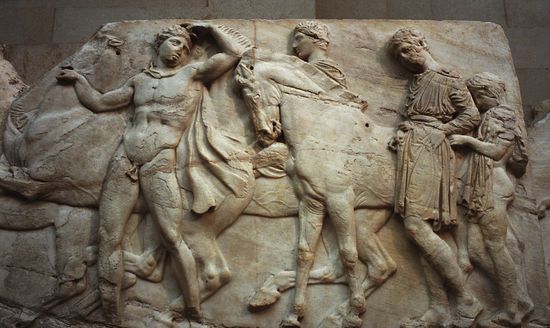
Answer: Britain has the Elgin Marbles.
Well, I exaggerate. But only slightly. Britain's financial position isn't quite as bad as Greece's but it's clattering downhill all the same and looking desperately likely to end in a fearful crash. If the budget deficit peaks at 13% of GDP this year then we'll look back on that as a good result. Which is kind of terrifying in its own right.
The seriousness of the fiscal crisis – brought on by a combination of feckless government spending (mislabelled, as is traditional now, as "investment") and the near-collapse of the banking system – is such that, frankly, the public would rather not contemplate it. But the next government, whether run (sic) by Gordon Brown or David Cameron is going to be in hock to the bond markets and it is they who will call the tunes.
The idea that neither party might win a majority and that instead we'll have a hung parliament (great for pundits; not so hot for the markets) is already spooking the markets. This spring is a good time for Americans to visit the UK: the pound has fallen below $1.50 and will probably fall further.
Worse, from the perspective of Britishers rather than tourists, there is a non-trivial possibility that Britain will lose its Triple A credit rating. We're not there yet and Britain isn't Greece yet but it's a testament to the seriousness of the situation that such comparisons can be made in the first place.
This, then, is the background to the election and yet no-one really wants to confront it. Both parties agree that cuts in public spending will have to come and that taxes will have to rise (VAT will almost certainly be increased to 20% for instance) but no-one, understandably, wants to frighten the voters too much by talking about any of this in any great detail.
But the underlying fiscal reality is that the winner of the election is going to have to tell the public that there isn't any money left. This too is something the public doesn't much care to hear and that only increases the sense that there will be few prizes awarded for winning this election.
by Graeme Wood
The Guardian's rules for writing fiction, a compendium of advice from writers, include platitudes (Andrew Motion: "Think with your senses as well as your brain"), morsels of wit (Elmore Leonard: "If it sounds like writing, I rewrite it"), and sound practical advice (Zadie Smith: "Work on a computer that is disconnected from the internet"). Most of all, the rules sound haughty and dismissive, which is about what you should expect when you ask skilled craftsmen to reduce their craft to a few simple rules.
The great Atlantic correspondent Jeffrey Tayler, a writer of nonfiction, recently meditated on the question of how one becomes a writer. He settled on a much more onerous approach:
The question for me was not, then, how does one read to write, but how does one read to live? I conceived early on the conviction that one should lead one’s life as if one were the protagonist of an epic novel, with the outcome predetermined and chapter after chapter of edifying, traumatic and exhilarating events to be suffered through. Since the end is known in advance, one must try to experience as much as possible in the brief time allotted.
The protagonist of “The Death of Ivan Il’ich” died moaning, in agony, overcome with the realization that he had wasted his days on earth following social conventions. He lacked l’esprit frondeur, and he paid for it. Conventions now are hardly less pervasive than they were in Tolstoy’s day; we’re pressured to start a career, build our résumé, earn a certain amount of money, and so forth. But remember: None of us gets out of here alive. So don’t fear risks. Rebel. Be bold, try hard, and embrace adversity; let both success and failure provide you with unique material for your writing, let them give you a life different enough to be worth writing about.
by Jonathan Bernstein
I posted earlier about the Reagan-era David Broder column that Ezra Klein used this morning to make good points about Barack Obama. Broder said:
One measure of that transition was last week's Gallup Poll showing Reagan trailing two leading Democrats in trial heats for the 1984 election. Former vice president Walter Mondale had a 52-40 percent lead, and Sen. John Glenn of Ohio had a 54-39 advantage.
Such leads for opposition candidates are extremely rare at this stage of the cycle when all presidents, including Reagan, enjoy an aura of authority.
Well, I don't know how rare it is, which brings up a worthwhile historical point. One of the things that people find puzzling about Watergate is: why did Nixon do it? After all, Richard Nixon defeated George McGovern in one of the largest landslides in history; surely there was no reason for him to take the huge risks entailed in criminal activity targeting the woeful Democrats.
As you've no doubt guessed by now, the answer is that Nixon's reelection was hardly a sure bet a little earlier in the cycle. The 1970 midterms went badly for Nixon, leading to plenty of speculation that he was a one-term president. Here's a fun column from May, 1971, referring to an eight-point lead that Ed Muskie held over Nixon at that point. And even as late as mid-January, 1972, Muskie was still tied with Nixon. That's when Muskie looked like the odds-on favorite to win the Democratic nomination. When Muskie faltered (don't forget – it was at least in part because the Nixon campaign undermined him), Nixon and his operatives didn't really believe that they could be so lucky as to face McGovern, at least not until very late in the process. They expected to either face Hubert Humphrey, who of course had lost a very narrow race in 1968, or Ted Kennedy — until late in the game, Nixon didn't understand the brand new, reformed, Democratic presidential nomination process, and believed that McGovern might still be a stalking horse for Kennedy (see Fred Emery's great history, Watergate). McGovern only looked like the clear nominee after winning the California primary on June 6 (and even then, Humphrey fought on to a test vote at the convention, so it wasn't a certainty even after California). The first attempted break-in at the Watergate offices of the DNC had been on May 26.
So: the operations that became Watergate began when Nixon's re-election prospects looked dicey indeed; the early operations may have played a part in getting the Democrats to choose their weakest candidate; and, the full operation was set into place before the political landscape of November 1972 was really clear. There is, too, some bureaucratic inertia. Once the switch was turned on, people were hired, and budgets were approved (although no one ever did take credit for approving the budget), it moved along with a momentum of its own. But I'm not sure it's necessary to explain the quest for information about the Democrats: while it was happening, Nixon was not yet sure he would face and destroy McGovern.
Yes, Nixon probably should have seen that whatever it is he wanted from the Democratic National Committee and from other sources wasn't worth the risk. But that's because it was risky to do illegal things, not because he had the election sewn up early.
by Andrew Sullivan
Jeffrey Goldberg, for one, hails his corporate overlords. But Jeffrey Goldberg doesn't know that much about new media. I know that sounds odd, given that he is a blogger at what was once one of the savvier new media websites, but there you have it. One of the many reasons I don't engage his blog more frequently on matters relating to new media is that he's not very knowledgeable about the dynamics of blogging as a form, or of the radical new democracy of online personal voices which render institutional authority and corporate branding so exhausted and old-school. This might be because these issues don't interest him. But his endorsement of this almighty mess could not be put more eloquently than this:
(Sorry, I can't seem to load his page right now, seriously — I'll put in the link as soon as I can).
Linking on the web. Who needs it?
After an avalanche of reader email, I've asked the suits for an end to the font mess, restoration of the latest posts of the other bloggers on the right (you don't read Goldberg because he's so goddamn sexy, after all), a fix for the 'continue reading' function so that you don't have to find out where you are when you click through, a restitution of the Dish search function, a return of a functional sitemeter – a transparency feature of the Dish since almost its inception – and a redesign of the header so it doesn't seem so fused with the blog.
Some vacation. See you next week unless the redesign strikes again.
 The Dish