Stuck

by Jonathan Bernstein

Barack Obama's approval rating today, according to Gallup, is 50%. 

Obama first hit 50% in Gallup's August 24-26 poll.  He bounced up against 50% several times, finally falling below that mark on November 20.  But instead of continuing to fall, he's just stuck.  Right around 50%.  Since the first time he hit 50% in August, his high is 56%; his low is 47%.  He has, as Pollster's invaluable chart makes clear, dropped a couple of points or so since mid-August, but that's about it, and it looks as if he's been just flat since around Thanksgiving.  Three months flat.

This seems fairly unusual to me: over three months with a total seven point range (47-53), and over six months with a ten point range (47-56). Let's see: OK.  Bill Clinton spent almost all of 1998, over ten months, between 60 and 66 on the Gallup scaleGeorge W. Bush had one long period of stability, ranging from 46 to 55 over about 12 months beginning in January 2004.  And then another from October 2006 through April 2008, he had a low of 29% and a peak of 38%. On the other hand, that was before Gallup started their daily tracking poll; it's fairly likely that with more polling that Bush or Clinton would have had a few outliers and the observed range would have been larger.  Going back in time only makes the frequency problem worse.  Gallup is now reporting more or less thirty polls a month, or the same number in a month now as it reported for all of 2006, and a bit more than all of 1996.  In 1986, Gallup only released thirteen presidential approval polls, all year.  So one can't really compare Obama's narrow range this year to, say, Reagan's plateau from fall 1985 through fall 1986, at least not well. 

Overall, however, and looking at these graphs as well, it does seem to me that this is a fairly unusual period of stability.  I shall conclude by making absolutely no prediction whatsoever about how long it will last, which direction he'll head next, or what will cause the eventual change, except for one thing: if Congress does pass health care reform, it will not cause his approval rating to plummet — and if Congress abandons health care reform, it will not cause his approval ratings to surge. 

Liberals and Atheists Are More Intelligent?

by Patrick Appel

A study (pdf) has found that monogamy (only in men), liberalism and atheism are correlated with IQ. PZ Myers isn't buying it. Joyner exercises appropriate caution:

The causality issue aside, the correlation seems to remain. But let’s not get terribly excited about what all this means. The vast majority of Americans — including high IQ Americans and well educated Americans — are religious. For that matter, the vast majority of Americans — including those of below average intelligence — are in monogamous relationships or strive to be. We’re talking about small differences in aberrant behavior, not a chasm.

It’s also noteworthy that the correlation is between intelligence measured at adolescence and ideology, religiosity, and monogamy as young adults.  It would be interesting to see if the correlation strengthens or fades with time. This particular cohort is being studied on through 2002; I don’t know if they’ll continue to be tracked.

Ilya Somin levels further criticism.

Anti-Gay Rhetoric And Unit Cohesion

by Chris Bodenner

Tony Perkins was disinvited from speaking at a national prayer luncheon on Andrews Air Force Base because the Chaplain's Office felt his outspoken opinions against gay servicemembers would not be "inclusive for the entire base community." Queerty sympathizes with Perkins' right to speak his mind, but:

The military is not civilian life! It is not a place where everyone gets an equal vote! It is not a place where personal freedoms are valued above unit cohesion! That's something defenders of DADT keep repeating in our ears and down our throats as a reason why, when gay soldiers voluntarily enlist, they are signing up to keep quiet about their sexuality.

Allahpundit, on the other hand, calls the disinvitation a "disgrace."

No Time for David Cameron to Go Wobbly

by Alex Massie

Hello everyone and many thanks to Andrew for the invitation to help mind the store while he takes a well-deserved breather. My day blog is at The Spectator but it's nice to moonlight occasionally…

The big news here in Blighty is the Tories vanishing lead in the opinion polls. As recently as December David Cameron enjoyed a 13 point lead; yesterday a poll was published that had the Tories on 37% of the vote and Labour on 35%. Since, thanks to the quirks of the current constituency boundaries, the Tories need to win by six or seven points to secure a majority, this result, if repeated at the election, would actually give Gordon Brown a victory that once seemed impossible.

The good news is that this means the election is going to be more interesting than once seemed likely. A betting man should still favour Mr Cameron, not least because the underlying fundamentals remain in his favour. So what's caused the Tory wobble? A mixture of complacency (a traditional Tory vice) and confusion, principally. What are the Tories really for? I wrote about this for the Daily Beast yesterday and Iain Martin has a measured judgement on the rallying call Cameron delivered to the Tories' Spring Forum yesterday:

David Cameron went to his party’s spring forum in Brighton with a rather serious problem. His poll lead has melted. His party’s campaign since the start of the year has been incoherent and ineffectual. Thus, once again the Tory leader found himself required (by dint of his own recent miscalculations) to make a big speech aimed at starting a fight back.

How did he do? It’s had some rave reviews, but I must admit that as a whole I thought it quite mixed in quality. Yes, parts were pretty punchy and fiery, with flashes of passion that suggest he’ll fight hard in the campaign proper. Overall, though? “Good, but not really great,” was how one friend of Cameron’s put it. That’s probably a fair summary.

Where it did work for him was in the delivery of clear messages in a very straightforward fashion. This is what Labour has understood brilliantly in its campaign so far (”take a second look at Labour, give the Tories a long hard look”). Elements of the Tory high command seemed to think they could get through a campaign without doing their version of the obvious stuff that works and wins in democratic elections. Instead, what they ended up with in the last seven weeks was a confusing cacophony with no easily understood story voters could comprehend.

The shrinking gap with Labour does seem rather to have energized Cameron, to have made him realize anew that he is actually in a fight. As a consequence, the Tory campaign seems a bit more disciplined and clearheaded in the last 48 hours. He’s decided to fight back by presenting the election as a straightforward choice between “five more years of Brown and change with Cameron.”

Quite. The Tories began the year with the slogan "We Can't Go On Like This" and, yup, finally they seem to have realised that this messge is equally applicable to their own faltering campaign. Time for Dave and his boys to get their game faces on. With just nine weeks to go before the likely May 6th election this is no time for mucking about.

Chart Of The Day

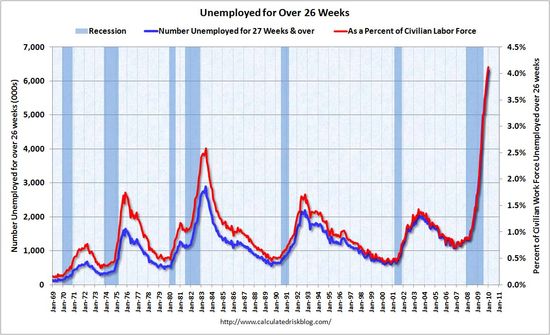
UnemployedOver26Weeks
 
by Patrick Appel

From Calculated Risk:

The blue line is the number of workers unemployed for 27 weeks or more. The red line is the same data as a percent of the civilian workforce. According to the BLS, there are a record 6.31 million workers who have been unemployed for more than 26 weeks (and still want a job). This is a record 4.1% of the civilian workforce. (note: records started in 1948).

Are Summits Here To Stay?

by Jonathan Bernstein

Via a tweet from Ezra Klein, Jon Alter gets enthusiastic about the summit:

The face-off set a teleprompter-free precedent that will be tough for future presidents or members of Congress to break. Now the skills required to chair a bipartisan gathering, master complex policy details, and adeptly summarize relevant arguments will be added to those of anyone seeking the presidency. Being quick and cogent in response will be part of any calculation of who should be House speaker or majority or minority leader. Having experienced one of these summits, the press and public will demand more. So savor the good news for the future: smarter presidents, smarter leaders on both sides of the aisle.

Ezra says that this is extremely optimistic; I think a better way to put it is that it's extremely backwards.  Presidents will create events that play to their strengths.  A Bill Clinton (remember the economic summit he held before taking office) or a Barack Obama will try to hold public events that reward deep knowledge of public policy and the ability to form coherent sentences on the fly.  A George W. Bush or a Ronald Reagan won't.  If a president with mastery of detail is successful in the White House, people will look for similar presidents; if a president with mastery of detail fails (think Jimmy Carter), then people will conclude (erroneously, but nevertheless) that mastery of details is a disadvantage in the presidency.  

(Oh, and as for being quick and cogent in response — yes, the president interacted with the others on the panel, but as far as I could tell everyone else spent much of the time giving canned talking points).

Meanwhile, as far as events like these are concerned, I wouldn't hold my breath.  Barack Obama and his White House will continue to look for events that show off his skills, but it's hard to imagine the particular set of circumstances that made this event a good idea for the White House, difficult to turn down for the Republicans, and relevant enough that the cable news networks carried it live to repeat itself.  Like it or not, it isn't going to become a regular institutionalized part of the legislative process.

The Weekend Wrap

We tracked coverage of the Chile earthquake here and here. Andrew is mostly offline for the week, but before signing off, he replied to Chait's latest response, countered Clive Crook on the clarity of torture, commented on British evangelicals, took stock of HCR in his weekly column, and criticized the Atlantic redesign (more scrutiny from bloggers and readers here, here, and here).

The Dish welcomes two new guest bloggers this week: political scientist Jonathan Bernstein and Atlantic globetrotter Graeme Wood. Jonathan discussed misunderstandings over public trust in government, pondered the implications of a third-party run by Crist, critiqued the NYT's explanation of the House's HCR strategy, evaluated the state of the filibuster, and wondered who in America has moral authority.

Graeme sounded the alarm over a wheat fungus, called out Sting for accepting millions from an Uzbek dictator, updated us on the Dubai assassinations, directed us to a dramatic tale out of Russia, noted the latest nuttiness from Qadhafi, chewed the cud over qat, and highlighted the horribleness of Haiti.

In assorted coverage, Reihan slammed Crist over his fiscal character, Menachem Kaiser went looking for small condoms, Nicholas Sautin theorized over amateur war footage, Ryan Sager studied the effects of vacation, Patrick pointed to a blind painter, and I featured a revolutionary archeological find.

— C.B.

The Earthquake In Chile

by Patrick Appel

The Big Picture focuses its lens. Ben Casnocha, who has been living in Santiago for the last few months, gives his account of the earthquake:

In the late afternoon, I walked around my neighborhood a bit more. The sky was a gray haze from a supposed chemical fire that had started downtown. Nevertheless, I was amazed at the tranquility of Santiago. Public buses full of people passed by. Cars drove calmly. People chatting on the streets. I ate dinner at my favorite local restaurant and it was full of people. Much of the rubble and glass I had seen earlier had already been picked up. The scene was such a contrast from the images on TV. I know what I saw was a million times better than what the scene is like more north in Santiago, or especially in Concepción and along the coast. Still it's a reminder that it's hard to generalize about a situation in an entire country, let alone in one city.

The Iran Debate We Should Be Having

by Patrick Appel

Larison makes several points in response to my criticism of the Leveretts:

Should skeptics of the Green movement be more careful to qualify our claims? Perhaps. It is true that it is difficult to know what is happening inside Iran, but given these limitations shouldn’t it count in favor of the skeptics that we seem to have understood the balance of political forces in Iran much better than Green movement sympathizers and most Iran hawks? If skeptics have seemed a little too sure about things, how ridiculously overconfident have many other observers been? Have the latter been right about much of anything so far? On balance, whose arguments seem to be more in accord with reality? Shouldn’t that be the relevant measure in gauging the merits of what the Leveretts have had to say?

The Iranian state has not fallen, but the Leveretts have not been proven right. Worse yet, by making extreme statements they have damaged their side of the debate. Take this sentence from their June 24, 2009 op-ed:

[T]to this day, there is no hard evidence of electoral fraud — which even some Mousavi campaign aides privately acknowledge.

There sure was a lot of evidence that suggested fraud. There might not be "hard evidence" but there is "hard evidence" of very little in Iran given that the government is running interference. The Leveretts don't explain how Ahmadi won in areas that were political or ethnic strongholds of other politicians. Another line from the same article:

[T]he Iranian government responded to the post-June 12 protests in a manner consistent with its own constitutional procedures — and with far less bloodshed than when the Chinese government suppressed the Tiananmen Square protesters in 1989.

As Andrew wrote at the time: "It's disgusting to diminish the violence on the ground, which we have only seen pieces of, by calling it constitutional and less awful than Tiananmen." The Leveretts write that they "certainly do not take glee in anyone’s death, injury, or incarceration." But re-reading their various op-eds it's difficult to find a single criticism of the Iranian government. The arrests, show trials, executions, torture, and rape of Iranian protesters hardly make an appearance. In this June 15, 2009 op-ed the Leveretts state –with absolute certainty– that Ahamdi won the election. The entire article has a 'move along, nothing to see here' quality.

Maybe the Leveretts are right and Ahmadi won the popular vote (I don't believe that but don't rule it out). Politicians are known to rig the vote, in order to intimidate political opponents, even when they are likely to win outright. Let's pretend that the Leveretts are right and Ahmadi won. That does not make the protests in Iran irrelevant. Hooman Majd said it well awhile back:

What is evident is that if we consider Iran's pro-democracy "green movement" not as a revolution but as a civil rights movement — as the leaders of the movement do — then a "win" must be measured over time. The movement's aim is not for a sudden and complete overthrow of Iran's political system. That may disappoint both extremes of the American and Iranian political spectrums, left and right, and especially U.S. neoconservatives hoping for regime change.

Seen in this light, it's evident that the green movement has already "won" in many respects, if a win means that many Iranians are no longer resigned to the undemocratic aspects of a political system that has in the last three decades regressed, rather than progressed, in affording its citizens the rights promised to them under Iran's own Constitution.

Mousavi's latest interview is in keeping with this understanding of the green movement.

I take no pleasure in character assassination, but the Leveretts have brought much of this upon themselves. Larison thinks that the Leveretts are being attacked "because of the policy course they recommend, which is significant, sustained engagement with Iran." And that what "Leveretts’ critics seem to want to do is identify this engagement approach with sympathy and collusion with the regime." That may be true of some Leverett bashers, but this is too simple. Dan Drezner has been one of the Leveretts' most constant critics. He's not exactly a hawk.

The Leveretts' substantive point, that we should engage with the Iranian government we have, is a serious position that deserves real debate. Arguing, without sufficient evidence, that Amadi won the election outright was not necessary to advance this position but doing so made made their position easier to defend, as did downplaying the protests and ignoring the violence. Pundits who advocate bombing Iran should address all the likely consequences of that action. Pundits who advocate engagement with Iran should recognize the crimes that the Iranian government has committed against its people.

Just because a fact is not convenient to the argument at hand does not mean you can disregard said fact. Ignoring the strongest evidence against a position opens one to charges of intellectual dishonesty and does not move the debate forward. It's intellectually lazy and it damages the discourse.
Towards A Vocation Nation

by Chris Bodenner

John McWhorter sees "great stuff" happening with education reform under Obama:

Take, for example, the National Center on Education and the Economy’s plan to have eight states experiment with allowing public school students to graduate after tenth grade upon finishing clearly stated requirements, and to then go on to community college. The states will have pilot schools using this program just two autumns from now. […T]he NCEE experiment can serve as a needed wake-up call to America about the value of community colleges, and more specifically, vocational training.

One of the most ironically damaging aspects of the GI Bill in the 1940s was the notion, now so deeply entrenched in the American soul as to seem not an opinion at all, that four years of a liberal arts education at a university is a default experience for people after high school, and that to not do this is opt for, or be saddled with, the lowlier fate of “Not Going To College.” In this era when we so often bemoan the plight of uneducated young men, it is high time we returned to championing vocational education as America used to – and once again the Obama Administration is on it, with its plan to put 12 billion dollars into community colleges.

The NYT recently debated the idea of 10th-grade graduation. In related news, Utah is flirting with the idea of making 12th grade optional (though primarily due to budget woes).