Slaughtered For Satire, Ctd

https://twitter.com/thekarami/statuses/552898632320831489

Tony Barber’s reaction to the massacre at Charlie Hebdo has been criticised for seeming to blame the victim:

Charlie Hebdo is a bastion of the French tradition of hard-hitting satire. It has a long record of mocking, baiting and needling Muslims. Two years ago the magazine published a 65-page strip cartoon book portraying the Prophet’s life. And this week it gave special coverage to Soumission (“Submission”), a new novel by Michel Houellebecq, the idiosyncratic author, which depicts France in the grip of an Islamic regime led by a Muslim president. This is not in the slightest to condone the murderers, who must be caught and punished, or to suggest that freedom of expression should not extend to satirical portrayals of religion. It is merely to say that some common sense would be useful at publications such as Charlie Hebdo, and Denmark’s Jyllands-Posten, which purport to strike a blow for freedom when they provoke Muslims.

This is a toned-down version of Barber’s original post, which called Charlie “not the most convincing champion of the principle of freedom of speech” and accused it of “editorial foolishness”. Chait follows that line of argument to its logical conclusion, which he finds dangerous:

On the one hand, religious extremists should not threaten people who offend their beliefs. On the other hand, nobody should offend their beliefs. The right to blasphemy should exist but only in theory.

They do not believe religious extremists should be able to impose censorship by issuing threats, but given the existence of those threats, the rest of us should have the good sense not to risk triggering them.

The line separating these two positions is perilously thin. The Muslim radical argues that the ban on blasphemy is morally right and should be followed; the Western liberal insists it is morally wrong but should be followed. Theoretical distinctions aside, both positions yield an identical outcome. The right to blaspheme religion is one of the most elemental exercises of political liberalism. One cannot defend the right without defending the practice.

Jesse Walker puts it more bluntly:

If there is an unconvincing champion here, it is not Charlie Hebdo. It’s Mr. Barber, a man who seems to think “the principle of freedom of speech” is best represented by speakers with views so inoffensive that no one would want to censor them in the first place.

Ezra cautions against framing this atrocity in terms of the magazine’s editorial choices or how offensive they are to Muslims:

What happened today, according to current reports, is that two men went on a killing spree. Their killing spree, like most killing sprees, will have some thin rationale. Even the worst villains believe themselves to be heroes. But in truth, it was unprovoked slaughter. The fault lies with no one but them and their accomplices. Their crime isn’t explained by cartoons or religion. Plenty of people read Charlie Hebdo’s cartoons and managed to avoid responding with mass murder. Plenty of people follow all sorts of religions and somehow get through the day without racking up a body count. The answers to what happened today won’t be found in Charlie Hebdo’s pages. They can only be found in the murderers’ sick minds.

Juan Cole posits that an anti-Islam backlash is exactly what the terrorists who carried out the attack are hoping to produce:

Al-Qaeda wants to mentally colonize French Muslims, but faces a wall of disinterest. But if it can get non-Muslim French to be beastly to ethnic Muslims on the grounds that they are Muslims, it can start creating a common political identity around grievance against discrimination. …

The operatives who carried out this attack exhibit signs of professional training. They spoke unaccented French, and so certainly know that they are playing into the hands of Marine LePen and the Islamophobic French Right wing. They may have been French, but they appear to have been battle hardened. This horrific murder was not a pious protest against the defamation of a religious icon. It was an attempt to provoke European society into pogroms against French Muslims, at which point al-Qaeda recruitment would suddenly exhibit some successes instead of faltering in the face of lively Beur youth culture (French Arabs playfully call themselves by this anagram). Ironically, there are reports that one of the two policemen they killed was a Muslim.

Poniewozik fears that this incident, like the threats surrounding the release of The Interview, will only further encourage self-censorship:

Terrorism, by definition, is never just aimed at its direct victims. The slaughter in Paris was aimed at every news organization that now has to decide whether to show the cartoons. It’s aimed at anyone who reports the next story like this. The Sony hack was aimed at anyone considering another movie that might offend radicals. (Already, one thriller about North Korea has been cancelled in advance.) It’s all aimed at any media corporation that looks at the headlines of shootings and hacking, thinks of the danger, however remote—not to mention the potential legal liability—and decides, you know what, not worth the trouble.

And it works. That’s not the inspiring, uplifting thing I want to say right now. But unless all of us reject the kowtowing and the playing-it-safe, it absolutely has worked and will work again.

Alyssa also sees parallels with The Interview, and meditates on what these incidents tell us about the price of free expression – and why it’s worth paying:

These are difficult equations of governance and freedom; how to express respect for the beliefs of others without sanctioning attacks on those who offend those beliefs; how to exhort private individuals and companies to courage while also protecting anyone who might suffer as a result of their actions. And as we experiment with our calculations, we reach different and unpredictable results. In the United States, “The Interview” has inadvertently become an advertisement for a new model of movie development, netting $31 million in online sales and rental fees. It’s as much a lesson about commerce as about courage. But in France, at least twelve people are dead.

In the attacks on Charlie Hebdo and the hack of Sony Pictures, we see the costs of making provocative art and protecting the people who make and distribute it. But we shouldn’t let these consequences blind us to the very high price we would pay for backing away from such a defense: a grayer, duller, smaller society, in which much milder challenges to orthodoxy and taste are met with ugliness and violence.

Last but not least, Slate reprints Hitchens’ reaction to the Prophet Muhammad cartoon controversy from 2006:

Islam makes very large claims for itself. In its art, there is a prejudice against representing the human form at all. The prohibition on picturing the prophet—who was only another male mammal—is apparently absolute. So is the prohibition on pork or alcohol or, in some Muslim societies, music or dancing. Very well then, let a good Muslim abstain rigorously from all these. But if he claims the right to make me abstain as well, he offers the clearest possible warning and proof of an aggressive intent. This current uneasy coexistence is only an interlude, he seems to say. For the moment, all I can do is claim to possess absolute truth and demand absolute immunity from criticism. But in the future, you will do what I say and you will do it on pain of death.

I refuse to be spoken to in that tone of voice, which as it happens I chance to find “offensive.”

Republicans Make 1+1=3

Yesterday, the GOP House changed how the fiscal costs of legislation are calculated:

The House on Tuesday adopted a controversial rule to require macroeconomic scoring on major legislation in the new Congress, which opponents say will politicize impartial budget analyses. … So-called “dynamic scoring” typically offers a more favorable view of cutting taxes, which is part of why Republicans support the method.

Chait claims the new GOP Congress is going after math itself:

The new, “dynamic” CBO will be systematically biased to make conservative proposals appear misleadingly cheap and liberal proposals misleadingly costly to the public fisc. This would be true even if the Republicans were soliciting a fair range of forecasting perspectives. By its design, the dynamic scoring rule allows the party in power to game its effects. It applies “dynamic scoring” only to legislation affecting 0.25 percent of Gross Domestic Product. As Chye-Ching Huang and Paul Van de Water point out, congressional leaders can manipulate this requirement easily: They can break up large pieces of legislation into smaller bills to avoid dynamic scoring, or combine smaller pieces into a major bill, if needed to make their agenda appear more affordable. Dynamic scoring is subject to abuse by its very design.

It is possible the Republicanized CBO continues to function in some distorted form, advancing Republican legislative goals by passing off slanted analysis as impartial. Or it is possible it simply loses all of its previous credibility and mutates into another partisan mouthpiece. Either way, the Republican right has struck a powerful blow against the sort of academic expert they have always loathed.

Shaun Donovan, the OMB Director, is upset by the rule change:

While all budget estimates are uncertain, there is substantially more disagreement among economists and experts about how policy changes affect the macroeconomy than about most other scoring issues. This helps explain why estimates from different CBO models of the long-run growth effects of a 10 percent tax cut differed by a factor of 15 – and ranged from positive to negative – when dynamic scoring was used.

But Keith Hennessey defends dynamic scoring:

We know that some policy changes can increase (or reduce) the size of the economy, and that to assume otherwise is wrong. The longstanding scoring process is biased against policies that would increase economic growth, and biased for policies that would shrink the economy. The size of the effect of large and broad-based reductions in tax rates is uncertain, but we’re pretty darn sure it’s not zero. Certain immigration reforms would increase domestic labor supply and increase economic growth. More accurate scoring would incorporate both types of effects.

Mark Thoma is unsure that the rule change will make a big difference:

How much of an impact would this change have? If the best evidence on this question is taken into account, not as much as Republicans hope. When previous tax cuts are examined econometrically, the impact on economic growth is hard to find. There does appear to be an effect according to some of the research (but not all), but the effect is relatively small — certainly not big enough to make a significant change in the budgetary impact.

So why are Democrats alarmed?

Some Democrats worry that CBO director Elmendorf will be replaced by someone willing to cherry pick the evidence on tax cuts to benefit Republican proposals and minimize benefits of the change to Democratic legislation. That would politicize an institution that has done its best to evaluate the budgetary impact of legislative proposals based upon solid evidence rather than politics and ideology and do great harm to an important part of the legislative process.

Mauled By Climate Change

ARGENTINA-CANADA-ANIMALS-POLAR BEAR-ZOO

Polar bear attacks are on the rise:

[Biologist James Wilder’s] data is still incomplete. But two things are already clear: the number of people killed by polar bears is relatively small—so far, Wilder has found just twenty-one deaths in the last 140 years—but the number of interactions between humans and polar bears is rising. According to Wilder’s tabulations, there were fewer than ten attacks per decade in the 1960s and ’70s. But in the first four years of this decade, Wilder has already documented fourteen interactions. At this pace, he expects to see about thirty-five incidents by the end of 2019—nearly as many as the last forty years combined.

Why this is happening:

Ocean temperatures are climbing faster in the Arctic than anywhere else in the world, leading to a substantial decrease in sea ice. In September 2012, the Arctic sea ice level was 49 percent lower than the historical average from 1979 to 2000. The southern parts of the Arctic, including the Torngats, have had an ice-free summer season throughout modern times. But the ice-free period is growing longer. Since the late 1970s, the number of ice-free days in the area around the Torngats has increased from 125 days to 175 days. Less sea ice means polar bears must spend more time on land. To survive, they live off the body fat stored from their earlier kills on the ice. As the period when they have to live off that reserve grows longer, some eat goose eggs, grasses, or berries. But their foraging goes only so far—they can’t survive without the fat they get from seals. “As the bears’ body condition declines, more seek alternate food sources so the frequency of conflicts between bears and humans increases,” the scientists [Ian Stirling and Andrew Derocher] concluded.

(Photo by Andres Larrovere/AFP/Getty Images)

Busted With An Eggcorn, Ctd

The Dish thread that won’t quit:

My twenty-four-year-old daughter has Down syndrome. While she has plenty to say and can be understood by most people, her speech sometimes takes some interesting twists and turns. She does her own laundry, often when I’m not at home. Occasionally a sock or something else falls into the laundry tub, blocking the drain. As the washer empties into the tub, it fills up and the water ends up on the basement floor. The wash machine shuts down and won’t finish the cycle. I get home and she explains the problem. The wash machine, she says, is overfloating.

Another reader:

I came across my favorite eggcorn because I‘m a huge ice hockey fan.

In online chats I’ve seen many English-speaking fans lament the poor quality of their team’s defense “core.”  While every team in every sport probably has a defensive core in some sense, these folks have misheard broadcasters and analysts referring to a team’s defense corps, i.e., the group of the team’s defensemen as a whole. Kind of ironic for a sport that has so many French-speaking followers in North America.

Another:

I just read a blog post where someone was fighting “tough and nail” for a position.  Not one I’d heard before.

Another:

My 5-year-old just used an eggcorn and I felt compelled to email you. I gave him one of my parental “looks” in response to some mild misbehavior, and he asked me why “I was raising my eyebrowns”.

And another:

When Cardinal Ratzinger became Pope Benedict, I’d recently started working at an international organisation. At the canteen table over lunch some colleagues were discussing the new pope’s personal history and views on social issues.  We were joined by a colleague from Poland who I didn’t yet know very well. “Have you heard what the Italian media have nicknamed the new Pope?” she asked, in heavily accented English. We shook our heads. I heard: “Papa Nazi.”

“Ah,” I said. “We were just talking about how he was in the Hitler Youth. He does still seem to have pretty right-wing opinions, doesn’t he?”

My other colleagues looked down, embarrassed, while my Polish colleague launched into an impassioned defence of Benedict’s theology and how he’d been forced into the Hitler Youth against his will. I was confused: if she felt that way, why pass on a joke about it?

It was only an hour later, back at my desk, that the penny dropped. Polish – probably Catholic. Italian media – probably not making Nazi jokes. I went to Google, and discovered that they had in fact nicknamed him Papa Ratzi.

I penned an embarrassed email to my Polish colleague, who responded gracefully. But I’ve never been able to shake thinking of Benedict as Papa Nazi.

Another:

My friend used to think “miniature golf” was “minutes of golf.” I think a lot of eggcorns are the result of the Boston accent (“min-ah-tcha gawlf”).

Another:

Not sure if anyone has mentioned this one yet. My dad’s a doctor who specializes in cardiology and internal medicine.  As a kid, anytime he mentioned having to swing by the ICU (intensive care unit), I thought he was referring to the “I See You.”

One more:

I worked in land surveying for several years with a very bright crew chief. Unfortunately, he got it in his head that a “guy wire” (those wires that run from the top of a utility pole to the ground) was a “guide wire.”  I never corrected him, and even though I always said it correctly, he either didn’t notice, or thought I was an idiot. We’re still friends and I still don’t have the heart to tell him. (If you publish this, though, I WILL post it to Facebook).

The NYPD Turns Its Back On Civilian Control, Ctd

nypd3

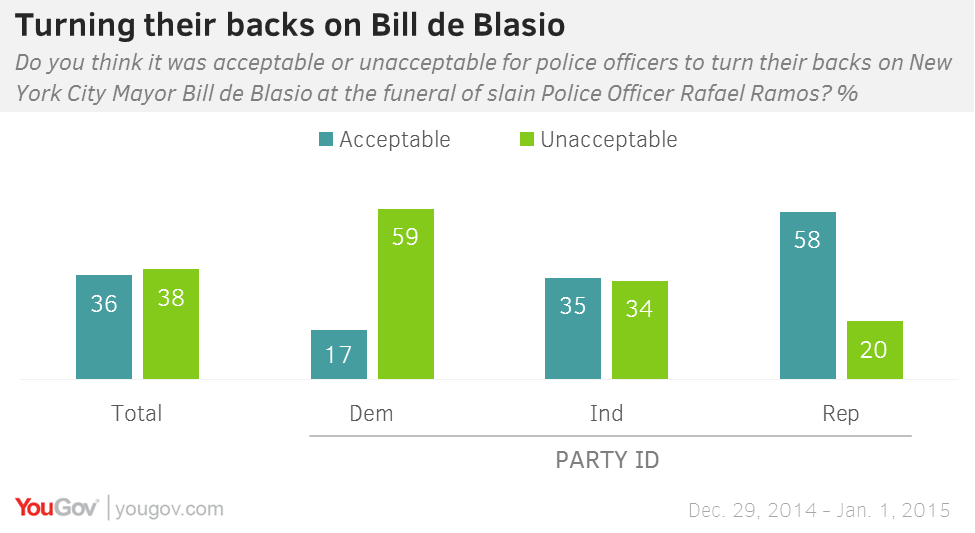
George Packer fears that the rift between the NYPD and de Blasio is irreparable:

The Mayor is doing what he can to overcome ill will among police. It’s probably too late—in just a year he’s lost his department. This is a disaster for a city that elected de Blasio with seventy-three per cent of the vote, and that also—judging by the wide and deep sympathy expressed after the execution of two officers in Brooklyn—generally supports its police force. Patrick Lynch, the demagogue who leads the Patrolmen’s Benevolent Association, is playing a very dangerous game by inflaming his rank and file, politicizing funerals, countenancing an unprofessional work stoppage (imagine aggrieved nurses refusing to treat patients), and laying the two officers’ murders at de Blasio’s feet. If New Yorkers are forced to choose between the Mayor and the police, the result—already showing up in polls and public discourse—will be a racially polarized city. If the police who turned their backs on the Mayor imagine that this confrontation will bring the city around to their side, they’re deluded.

Linker is pissed that the NYPD is disregarding its civilian leadership and getting away with it:

It is absolutely essential, in New York City but also in communities around the country, that citizens and public officials make it at all times unambiguously clear that the police work for us. … When police officers engage in acts of insubordination against civilian leadership, they should expect to be punished. Just like insubordinate soldiers. The principle of civilian control of the military and police depends on it.

It also depends on cops who kill unarmed citizens being tried in a court of law. And on cops respecting the right of citizens to protest anything they wish, including the failure of the judicial system to hold police officers accountable for their use of deadly force in ambiguous situations. All of this should be a no-brainer. That it apparently isn’t for many police officers and their apologists in the media is a troubling sign of decay in our civic institutions.

Noah Millman mulls over what NYPD Commissioner Bill Bratton needs to do to heal the damage going forward:

Bratton does not need to turn against his own legacy – nor does he need to defend it aggressively. The consensus against allowing crime rates to go back up is overwhelming. What Bratton needs to demonstrate is that he has control over his department, and that he is committed both to keeping crime low and to reducing the perception that the police are an oppressive presence.

Which, however, genuinely represents a change of mission. It’s implicitly admitting that driving crime rates ever-lower is no longer the overwhelming priority – that the “change” goal is to lighten the police footprint. A change of that sort could very well be demoralizing – even threatening – to the NYPD. But Bratton surely remembers that CompStat itself was threatening when it was introduced – it meant telling beat officers that the computer knew better than they did how they should do their job.

Friedersdorf is exasperated at how many conservatives are quick to dismiss the outrage over police brutality as rabble-rousing racial politics when the evidence points to something much more concrete:

[T]he 90 percent of black voters who say that police brutality is a “very serious” or “somewhat serious” problem, the 59 percent of black New Yorkers who disapprove of the way the NYPD is doing its job, and the 81 percent of black New Yorkers who believe the NYPD is tougher on blacks than whites cannot be explained away by gesturing at a criminal mindset. Millions of law abiding people share these critiques. …

And despite the evidence of racial bias in New York City policing, the majority of people who disapprove of how the NYPD is doing its job don’t actually “hate” or “despise” the NYPD. They just desperately want it to be reformed so that bad policing is documented and punished rather than being ignored or covered up. Conservatives could argue that race isn’t actually the core of the problem, that the culture of unpunished misbehavior in the NYPD is driven by, say, the tribal mindset documented by Frank Serpico much more than any deliberate desire to disadvantage blacks. But too many NYPD defenders refuse to acknowledge widespread misbehavior of any kind.

The one bit of good news is that police violence in New York is far less prevalent than it was a few decades ago:

In 1971, NYPD officers shot and killed 93 people, which works out to 12 fatal shootings for every million residents. In 2013, by comparison, 8 people were fatally shot by the police, or one fatal shooting for every million residents—a decline of more than 90 percent. Also in 1971, 12 New York City cops were shot and killed—the same number as in all of the last fifteen years put together. Also, police-related violence in New York isn’t low just in relation to the city’s historical rates; it’s low compared to the rest of the country.

(Chart via YouGov)

Is Christie Too Liberal To Win?

The New Jersey governor may jump into the 2016 race sooner rather than later:

Bush’s aggressive entrance in the race has sped up the timing of [Christie], who is preparing to make a public move toward running at the end of this month rather than waiting until February or March, according to a person familiar with discussions.

But Nate Silver doubts that Christie has a shot at the nomination, largely because “Christie takes moderate positions on the very issues where Bush notoriously deviates from the party base – such as immigration and education – along with others where Bush lands in the GOP mainstream, like on gun control”:

In late 2012, his favorability rating was 45 percent nationally against just a 20 percent unfavorable rating, according to Huffington Post Pollster. But Christie’s popularity has waned considerably in the wake of“Bridgegate” and other controversies. Now his ratings have turned negative; he has a 33 percent favorable rating and a 43 percent unfavorable rating, according to HuffPost Pollster. His head-to-head numbers against Hillary Clinton are no longer any better than those of fellow Republicans Bush and Mike Huckabee.

This isn’t catastrophic unto itself. There are lots of unpopular politicians in both parties. The head-to-head numbers don’t mean much yet, and many Republican voters would come around to Christie were he to win the nomination. But Christie’s case to Republicans is especially dependent on his perceived ability to win the general election. That’s the reward the GOP would get for putting up with the baggage Christie carries. Without it, it’s hard to see the Republicans’ rationale for choosing him.

The Whole Damn Country Is Sick

Flu

Basically:

The annual influenza outbreak has reached widespread levels in 43 states – up from 36 states a week ago.

Flu season arrived early this year – reaching epidemic levels last week:

That the flu has reached epidemic status is not unexpected — this is a regular part of flu season — but it has reached epidemic levels somewhat earlier than it usually does. The last two flu seasons were declared to be epidemics in mid-January.

And this year’s flu vaccine isn’t well suited to the bug going around:

This season is looking particularly bad because the predominant strain, H3N2, is not completely covered by the current flu vaccine and tends to have more severe symptoms. H3N2 accounted for the majority of the strains tested by the CDC so far this season, according to a health advisory issued in early December.

Sarah Zhang explains why flu vaccines don’t always work:

A network of labs working around the world is always on the lookout for new and emerging viruses year-round. These viruses are then tested against human blood serum; the ones that provoke the least immune response are the ones that are most novel and dangerous to the population.

But flu viruses naturally mutate, which is, after all, why we have to formulate a new flu vaccine each year. This year, the H3N2 virus mutated faster than usual, so the vaccine we now have is less effective against the H3N2 virus that is circulating most widely. The new H3N2 was first detected in March of 2014, and it became common by September. And now it’s too late to add it to this year’s flu vaccines altogether, thanks to the decades-old process we use to create vaccines in the first place.

Kent Sepkowitz defends the flu vaccine, even if it’s somewhat less effective than normal:

25,000 to 40,000 people a year die of influenza—the vast majority of them unvaccinated. A simple halving of the number with today’s mediocre vaccine would represent a major public-health triumph. By way of comparison, about 14,000 people in the U.S. died of AIDS in 2011—a vaccine to cut that number in half likely would result in a Nobel Prize.

That’s why the CDC still wants you to get the shot:

[T]he vaccine is still effective in about one-third of cases. “While some of the viruses spreading this season are different from what is in the vaccine, vaccination can still provide protection and might reduce severe outcomes such as hospitalization and death,” said [Darlene Foote, a representative of the CDC].

(Chart from the CDC)

France’s South Park

A reader writes:

enhanced-27032-1420647847-2Here’s something I’d like to contribute re: the massacre. First, I went to high school with the daughter of one of the victims, a long time ago but still. I met him and knew him – a very nice and funny guy. So it’s shocking on a personal level.

Second, these things do not usually happen in France. Especially the part where a commando uses automatic weapons (AK-47). It’s very hard to procure AK-47s in France. It’s not on sale at Walmart, like here. So this means these are organized criminals (obviously).

Charlie Hebdo is an institution. Its humor was always very corrosive and harsh. The writers and illustrators have been active in one form or another since the late ’60s, making fun of everybody and angering everybody since then.

Its first incarnation, aptly called “Hara-Kiri” was the most scandalous weekly magazine you could find.

The week after the General de Gaulle died, they came out with the title: “Tragic ball at Colombey: one dead.” (Colombey-Les-Deux-Eglises was the village where the General’s private residence was located). After the scandal, they were forbidden to print and had to start another weekly under a new name.

enhanced-22753-1420647659-17Charlie was always committed to intellectual anarchism, virulently anti-clerical and anti-religion and resolutely left wing. But always in a hilarious manner. There is no 40-year-old French person of all political persuasion who has not read and laughed along with Charlie’s weekly delivery of caricatures.

More recently, Charlie been printing lots of cartoons making fun of Islamists and their Prophet. They were already the target of a bombing a couple of years ago. So everybody is thinking what I am thinking. If it turns out to be the doing of an Islamist cell, this is almost like France’s 9/11. On a much smaller scale, but France is a much smaller country. To assassinate the comedians and the satirists is as big, if not bigger thing. It is a direct impact on France’s most cherished cultural trait: the active, public, vocal disrespect and skepticism towards any form of authority, political or religious.

I am crestfallen and scared. This is a very dark moment.

Amy Davidson adds:

Recently, the magazine had mocked the Islamic State in Iraq and al-Sham, or ISIS. Its last tweet before the attack was of a cartoon making fun of the group’s leader, Abu Bakr al-Baghdadi. That is not recklessness; it’s how one knows that ISIS has not won, and never will. There Charlie-Hebdo-Secondary2-320ought to be more such tweets. (Whether ISIS in particular had a role in this attack is a question that can’t be answered at this stage; its members are, sadly, not the only ones in the terrorism business.)

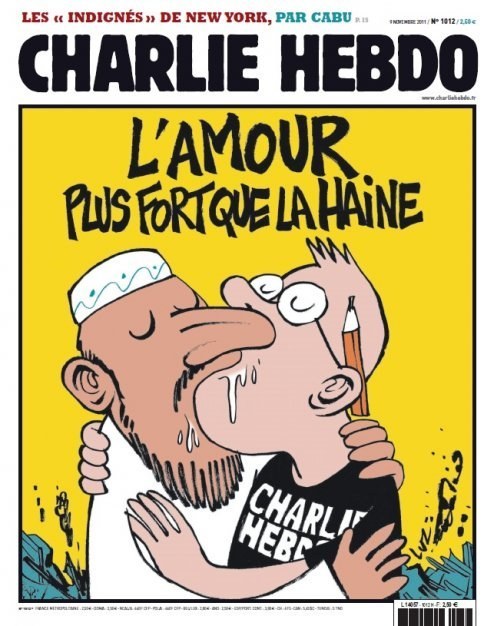
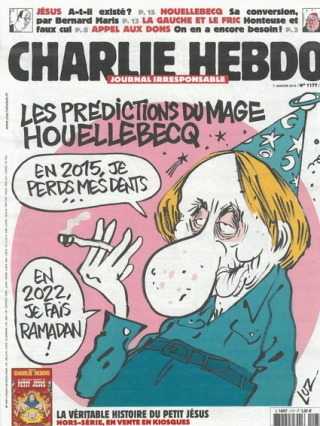
The current issue of Charlie Hebdo, published the day of the shooting, featured a caricature of the novelist Michel Houellebecq on the cover. Houellebecq’s new novel, “Submission,” also out Wednesday, according to the Times, “predicts a future France run by Muslims, in which women forsake Western dress and polygamy is introduced.” The drawing of Houellebecq, accompanied by a joke about Ramadan, is not flattering. The French police have added the protection of Houellebecq to their list of priorities on what is, by all accounts, a traumatic and disorienting day for the entire country.

Update from a reader:

I have to ask, does your reader who states:

Especially the part where a commando uses automatic weapons (AK-47). It’s very hard to procure AK-47s in France. It’s not on sale at Walmart, like here.

… understand that automatic weapons are not on sale at Wal-Mart? Granted, something of the point may stand – it’s not as if illegal firearms play no role in crime in the US – but it makes me question someone’s ability to expound on a topic of they’re willing to throw out factual inaccurate remarks in the process.

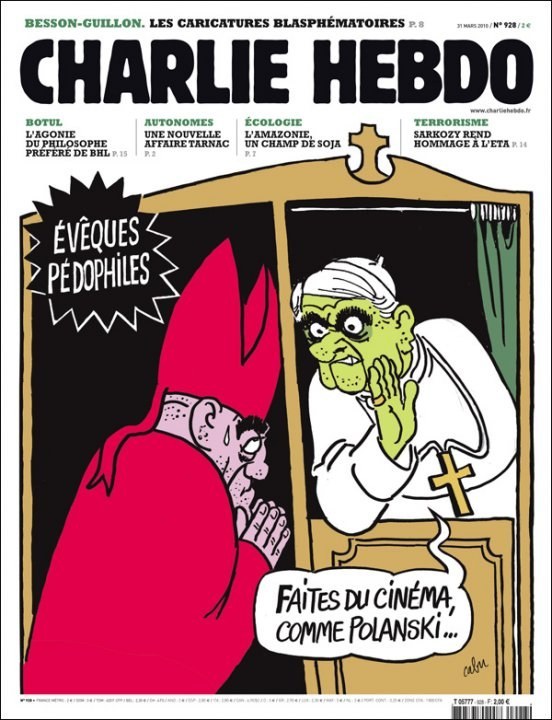
(Top cover translates to “Love: Stronger than hate.” Middle cover depicts Catholic bishops discussing how to get away with pedophilia. Bottom cover is the aforementioned one featuring a caricature of the Houellebecq.)

Slaughtered For Satire

The Paris offices of the French satirical magazine Charlie Hebdo, which has in the past been condemned and firebombed for its satirical depictions of the prophet Muhammad, were ambushed this morning by two gunmen, who killed 12 people before fleeing the scene. A massive manhunt is now underway throughout the French capital:

Visiting the scene of the country’s worst atrocity in decades, the French president, François Hollande, described it as “a terrorist attack, without a doubt”. Hollande said the assault, which happened at about 11.30am on Wednesday after the magazine’s staff had gathered for their weekly editorial meeting, was “an act of exceptional barbarism”. Warning that several other attacks had been foiled in recent weeks, the president called for national unity and convened an emergency cabinet meeting. The French government raised the terror alert level in the greater Paris region to the highest level possible. …

A spokeswoman for the Paris prosecutor’s office, Agnes Thibault-Lecuivre, confirmed that 12 people had been killed in the attack. Police said three attackers were involved, two who entered the building and a third who drove a car to the scene, in rue Nicolas Appert in the 11th arrondissement in eastern Paris. The gunmen escaped in the car before abandoning it in the 19th arrondissement, where they hijacked another car, ordering the motorist out.

The Guardian is live-blogging. As of this writing, the gunmen have not been identified or apprehended, and no group has claimed responsibility for the attack, though ISIS had previously threatened to target France. Katie Zavadski speaks with a terrorism expert on what made this attack unusual:

That the attackers sped away instead of fighting to the death, however, means that Wednesday’s attack is different in style from the suicide attacks often deployed by terror organizations. Mia Bloom, a professor of security studies at the University of Massachusetts, Lowell, tells Daily Intelligencer that the highly-trained gunmen may have been too valuable to waste on such a mission — especially given that a suicide attack would have only required one bomber. “This is a far more dangerous kind of attacker because the terrorist group invests heavily in their training and preparation, and will be able to have a second or even a third strike if they want to really spread terror and panic beyond the magazine and the 11th arrondissement,” she said, referring to the area of Paris where the attack occurred.

Max Fisher stands up for Charlie Hebdo’s dedication to pushing Islamists’ buttons:

The magazine was not just criticized by Islamist extremists. At different points, even France’s devoutly secular politicians have questioned whether the magazine went too far; French Foreign Minister Laurent Fabius once asked of its cartoons, “Is it really sensible or intelligent to pour oil on the fire?”

It is, actually. Part of Charlie Hebdo’s point was that respecting the taboos strengthens their censorial power. Worse, allowing extremists to set the limits of conversation validates and entrenches the extremists’ premises: that free speech and religion are inherently at odds (they are not), and that there is some civilizational conflict between Islam and the West (there isn’t). These are also arguments, by the way, made by Islamophobes and racists, particularly in France, where hatred of Muslim immigrants from north and west Africa is a serious problem.

Michael Rubin comes to a similar conclusion:

Satire and ridicule are like carnival caricatures. They may exaggerate, but they strike a chord because their basis in fact resonates with a wide audience. Such is the case also with satire. Islamists cannot handle free thinking at the best of times, but ridicule is their kryptonite, for it shows that the would-be caliphs have no clothes.

Free speech can be a powerful tool, and so Western liberals should rally around Charlie Hebdo. To suggest that the satirical outlet brought violence upon itself is to suggest women wearing bikinis invite rape. Do not blame the victims, but rather the perpetrators. Recognize that free speech is under assault, and that it is a value worth protecting. Let us hope that no government or publisher responds to today’s violence with self-censorship, as some commentators and journalists have counseled under similar circumstances. If they do, the Islamists have won and all man’s progress since the Enlightenment is at peril.

But Massie despairs of the aftermath of this attack:

Doubtless some will still, even now, find a way to blame the victims. Doubtless some will do anything they can to avoid looking reality squarely in the face. Doubtless some will pretend that reality can be wished away or that responsibility can be transferred to someone, anyone, other than the perpetrators. Shame on those people. Shame. 

Doubtless, too, there will be the usual calls on all Muslims everywhere to condemn these attacks as though they bear some inchoate communal responsibility for the barbarous actions of their co-religionists. This too will be drearily predictable and familiar and, most of all, desperately unfair. Their Islam has nothing to do with this even if it is also true that other subscribers to the faith do not share their views. The platitudinous suggestion Islam is a religion of peace is evidently, abundantly, true for the vast majority of Muslims while being utterly untrue for some. And so what? Where does that leave us? Only in a state of dread that’s matched only by its inadequacy.

The Wrong Way To Chip Away At Obamacare

Suzy Khimm examines the GOP’s plans:

One of the first items on their agenda in January is President Obama’s signature health care legislation. But Republican’s won’t be pushing for a full repeal of Obamacare. They’re not even pushing for partial repeal. Instead, they’re angling for a seemingly incremental change: to be counted as full-time, workers should need to rack up 40 hours a week, not 30 hours. …

But the GOP’s proposed change is hardly a minor tweak to Obamacare—and not all conservatives agree it’s the best way forward. It would effectively gut the employer mandate, reducing employer-sponsored coverage by 1 million people and costing $74 billion in lost penalties, according to the Congressional Budget Office and Joint Committee on Taxation. But it would also make it even more likely that the Affordable Care Act will have negative consequences for ordinary Americans, according to Larry Levitt of the Kaiser Family Foundation.

Paul Van de Water likewise warns that “raising the threshold from 30 hours a week to 40 hours would make a shift toward part-time employment much more likely — not less so”:

That’s because only a small share of workers today — 7 percent — work 30 to 34 hours a week and thus are most at risk of having their hours cut below health reform’s threshold.  In comparison, 44 percent of employees work 40 hours a week, and another several percent work 41 to 44 hours a week.  Thus, raising the threshold to 40 hours would place many more workers at risk of having their hours reduced.

In short, it’s the House Republican bill, not health reform, that threatens the traditional 40-hour work week the bill’s sponsors say they want to protect.

Jason Millman argues along the same lines:

[S]etting the ACA workweek at 40 hours puts far more employees at risk of having their hours reduced, according to a Commonwealth Fund analysis. Compared to the 30-hour definition, “there are more than twice as many workers at high risk of hours reductions because they are within five hours of the full-time definition at firms that do not offer health insurance coverage,” the analysis found. Commonwealth also concludes raising the full-time threshold will increase reliance on public coverage through the ACA.

The National Review’s Yuval Levin also took note of the Commonwealth findings, writing in November that adjusting the 40-hour workweek “seems likely to be worse than doing nothing.” Instead, the conservative pundit wrote, the GOP should focus on repealing the employer mandate entirely.