Putting Up A Fight

Drum thinks that repealing DADT will be difficult:

[E]ven after 15 years to get used to the idea, even with public opinion strongly in favor, even with the military itself slowly getting accustomed to the inevitable, this is going to be a pitched battle. And as with healthcare reform, although Obama's support will be important, it won't be decisive. What's really going to matter is whether 218 representatives and 51 senators are willing to support it. (That's assuming it gets tacked onto the defense appropriation bill, which is passed under reconciliation rules.)

So we will fight. A good place to review the evidence for whether the current cruel, discriminatory and unproductive policy is working can be found here in Nathaniel Frank's latest missive:

Senator McCain and Representative Boehner think discrimination is working well in the military. And if discrimination is their goal, they have a point. But this hardly means “don’t ask, don’t tell” is a success. My twelve years of research on this policy show it’s a colossal failure that’s had the opposite of its intended effect.

“Don’t ask, don’t tell” was supposed to make sexual orientation a non-issue so gays could serve discreetly while protecting privacy and cohesion, and sparing our military the unaffordable loss of essential talent. Instead, it has:

• wasted thousands of essential personnel, including Arabic speakers, and filled those slots with ex-convicts and drug abusers • struck at the heart of unit cohesion by breaking apart cohesive fighting teams, and undermining trust, integrity, and honesty among soldiers

• hamstrung tens of thousands of gay, lesbian, and bisexual soldiers from doing their jobs by limiting their access to support services that are essential to morale and readiness • invaded the privacy of all service members by casting a cloud of suspicion and uncertainty over the intimate lives of everyone in the armed forces

• cost the American taxpayer hundreds of millions of dollars In this climate, it’s no wonder that rumor and innuendo have led to witch hunts that have meant yanking gay soldiers from their units, even when they have followed the law and policy. The military itself knows the policy doesn’t work, as evidenced by the declining discharge figures now that America is at war—clearly commanders on the ground are ignoring a policy which is not serving them well.

The idea that “don’t ask, don’t tell” is a success reflects a profound detachment from the reality on the ground. By every possible measure, it’s been a costly failure.

It appears that Gates and Mullen understand this. But one worries that the irrational and fundamentalist forces in the GOP will try to swamp reason with fear once again.
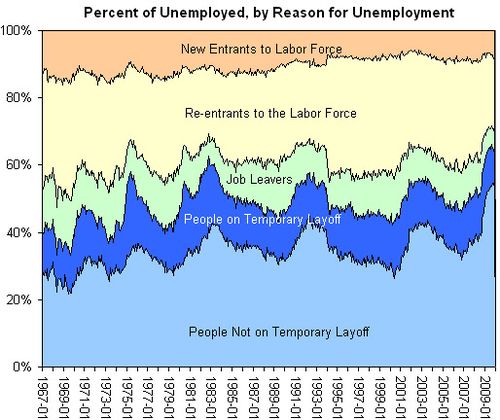

Some Jobs Aren’t Coming Back

NotTemporary

Catherine Rampell worries:

Whatever the underlying cause, the result is concerning: Compared to previous recessions, many more of the employment gains in this recovery will have to come from new jobs. That is much easier said than done. Workers whose entire occupations — not just the previous payroll positions they held — are disappearing (think: auto workers) will need to start over and find a new career path. But the new skills they will need take a long time to acquire.

Ending The Deficit

Yglesias makes an obvious point:

You need a combination of tax increases and overall spending cuts, with defense and Medicare on the table. This doesn’t happen because it’s politically impossible. But it’s politically impossible because it’s not really necessary. You can see the lines on the charts easily enough, but it’s just not the case right now that there’s a crisis in the market for US treasury bonds that’s forcing action. And the action that would be needed is the kind of unpopular action that nobody would undertake unless forced.

If your idea of what is politically possible is restricted to only those things that are absolutely essential or the system collapses, then it seems to me you have a very cramped idea of what politics can accomplish. If we got a bipartisan agreement to raise some taxes and cut entitlements and defense, say, five years from now, and bound that into the system, you'd see confidence in this economy rebound and growth strengthen.

A political system that cannot take steps to avert disaster until disaster strikes is not a political system. It's a kindergarten.

The Daily Wrap

Today on the Dish we continued to assess the president's address last night. Sprung and Pareene pondered its impact on healthcare. Liz Cheney spun her pusillanimous propaganda, McCain singled out gays in the military, and Rove regurgitated his shame. Greenwald and Andrew chastised Alito's grumbling against Obama while Chait and Dahlia defended him. Andrew jumped on Clive Crook for dismissing Obama's inheritance and called out the joint chiefs for their selective applause (a reader dissented). Gates clapped against DADT and later indicated an end to it once and for all. Douthat and Larison surveyed the political horizon.

In other news, Iran executed two protesters, the tea-partiers continued to revolt against Palin, and McCain's Senate challenger talked crazy. The Dish commemorated J.D. Salinger's death here and here. Prop 8 update here and here. iPad discussion here, here, here, and here. More masturbation talk here

— C.B.

Face Of The Day

ChildMaraiGettyImages
A displaced Afghan child from Helmand province covers herself during a brief snowfall on the outskirts of Kabul on January 28, 2010. London is hosting a critical day-long international conference today on the future of war ravaged Afghanistan. Among the proposals being discussed is a plan to bring moderate Taliban fighters into civilian life with offers of employment and education. By Shah Marai/AFP/Getty Images.

How Judges Become Partisan, Ctd

Dahlia Lithwick defends Alito:

Both the president and the justices are political actors, and all are entitled to screw up their faces and grumble in public as they see fit. Anyone who’s watched Alito at oral argument at the high court knows that he screws up his face and mutters to himself all the time. The suggestion that he was showboating or grandstanding last night is spectacularly unfair. Unlike several of his colleagues, Alito is meticulously polite, balanced, and measured on the bench, and goes out of his way to shun big drama. I’m sure if Alito could take it back this morning he would. I’m equally sure that if he attends the next SOTU at all, he won’t move so much as a muscle.

Chait seconds.

Dissent Of The Day

A reader writes:

In your post "Those 'Neutral' Chiefs of Staff," you were wondering why the Joint Chiefs of Staff didn't applaud when President Obama called on Congress to repeal DADT, especially since they applauded when he spoke about Iran.

When I was a little boy, my parents sat us in front of the TV for most (if not all) SOTU addresses.  They explained to me some of the intricate rules (usually) governing behavior of various parties during the SOTU address.  One example that I've always remembered is the behavior of the Chiefs. They don't applaud (or rarely applaud) when the President discusses domestic or blatantly political issues. They only applaud and stand in support of the President's foreign policy agenda, especially in those areas where the military is involved. 

They stood and clapped for his Iran remarks in support of President Obama's role as Commander-in-Chief.  But, I'm guessing they remained seated and still for the DADT remarks, regardless of how they feel personally, because DADT has largely become a controversial domestic political issue.  Their job is to do abide by the rules that the President and Congress have set, and obey the orders of their Commander-in-Chief — not weigh in on such an issue.  True, the military has made its desires known in the past when it comes to gays — but, give the Chiefs a break.  Maybe in this case, they sat still to show neutrality and deference to the authority over them that the executive and legislative branches have.

In Fox We Trust, Ctd

Ryan Sager has further thoughts on the poll finding Fox News is the most trusted network:

Is any of this surprising? It shouldn’t be by this point. Jonah Lehrer points to a study of 35,000 viewers conducted by TiVo: for each Democrat who watches Fox News there are eighteen Republicans, and for every Republican who watches MSNBC there are six Democrats. And, of course, we engage in the same confirmation-seeking online.

We have a major bias toward seeking out information that confirms what we already know. The flip side is that information that challenges our preconceptions makes us feel uncomfortable. After all, suddenly the world isn’t as we thought it is — and that’s a scary prospect for a shaved monkey.

The incentives for the news media are clear: Tell people what they want to hear and what they already believe. It’s the path to ratings. And the electorate will be exactly as informed as it wants to be.