Is The GOP Now Misreading The Public?

Mike Lillis reports:

While Republicans are hoping Brown’s victory foreshadows a GOP landslide, a number of political experts are warning that the country’s restless anxiety — as evidenced not only in Massachusetts, but in Virginia, New Jersey, and now Florida as well — is less a backlash against Democrats in particular than a rebuke of the business-as-usual politics of Capitol Hill in general. Even as unemployment soared and housing markets tanked, voters have watched lawmakers bicker endlessly over a stimulus bill that proved too small and a health reform proposal that remains unfinished. Meanwhile, the banks have bounced back on the wings of a taxpayer bailout, paying out billions of dollars in employee bonuses this month while the jobs crisis outside Wall Street only worsens. In such an environment, some experts caution, incumbents on both sides of the aisle could find themselves surprisingly vulnerable in November.

Can He Pull It Off?

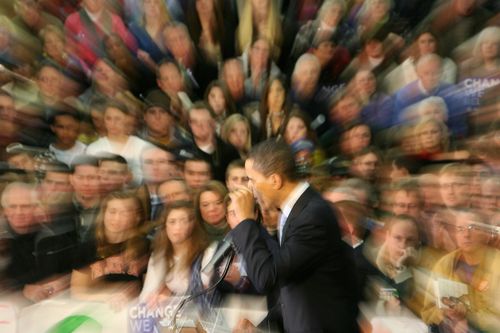
OBAMAEmmanuelDunand:AFP:Getty

Cohn compares the State Of The Union to Obama's speech on race during the campaign:

The easy approach to that controversy–the one, I’m sure, most political consultants would have advised–would have been a simple and apologetic disavowal of Wright. Instead, Obama seized the opportunity to offer a disquisition on American attitudes about race, in all of its mind-numbing complexity. 

Somehow, the gambit worked. People paid attention. They respected Obama for it. And his candidacy survived.

My gut tells me that this State of the Union cries for the same approach–that people will respect and embrace Obama if, rather than backing down, his reaffirms his commitment to the ideals on which he ran. They want to know he’s listening, but they also want him to keep fighting. They can handle the complicated message–in fact, they want it.

My feelings entirely. I'll be live-blogging of course.

(Photo: Emmanuel Dunand/Getty, during the campaign.)

The Not-So-Great Recession

Zachary Karabell takes stock:

Outside the United States, the Great Recession wasn’t nearly as great. Unlike prior economic crises, when governments fell and mobs assaulted the centers of power, there has been little political upheaval and almost no violence. In fact, large swaths of the world – China most notably, but followed closely by Brazil and India – emerged with their relative position enhanced as a result of the crisis. China has $2.4 trillion in reserves and a larger share of world trade than before the crisis, and India—by virtue of having an insulated and partly closed financial system – suffered far less and has emerged much stronger. In fact, what is termed the worst crisis since the Great Depression in the United States and Europe is actually the greatest boon since decolonization for much of the rest of the world.

Why Not Let The Republicans Filibuster?

Political scientist Seth Masket explains:

[S]enators made the decision a few decades back that agenda time was simply too valuable to let a few filibustering senators hijack it. A truly effective filibuster could theoretically shut down the Senate for the rest of the year. Congressional Dems and the Obama administration actually want to get some other stuff passed this year while they still have a (large) majority… [A] true filibuster today probably wouldn't involve a whole lot of phone book-reading…Today, there are dozens of policy shops and hundreds of conservative writers who could generate days and days of material for filibustering Republicans to read.  Fox would likely televise many of the speeches live and portray the filibuster as a great patriotic act.  If anything, the Republicans would control the discussion during a filibuster more than they do now.

I'm not so sure. That kind of smug posturing while doing nothing seems to me like gasoline on a populist fire. Remember the government shut-down? It backfired. And part of me wonders whether GOP hubris is now overtaking Democratic fecklessness.

The Fiscal Pivot, Ctd

TNC isn't buying it:

[Andrew] notes that [the spending freeze is] largely a symbolic measure, but has faith that Obama will eventually move to the hard choices around defense and entitlement. I don't know. I think the way Obama has evidently decided to fold on health-care leaves me with little faith that he'll actually do the hard work. 

It is, potentially, like this with all presidents. And I heard his point the other day about being happy with serving as a great one-termer. But I'm struggling to understand what he deeply, truly believes in.

A Critical Endorsement

“As a nation built on the principle of equality, we should recognize and welcome change that will build a stronger more cohesive military. It is time to repeal “don’t ask, don’t tell” and allow our military leaders to create policy that holds our service members to a single standard of conduct and discipline," – former JCOS chairman General John Shalikashvili.

I don't believe this will happen in Obama's first term. I gave up hope on Obama and civil rights a long time ago. But I'd sure love to be proven wrong.

Dissent Of The Day II

A reader writes:

You conflate two policies with being essential to avoiding a Depression, when they are distinct. The Fed did the right thing when it pumped up the money supply in the banking system to avoid what Milton Friedman called “The Great Contraction” that led to the Great Depression in 1929. The analogy often used to justify this action is similar to putting out a fire in a row house that could spread to the other homes in the row if it isn’t put out.  Ben Bernanke did the right things to avert that disaster and your Big Babyism critique applies to that policy. However, what many conservatives do justifiably complain about are the TARP expenditures that amounted to pure wealth redistribution with no contagion rationale. 

The bailout of AIG preserved the credit default swap market to the benefit of Merrill Lynch, Morgan Stanley and Goldman Sachs shareholders.  These institutions were not part of the banking system when the crisis broke out.  In fact, the government strong-armed them into becoming bank holding companies so that a fig-leaf could be used to justify this policy, ex post facto.

The same goes for the GM bailout.  The US economy would not collapse if GM went bankrupt.  However, a key voting Democrat voting bloc would be severely impacted – the unions who mostly contributed to the financial demise of the auto industry in the first place.

The pork-barrel spending contained in subsequent stimulus bills were of the same ilk and only deepened the government’s fiscal crisis in the hopes of creating a soft landing that doesn’t feel so soft 8 months later.  And now Obama wants to take over another 16% of the US economy before the fires have been put out on the Medicare and Social Security fiscal crises?  This is what is causing true conservatives to snap.

The brazen abuse of a crisis to pursue an ideological agenda instead of resolving the deep fiscal crisis faced by this government is what has caused the severe reaction against Obama. You should be ashamed of yourself for not screaming STOP to this madness.

This is it? Seriously? The madness is in my reader. There were indeed emergency measures used to prevent both a financial meltdown and an economic spiral. To my mind, the acid test is whether these measures helped avoid a second Great Depression, as a lot of people feared. They did. Now we get to tackle the underlying causes of the crash and re-regulate the financial industry to saner, older, more conservative standards. Then the recourse to utterly trivial pork barrel spending and the idiotic canard that Obama wants to “take over” 16 oercent of the US economy suggests to me we are simply dealing with ideology here, removed from any real engagement with the actual real world choices Obama faced and the real world choices we all have to face.

It is as if the right has become so ideologically calcified they cannot see what is in front of their noses. And so they concoct a fantasy world in which Obama is the leftist spender – rather than what he is, a pragmatic reformer in a desperate situation caused in part by conservatism’s ideological over-reach.