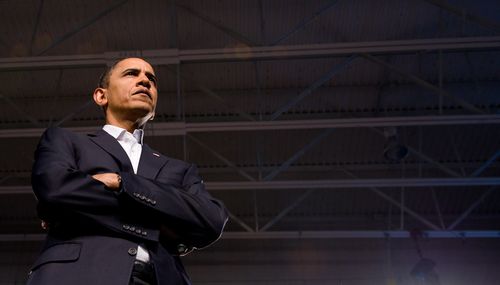
A Failure Of Nerve

Friday marked the one-year anniversary of Obama's pledge to close the prison. Heather Horn rounds up the reaction. John Bellinger, a former legal adviser to Condoleeza Rice, observes:

President Obama has not only missed his self-imposed one-year deadline to close Guantanamo but will likely not be able to shutter the prison in 2010, and possibly not even during the next three years. Politically gun-shy Democratic majorities are unlikely to vote to move the Guantanamo detainees into the United States during an election year, and may be unwilling to do so at all.

And this is a function of three things: the chaotic state the Bush-Cheney crew left the paperwork in; the nihilism and fear-mongering of the GOP; and the usual lack of nerve among Democrats. The Bush inheritance, GOP cynicism and Democratic cowardice: three things that dominated Obama's first year.

The Source Of Altruism

Jonah Lehrer ponders giving:

[C]haritable donations aren't purely rational calculations. Instead, our decisions are deeply influenced by the quirky social machinery of the brain, which is influenced by variables like empathy (How close do we feel to the beneficiaries of the good cause?) and the ability to detect agency (Does the charity make us think of other people?).

This helps explain the effect I blogged about yesterday, or why abstract appeals tend to be less compelling than concrete examples of individual suffering. When it comes to altruism, specificity beats scope, if only because the decision to give is inherently social.

I think this research also helps explain why social media like Facebook, Twitter, etc. always seem to become extra relevant during crises and disasters. While the platforms were designed to convey social banalities, they can also serve as vessels of empathy, as people forward along the latest reports and most resonant stories. It doesn't matter if the subject is Iranian protests or Haitian refugees – social media makes the tragedy feel closer, more human. And that is what makes the tragedy feel real.

Economic Rumblings In Iran

The NYT reports that the Khamenei junta has restricted withdrawals from banks:

Deputy Finance Minister Asghar Abolhasani said withdrawals of more than 150 million rials (roughly $15,000) per day would be banned ''in order to combat money-laundering,'' state radio reported. The decision means an account holder cannot withdraw more than that amount daily in cash, but can still write checks for larger amounts.

And this, according to this reader, has led to some panic:

After this decision a rumor has spread that without a bailout, two major government owned banks (Melli and Mellat) will declare bankruptcy on Wednesday, January 27th. There is no way of confirming this, but the rumor itself has triggered a run on these two banks and people are rushing to get their money out (mostly in Tehran and

Isfahan). 

Some branches have even run out of cash and did not pay the customers, triggering anger, unrest and anti government chants. Two branches where this has happened are: Mellat bank at Tehran's Bazar and Mellat bank in Sadeghiye Square (there are even reports that in the latter, one person was injured). I have not found any report in English on these rumors and the subsequent events however here is the relevant Farsi page in "balatarin" as noted abive.

Beside the rumor, which right now looks more like a self fulfilling prophecy, there is other reasons not to hold Rial (the Iranian currency): the government plans to devalue it in the new Iranian year which starts 21st March. Right now there is a more or less fixed exchange rate of 10000 Rials = 1 USD. Also some of subsidies will end at the same time (the most prominent one being the gasoline subsidy and the plan is to end all subsidies in 3 years period). So people expect a massive and sudden jump in the price of almost everything and as a result are abandoning Rial and getting into USD or gold.

The Weekend Wrap

This weekend on the Dish, Rauch reviewed the Senate bill, Sarah Binder explained reconciliation, and Steve Benen saw some hope from the Democrats. On the SCOTUS decision, the Volokh Conspiracy aired the hard libertarian view and Greenwald laid out the soft one.

Junot Diaz argued that Obama's narrative is slipping, Tom Junod reflected on his first year in office, and Brendan Nyhan compared Obama and Reagan. Hanna Rosin scrutinized the sexism of the '08 election and Pascal-Emmanuel Gobry found feminism in the New Testament. Fallows highlighted some great new journalism and we pointed to some sex-positive journalism. Reason featured a forum for praising government and the NYT still had trouble with the t-word.

Elsewhere on the Dish, a dating site analyzed the best ways to allure mates, Nicole Allan gawked at food porn, Susanne Sternthal spotlighted train-riding dogs in Moscow, the Moscow Times reported on its psychopathic cops, Richard Dawkins traced the evolution of wolves, an Italian gay couple continued their hunger strike, and Susan Clancy provoked readers over sexual trauma.

We featured cartoons of Obama getting pissed off and getting caught by Wile E. Coyote (though in the real world, he's fighting back). Werner Herzog read Curious George, an English wife recorded the brilliant gibberish of her sleeping husband, and Pogo produced another quintessential MHB.

— C.B.

As The Dust Settles

OBAMA09OlivierDouliery-Pool:Getty Images My Sunday column looks at the path ahead for the president:

In the vast, ungainly contraption of the American political system, there is always surprise. A couple of weeks ago, as news started to trickle in of the spectacularly awful campaign of one Martha Coakley in Massachusetts, we were warned. And the result was not, in the end, much of a surprise. In a by-election in a safe seat in a deep recession, the voters threw out the de facto incumbent. This happens in politics. When you realize that the seat had been a Democratic party sinecure for decades (it had been all but owned by the Kennedy family for half a century) and that voters knew they could vote out the Republican in only a couple of years, it’s even less of an earth-shaker. And if you simply watched the two candidates, it would take a partisan maniac to prefer the wooden, listless Coakley over an affable, moderate Republican who supports universal healthcare (in his home state) and abortion rights. What doesn’t usually happen is that an entire presidency is suddenly immobilized by one stray result. Washington is still a little stunned by the immediate consequences. But the asteroid hit just as the final, small adjustments on the massive health insurance reform bill were being completed. Getting that far along in the sausage-making – keeping conservative and liberal Democrats together against total Republican obstructionism – was like finishing a book on a lap-top, clicking save, and then watching it accidentally delete the whole thing for ever.

It was staggeringly demoralizing for the Democrats.

In one swoop, the implications sank in. As long as the Republicans refuse to accept or compromise on anything, as long as they insist on filibustering every single piece of legislation Obama favors in the Senate, then nothing can be done. That’s how the system works. It doesn’t matter that the House passed health reform (and cap and trade) by a big margin months ago. What matters is that just one or two senators can hold up the entire process indefinitely. This is, of course, an insane way to govern a country. But it’s right there in the Constitution. Because every state gets two senators, and the empty rural states tend to be Republican, you end up with the fact – illustrated by writer James Fallows – that the Senators favoring health reform represent 63 percent of Americans, while those voting against represent 37 percent. But the 37 percent wins. Hence the great spoof headline of last week: Republicans win 41 – 59 majority in Senate.

The public is evenly divided on such a huge reform in a period of real economic distress. The current polls show 40 percent in favor and 50 percent against. But a swathe of the opposition comes from the left who think the bill does not go far enough. The complexity of the issue makes it hard to sell, and in the current recession, right-wing populism against all forms of government control is as red-hot as left-wing populism against bankers. In an adult political culture, in a period of economic growth, it might be possible to achieve something this complicated and necessary for long-term reform. Most sane people understand that America’s current healthcare system is bankrupting the public and private sectors while failing to provide any care at all to 40 million people. But the centrist reform Obama has laid out – marshalling the policy consensus of the last twenty years – is just too abstract and diffuse to succeed against all these forces at once.

So is Obama finished? Of course not. By last week’s end, even the most panicked Democrats had begun to calm down. The only practical option left is for the House to pass the Senate bill unamended. Last Thursday, Speaker Pelosi said that she didn’t have the votes for that. But she might get them if the House gets to fix its problems with the Senate bill in a subsequent bill that can be passed by a mere 51 senators in a process called “reconciliation.” This process would also be brutally obstructed – but it could possibly win out in the end. And the only way to do that right now, without brutal blowback, is to alter the political dynamic dramatically.

Only Obama can do that. And like many moments in the campaign when he seemed adrift or embattled, he has been given a big speech next week, his first State of the Union address, to recast the debate. And for the first time, he has experienced a major defeat at the hands of his opponents. These two things lead to one obvious battle plan.

What Obama needs to do is not ram the current bill through. He needs to accept, as he has, that the public remains anxious. But he also needs to remind people that he was elected to grapple with the mounting problems, not avoid them. The pivot is obvious: tell the American people that he understands their anger and frustration (hence the big swipe at the banks last week), but that he refuses to stand by and do nothing. If the American people want nothing, they should support the opposition. If the American people want something, they should back the president they just elected in implementing a health reform plan he campaigned on.

In my view, the key to reassuring Independents, the critical swing vote, is the deficit and the long term debt. If Obama can persuade them that the healthcare reform actually addresses that problem and cuts entitlements (as it does), he can combine it with his recently announced plan for a bipartisan commission to cut entitlements and raise taxes. Such a plan can alone reassure the markets that the US isn’t headed toward the fiscal status of a banana republic.

I feel for the guy. His bill was attacked by the left as a sell-out to insurance companies; it was attacked by the foam-flecked right as communism – the end of America as they have known it. The bill remains more moderate than those once proposed by Richard Nixon and Bill Clinton. Obama has also taken all the blame for the recession and the debt, as if Bush never existed. And he has helped turn the economy around in ways not yet felt on main street.

But this is the big time and politics is a contact sport. How Obama responds to this will tell us a huge amount about him. He cannot and should not reinvent himself as a Democratic partisan. He isn’t. He cannot fake populism. He’s too responsible for that. He cannot ram a bill through by hook or by crook if he is to respect the genuine anxiety about the reform. So he has to be calm, patient, reasonable and somehow harness Democratic anger as well. He is still well-liked and his approval ratings have recently been gliding up. He could easily prosper personally, as Clinton did, by presiding over a Congress dominated by the opposition. But he does not want to be a Clinton; and the times require much more.

If he fails now, the reformist center of American politics, fragile at best, may be gone for a long time. And so his crucible awaits. The promise of his candidacy – that there must be a way to unite Americans in dealing with their longstanding problems – hangs in the balance. I do not know  – because no one can – how he will grapple with this. But one recalls that politics, in the country as well as Massachusetts, is always pregnant with the possibility of surprise. And the audacity – for it is truly audacious now – of hope.
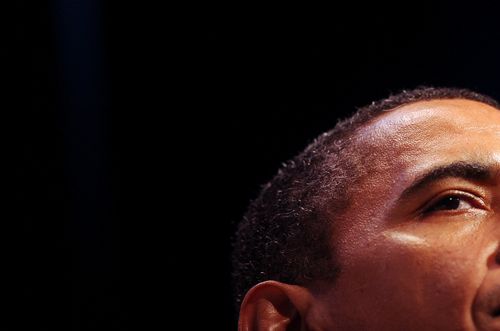
(Photo: OlivierDouliery-Pool:Getty.)

Addiction In The Heartland, Ctd

A reader writes:

There's one other factor in rural drug use.  There's nothing to do in small towns.  Growing up in New Mexico, we were bored.  When you're a teenager, you can only watch so much TV.  My best friend and I would get high on meth and drive around all night just talking, but we felt great because we were high.  All of my friends and a huge chunk of my high school did a lot of drugs and had a lot of sex.  When I moved to Seattle and talked about my past drug experience, my new friends looked at me like I was Tony Montana. 

Genuinely puzzled, I asked if they'd ever done drugs, and the responses were generally along the lines of, "No, I was too busy with my theater group/after school job/non-traditional sports team/other socially acceptable activity."  Weird as is, I think Seattle's dumbass dodgeball league on Capitol Hill is keeping more kids off drugs than all the efforts of all past Drug Czars combined.

Ribbons For Bedrooms

A first-person blog from Haiti:

Port-au-Prince is now a city where most people are sleeping outside at night (estimates put it at 80 percent of the residents). I drove back to our camp just after dark a couple of nights ago, rushing to meet our own night-time curfew. At street corner after corner, people had blocked access to their blocks by placing stones in the way. They didn't want vehicles rushing blindly in and injuring sleeping families. I looked up these blocks and saw winding ribbons of re-created bedrooms, demarcated with bedsheets and string, as far as my eyes could see in the dark.

Quote For The Day II

Hope

“Do not depend on the hope of results. When you are doing the sort of work you have taken on, essentially an apostolic work, you may have to face the fact that your work will be apparently worthless and even achieve no result at all, if not perhaps results opposite to what you expect. As you get used to this idea, you start more and more to concentrate not on the results but on the value, the rightness, the truth of the work itself,” – Thomas Merton, “Letter To A Young Activist”

Now Fight! Ctd

OBAMA10SaulLoeb:Getty And he is:

I also know that part of the reason is, is that this process was so long and so drawn out — this is just what happens in Congress. I mean, it’s just an ugly process. You’re running headlong into special interests, and armies of lobbyists, and partisan politics that’s aimed at exploiting fears instead of getting things done. And then you’ve got ads that are scaring the bejesus out of everybody.

And the longer it take, the uglier it looks.

So I understand why people would say, boy, this is — I’m not so sure about this — even though they know that what they got isn’t working. And I understand why, after the Massachusetts election, people in Washington were all in a tizzy, trying to figure out what this means for health reform, Republicans and Democrats; what does it mean for Obama? Is he weakened? Is he — oh, how’s he going to survive this?  That’s what they do.  But I want you — I want you to understand, this is not about me.  This is not about me. This is about you. This is not about me; this is about you. I didn’t take this up to boost my poll numbers. You know the way to boost your poll numbers is not do anything. 

… So if I was trying to take the path of least resistance, I would have done something a lot easier. But I’m trying to solve the problems that folks here in Ohio and across this country face every day. And I’m not going to walk away just because it’s hard. We are going to keep on working to get this done — with Democrats, I hope with Republicans — anybody who’s willing to step up. Because I’m not going to watch more people get crushed by costs or denied care they need by insurance company bureaucrats. I’m not going to have insurance companies click their heels and watch their stocks skyrocket because once again there’s no control on what they do. So long as I have some breath in me, so long as I have the privilege of serving as your President, I will not stop fighting for you. 

(Photo: Obama in Ohio Friday. By Saul Loeb/AFP/Getty.)

Quote For The Day I

"To pretend that the Congressional Republicans have not been pursuing a monolithic strategy of rejection and obstruction, that they have been willing to bargain in good faith, and that the Democrats are the ones who haven't been open to reasonable compromise–yes, there are people who have made, or implied, all these claims–is simply to lose contact with reality. I realize that a few readers will have sincere disagreements with me on this point, so I hope they will pardon me for being blunt," – Jeff Weintraub.