Talking To Barney Frank, Ctd

A reader writes:

Barney isn't reveling in it; he's running scared. Yesterday, Brown and Coakley split the vote in his district right down the middle. He's facing re-election in less than a year, he's saddled with an unpopular governor and endemically corrupt legislature, and now he's facing an emboldened opposition. Barney is, above all, a politician. So he's doing his best to placate Brown's supporters, to signal that he hears their concerns, and to put the kibosh on any bill that can't be sold as bipartisan. It's not that he can't cobble together enough support to squeeze the Senate bill through the House – it's that right now, he figures it would cost him his job.

So give the man a little credit. At least he's doing his part to fight unemployment.

Hello To All That

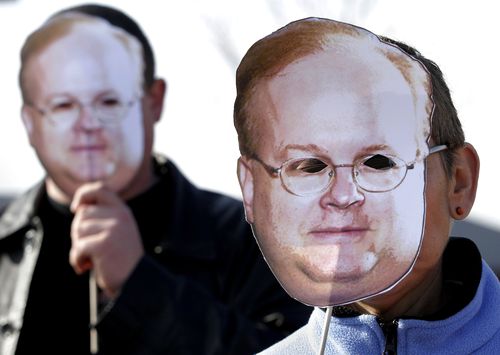
ROVEMASKBillPugliano:Getty

I have to say that my deepest gloom right now is about how exactly the kind of red-blue, right-left, abstract ideological posturing that has bedeviled the US since Vietnam has come back with a vengeance. My hope was that Obama could get past this. He's trying and his record, to my eyes, is exactly as he promised. But old habits die hard, and the anger on the left and viciousness on the right seems straight out of a boomer playbook. I think the right is much more destructive right now, but the Hamsher left is driving me a little nuts as well. A reader echoes this sense:

My teabagger parents are gloating today about the Brown victory. To them, this whole politics game is like football: they simply cheer for the red team to beat the blue team. Period. They don’t know or care how Brown or any of their other preferred candidates are going to solve the real crises my generation will face.

And for all their slogans and smugness and phony outrage, the teabaggers are on the wrong side of the future in every way I can imagine:

Entitlements will have to be cut. The eligibility age for Medicare and Social Security will be raised, benefits will be means-tested, and Medicare will eventually be rationed. Everyone in my generation knows this. We accept it. But we want those programs to stick around in at least a minimal, bare-bones form. The teabaggers just mindlessly shout “Don’t cut my Medicare!” But they don’t mind bankrupting it for my generation.

Taxes will be raised. This is a fact. But teabaggers keep demanding tax cuts, insisting that cuts increase revenues, a claim that can’t even be called discredited because it was never credible in the first place. Policy-smart conservatives know it’s hooey, but teabaggers love it because it’s a convenient, feel-good talking point, truth be damned.

The rest of our lives will be filled with economic stagnation and profound personal insecurity.

The health care system as we know it will fall apart, spiraling costs will destroy growth, and the government will be forced to take an ever-bigger role in health care, sooner or later. What it means to be middle-class will be drastically different in fifty years, maybe even twenty. The disruptions of globalization will require government to alleviate the economic risk on individuals through programs like expanded unemployment benefits, targeted job training (and re-training), and education reforms. Teabaggers’ answer? Scream “Socialism!” and argue for ending all regulations and social welfare programs.

The theme of the future will be the need to accomplish more with fewer government resources. This will require a generation of leaders committed to the old-fashioned conservative notion of good government. For teabaggers, though, it’s an article of faith that there is no such thing as good government, so they don’t care what kind of hacks they put in office.

American empire will have to be rolled back. We can’t afford it. The defense budget must be cut. But teabaggers just want more and more war, imperial occupations that never end, in every corner of the globe. You have to wonder if war simply makes them feel good. Climate change and peak oil are facts. They will alter our lives in ways that seem like science fiction to us now. But teabaggers grasp at any flimsy excuse they can find not to face these facts, from “Al Gore is a hypocrite!” to “Drill, baby, drill!” to “The emails prove it’s all a hoax!”

The ridiculous, exhausting culture war has to end. My generation is sick of re-fighting Vietnam and Selma and Stonewall. We don’t want to be defined by whether we eat arugula or wear Carhartt. But the teabaggers need the culture war to continue forever because it ratifies their prejudices. It justifies their hate. It prevents the change they fear.

Now who is better prepared to start solving these problems now, a pragmatist like Obama or the teabaggers? Who is the real small-C conservative? If teabaggers continue to stand in the way—or God forbid, if they take power—how much longer will it take for leaders to emerge who are willing to do the hard work? I asked my father what his solution would be. “Blow up the whole government,” he said. “I’m not responsible for your security.”

If that’s not nihilism, what is?

Brown Is To The Left Of Snowe?

That's Boris Shor's reading:

[B]ased upon his voting record in the Massachusetts State Senate as well the Votesmart surveys of MA state legislators (include his own from 2002), I estimate that Brown is to the left of the previously leftmost Republican in the Senate, Olympia Snowe of Maine (see her issue positions here) and to the right of the rightmost Democrat in the Senate, Ben Nelson of Nebraska (issue positions here). Just as important, Brown stands to become the pivotal member of the Senate—that is, the 60th least liberal (equivalently, the 40th most conservative)–a distinction previously held by Nelson.

Nyhan is skeptical:

I think Brown moved right to motivate the GOP base in a low-turnout special election, so I'm skeptical he'll pursue such a moderate course (at least right away). But if Shor is correct and Brown is between Nelson and Snowe, it reduces the rightward shift in the filibuster pivot, meaning that Brown's win would have an even smaller effect than we might have otherwise thought.

Memo to Obama: co-opt Brown. When the GOP balks, and Brown is cowed into the Rovian box, show the country what they are really about.

The View From Your Recession

A reader writes:

I would like to echo the comments of your recent VFYR writer, the one who "never gave much thought to social programs, frankly, I neither needed or qualified for them." This is true of me as well.

I am a self-employed paralegal and project manager, specializing in contract and IP-related law. This year was going very slowly for me, as it was for my clients, until several months ago, when one of my clients was suddenly overcome with demand for its datacom product as a direct result of stimulus funds becoming available to their customers (who were funded to deliver broadband services to *their* rural customers.) Now I have more work than I can handle.

Now I battle the traffic on the main street near my home to get to this work; the traffic is slow, because the street has been under construction for some months, construction funded by stimulus funds, according to the signage on the road. I call my brother on the cell-phone to kill the time while I'm in traffic. He's an IT professional at AIG, employed only by virtue of the bailout.

In the meantime, my retirement savings, decimated by the economic collapse, is very quickly recovering. My IRA has grown 35% in the past 6 months.  I have worked for 7 different companies over my 25 year career, and have never had access to a pension plan. Although it is a common trope that the stock market is not a reflection of the health of the overall economy, most middle class people like myself rely solely on our stock market-invested deferred retirement savings plans for a sense of well-being about the future. My sense of well-being is quickly improving. Love it or hate it, the healthy stock market is a direct result of the bailout.

So, for the first time in my life, my loved ones I are direct beneficiaries of social programs. It is a very strange sensation, but I'm getting used to it. I credit President Obama and his steady hand at the tiller. He is playing the long game, and I believe it will pay off for all of us in time.

The Sheer Uselessness Of The Democrats

A brutal, bitter letter to TPM from an anonymous Senate staffer is worth reading in full. Money-quote:

This is my life and I simply can't answer the fundamental question: "what do Democrats stand for?" Voters don't know, and we can't make the case, so they're reacting exactly as you'd expect (just as they did in 1994, 2000, and 2004). We either find the voice to answer that question and exercise the strongest majority and voter mandate we've had since Watergate, or we suffer a bloodbath in November. History shows we're likely to choose the latter.

I'm not a Democrat; and I'm patient; and understand the enormous difficulties of the process. But still, the loss of this bill is devastating. The Republicans have led the country into a ditch, but with denial, energy, determination and barely any in-fighting. I don't want to see the Dems turn into the same kind of thought-free machine. And I want Obama to break that particular cycle. But unless you have a minimally functional legislative branch, I don't quite see how it's done in a recession and a political climate that has been deliberately toxified to benefit the extreme right.

Obama’s Non-Ideology In a Populist Age

George Packer reflects on Obama's first year:

[T]he whole drift of political currents—especially in the wake of last night’s Massachusetts result—is away from Obama’s agenda, and toward a kind of populism that, like a wild fire, can shift directions with any light wind that blows through and quickly burn up large tracts of land (it just immolated Martha Coakley). This is a politics that Obama has never been comfortable with. His preferred approach, as we’ve learned this past year, is to bring together his relatively non-ideological advisers, let each one argue a point of view, then make a decision on the rational basis of evidence and expertise, and explain it to the public in a detailed, almost anti-inspirational manner. Thus the bank plan, the Afghanistan policy, the “jobs summit,” etc. A Democratic politician recently told me that the best way to get Obama to do what you want is to tell him that it’s the unpopular, difficult, but responsible thing.

If Obama has any ideology, it’s this process. It is not an approach that’s easily adapted to leading and guiding the volatile hearts and minds of a beleaguered and cynical public. My guess is that it’s driven his political advisers around the bend many times.

The whole post is worth a read. It helps illuminate the divide between Obama's Reaganite campaign and George H W Bush-like administration. The trouble is: I think we need exactly this kind of good faith engagement with serious and complicated problems right now. And looking back, the first Bush administration looks substantively better and better. The question is whether this kind of small-c conservative good-governance can survive in a climate where the mood is populist, the economy is wrecked, the opposition is as angry as it is incoherent, and the Democratic base is in a mood for revolution.

Bush had no option. But Obama does. He can do the "vision thing". He needs to find a way to harness it to the pragmatic tasks in front of him. Never easy. But we will now see what he is made of.

Bush Is Not The President Anymore

The Transplanted Lawyer, a blogger in California, explains why a Brown win might be good for the Democrats:

The theme for 2010 was going to be "Blame Bush."  Why Democrats would think that two years after Bush was forced out of office and not even an option anymore, why they would think that two years in to the term, they could say thing like, "Huh, what an awful economy!  We in-hair-it-ed it!" and get a good response from the electorate, why they would not think people might notice when they spout nonsense like "a Republican created this bad economy and now we have to take the blame!" is beyond me.  Much less the basic incompatibility of running against an out-of-office Republican while their own President says things like "There are always folks who think that the best way to solve these problems are to demonize others and, unfortunately, we're seeing some of that politics in Massachusetts today," and then they can turn around and demonize George Bush instead of offering actual solutions to the problems and reaping the electoral rewards for doing so.