Chart Of The Day

Poll-pot

The march against prohibition continues:

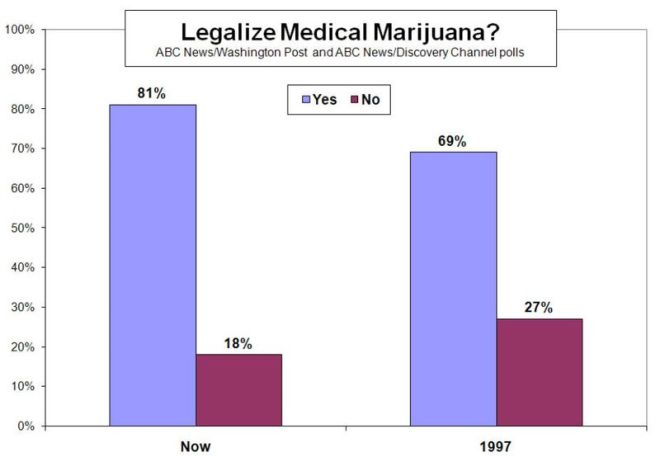
With New Jersey this week poised to become the 14th state to legalize medical marijuana, 81 percent in this national ABC News/Washington Post poll [pdf] support the idea, up from an already substantial 69 percent in 1997. Indeed the main complaint is with restrictions on access, as in the New Jersey law. Fifty-six percent say that if it's allowed, doctors should be able to prescribe medical marijuana to anyone they think it can help. New Jersey's measure, which is more restrictive than most, limits prescriptions to people with severe illnesses.

The Daily Wrap

95881988

Today on the Dish we covered the devastating defeat of Martha Coakley. Blogger reax here. Andrew's reaction here, and his earlier assessment of the race here. Leading up to the defeat, TPM, Ambinder, Yglesias, Tom Schaller, DiA, Jeff Davis, and a reader divined the political fallout. Karen Tumulty, Michael Moynihan, Ambinder, and a reader tracked Coakley's plummet. Josh Marshall and Reihan imagined how things could have been different. Andrew warned the Democrats not to get sucked into Rove's game. James Joyner, Reihan, and a reader rebutted Andrew's view of Republican nihilism, but he stood his ground.

On the torture deaths, the American media continued their silence, the denial on the right deepened, and the Obama administration coweredGreenwald, Andrew, and Megan despaired. On Haiti, Noam Scheiber critiqued the coverage, Tyler Cowen flagged the perils of US involvement, and George Packer worried about Haitian politics. More images here.

Prop 8 update here.

— C.B.

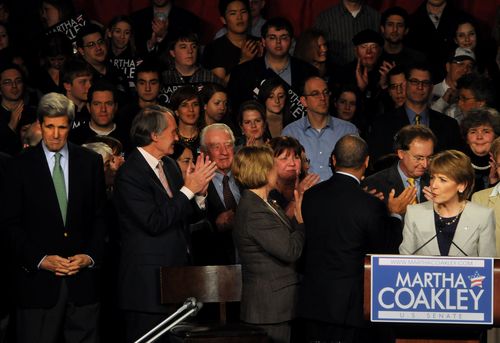
(Photo: U.S. Senate democratic nominee Martha Coakley gives a concession speech as U.S. Senator John Kerry (D-MA) looks on (far left) January 19, 2010 at the Sheraton Boston in Boston, Massachusetts. Coakley lost to republican challenger State Senator Scott Brown in a special election to fill the seat of late U.S. Senator Edward M. Kennedy.  By Darren McCollester/Getty Images)

What The Independents Are Saying

Here's some real arguments from real people explaining their vote for Brown. It was multi-determined from these quotes. But one theme came through:

“I like what Scott Brown stands for and I feel that the Democrats cannot run the country anymore. That too many people that don’t have jobs are going hungry. They’re not taking care of business. They’re not doing their jobs. They’re caught up in this health care thing. I’m saying they’re not taking care of the people that are unemployed.”

Of course the Democrats have extended unemployment insurance, passed a stimulus, bailed out the banks, and revamped a war. But the impression is that they'd been spending so much time on healthcare they couldn't have been doing much else. It was the length of the process in a time of acute economic distress that fanned these fears. Another interviewee sees a divided Congress as better than unified one:

“My feeling is the Democrats have really screwed up since Barack Obama has been in office, and the sooner they lose their majority the better for our country. I think I’m just very disappointed in the direction this country is taking.”

Check it all out. With no exit pols, these focus group sentiments are among the best tools we've got.

Classy Brown

His victory speech:

This special election came about because we lost someone very dear to Massachusetts, and to America. Senator Ted Kennedy was a tireless and big-hearted public servant, and for most of my lifetime was a force like no other in this state.  His name will always command the affection and respect by the people of Massachusetts, and the same goes for his wife Vicki.  There’s no replacing a man like that, but tonight I honor his memory, and I pledge my very best to be a worthy successor.

These are emotional times on all sides. I feel myself slipping into fury too often, and the blogosphere is currently red-hot. But Brown’s speech does remind us that it should be possible to be civil to one another, even during these intense times.

The Nihilist Left?

A reader writes:

I keep reading you calling the current right "nihilist," but I'm not sure I agree.  The tea partiers, neocons and Palin fans are not people who believe in absolutely nothing or reject everything that emerges from the beltway outright.  They support the use of torture, want Guantanamo open, support American colonialism and are dyed-in-the-wool supply siders. In short, they want things that either never were (as if Keynesian economic policies never existed) or can't be (expansion of the American empire at gunpoint).

The left, on the other hand?  Voters in Massachusetts are ready to toss away a year's worth of work to reform healthcare.  For what?  Because Brown, while being slightly more atrocious than Coakley from a political standpoint, is more of a "regular" salt of the Earth kind of guy?  The type mentioned by one of your readers, who they'd basically have a beer with at the ballpark?

It's tantamount to saying political positions don't matter.  But whether someone would be "fun" to hang out with?  That does.  There's an unsettling sense of abnegation that has taken hold in Massachusetts, but it's from the left, not the right.

For some reason, as you have already mentioned, these voters don't trust themselves to vote Coakley out after this special election.  They assume she'll get a 20-year career because of…what, exactly?  Their own apathy in voting for an incumbent?  Maybe that isn't quite nihilism, because it's not the political system these voters don't believe in.  The voters don't believe in the voters.

Another writes:

It is time for the whiny left to shut up and get behind the President. I agree that the right has gone bonkers and wants to burn the place down in the vain hope the voters choose them to rebuild. But the left is no better. The Jane Hamshers and Keith Olbermanns and Arianna Huffingtons are giving aid and comfort to the enemy. And make no mistake. The GOP has no interest in governing, no interest in leading and no interest in doing one damn thing except for cutting taxes and torturing terror suspects. The entire future of this country was at stake and Jane Hamsher was pissed because her parents gave her a blue Ferrari instead of a red one.

Even Jon Stewart has lost his way, as he blathers on about an 18-vote majority. He fails to grasp the filibuster and fails to grasp that comparisons to Bush are folly. Bush did nothing except cut taxes and go to war. Only Senators with career death wishes filibuster tax cuts and troop funding.

The left MUST understand that their own differences can wait.

Quote For The Day

"In many ways the campaign in Massachusetts became a referendum not only on health care reform but also on the openness and integrity of our government process. It is vital that we restore the respect of the American people in our system of government and in our leaders. To that end, I believe it would only be fair and prudent that we suspend further votes on health care legislation until Senator-elect Brown is seated," – Jim Webb (D-VA).

So Webb simply caves. Immediately.

Massachusetts Reax

Matthew Continetti:

After the off-year elections, Democrats could cling to Bill Owens’s victory in NY-23 as a shred of evidence that the Tea Party message could hurt Republicans. Scott Brown’s victory exposes NY-23 as a fluke. The trend is clear. Independents have moved sharply right over the course of President Obama’s first year in office, even in Massachusetts. Attention Democrats: Obama’s version of change is not what most of the country believes in.

Josh Marshall:

For a whole variety of reasons voters clearly have a lot of hesitation about this reform. I think the polls make clear that the public is not against it. But the reticence is real. If Dems decide to run from the whole project in the face of a single reverse, what are voters supposed to draw from that? What conclusion would you draw about an individual in an analogous situation in your own life? Think about it.

Yglesias:

Scott Brown joining the Senate will make it impossible to make big progress on the big issues facing the country. But a number of “centrist” Democrats have been making it clear for a while now that they don’t want to make big progress on the big issues facing the country. That’s too bad, and Brown winning will only make things worse. We’re much more likely looking at a situation where Brown’s victory becomes an excuse for people not to do things they didn’t want to do anyway than a situation where Brown’s victory is the actual reason those things can’t be done.

Ramesh Ponnuru:

There are a lot of signs that the Ds are going to go on an anti-Wall Street jag to try to save themselves. If their political assumptions are correct, shouldn’t the bank tax—which Brown opposed—have worked better for Coakley?

Nate Silver:

As one would naturally expect from an election in which the Republican won Massachusetts, Brown outperformed typical GOP margins in every corner of the state. But the swing tended to be largest in red-leaning and swing areas in central Massachusetts. Coakley’s numbers were relatively good in Western Massachusetts and a handful of left-leaning suburbs, but underwhelming in Boston itself.

Yuval Levin:

[The Democrats] are of course not in fact powerless at all. But they have adopted an agenda that only a supermajority could pass (if that, even a supermajority couldn’t pass cap and trade), and with every indication of public opposition have only intensified their determination to pursue it, putting themselves on the wrong side of independent voters while persuading themselves that people would come around because this health care bill is something liberals have wanted for three generations. They have made it impossible for themselves to change course without a massive loss of face and of political capital. But however costly, that change will now need to come.

Ezra Klein:

I really wonder what the Democratic Caucus thinks will happen if they let health-care reform slip away and walk into 2010 having wasted a year of the country’s time amidst a terrible recession. It won’t be pretty, I imagine. If health-care reform passes, the two sides can argue over whether it was a success. If it fails, there’s no argument.

[Brown] going to be a short-lister for every GOP presidential contender. It doesn’t matter if he emerges as a great legislator or policy mench in the next two years: Scott Brown will be known as the “guy who took away the Democrats’ (supposedly) filibuster-proof majority,” the guy who “sent a shiver down the spine of the Obama Administration,” and, of course, the “guy who won Teddy’s seat.”

Reihan:

The polls also suggest that Brown performed very well with under-30 voters, which could mean that I won’t have to have another endless conversation about whether the right has lost Generation Y for good. My guess is that these voters in their late teens and twenties have scarcely any recollection of the Reagan years…The fact that America elected an African American president is a tremendous source of proud to these voters, I’m guessing. Yet that doesn’t change the fact that many feel disappointed with a technocratic president who hasn’t lived up to some of his more grandiose promises about transparency and a revival of grassroots democracy.

Taegan Goddard:

The politics of health care reform in the coming days is going to be one of the most interesting political stories in a long, long time.

Both Sides Now

OBAMATimSloan:AFP:Getty

Now we know that Brown's margin is solid, it behooves us to respect and admire the daring insurgent campaign Brown ran, and to think through what this could mean in Washington. The next few days will be volatile. So let me try to show why I think Obama's reform is imperfect but still necessary by responding to  a thoughtful post from Megan. Am I misreading the populist passion? Am I not seeing a genuine attempt to reform conservatism? Is the opposition to the attempt to reform health insurance merely a function of nihilism, as in my reader's vent:

Unabashed nihilism. But what leaves me shaking with anger damn near every day since President Obama's inauguration is the pure smugness and nonchalance of their nihilism?

Although I understand the feeling behind the email, it is a little sweeping in its dismissal. I ran it as a vent, not a policy analysis. But I still think it's more on the mark than Megan is. Her diagnosis of the protest vote in Massachusetts and the poor poll numbers for health insurance reform is simple: that the voters believe that it's "a bad idea."

In the abstract, if I were devising my ideal health reform plan, it would indeed be hugely different. Probably more like Megan's. But here's the difference: I think the lack of insurance for 40 million people is a real issue that we have a moral duty to deal with – now. I've been deeply affected by the nightmare stories readers have sent in of the current horrors. I also think that healthcare costs under the current system are crippling and require some sort of response by, yes, government – now. And I believe there is only one adult in Washington proposing an actual solution to these problems.

Here's Megan's description of her opponents:

They look at people without insurance, and they want to help them.  I'd like to help them too.  They believe, as I do not, that the government will be able to muster the political will to control costs. They believe, as I do not, centralized government planning will improve the health care system rather than being hijacked by special interests within it. They believe, as I do not, that there is so much fat and waste in the pharma and medical technology industries that they can considerably reduce reimbursements without reducing useful innovation and thereby condemning those who might have been saved to an early death.

I have yet to see a single proposal from the right that would in any way address the problem of the uninsured in America. McCain sure didn't and the GOP offers nothing. Cost control? Again, the current bill is the first one even to start to address this issue and Megan wants to kill it. What else would do that in any practical way in the current climate? I agree that one of the costs of reining in the healthcare industry will probably be less research, fewer new drugs, less innovation. But I cannot see a way in which the recent amazing breakthroughs will continue to occur without bankrupting the private and public sectors. And I say this as someone who has a constantly evolving retro-virus in my body trying to kill me.

The Senate bill is more moderate than the Clintons'; it has enraged the left; it won't insure everyone; it won't automatically control costs. But it's a start. It takes the problem seriously. In the real world, if this fails, there will be no reform until the country is bankrupted. The GOP has no interest in offering an alternative, just as they have no plans to cut the deficit – only plans to increase it. If this bill goes down, no Democrat will touch the issue for another decade.

I live in the real world, where these issues have to be dealt with, where a president was elected by a landslide on this very platform, and where the opposition was based not on Megan's thoughtful, if, in my view, utopian libertarianism but on populist rage, stoked by inflammatory claims of government take-over and communism, fed by every discontent in an economy wrecked by the Republicans.

I supported Obama to support reform in a difficult climate against enormous vested interests. I am not going to stop supporting his efforts now. And I am not going to dignify the vicious campaign against him and anything he does with the respect it has not yet deserved.