The Gregory Brothers commemorate the civil rights legend with a meme remix. The music of King's own speech patterns is enough for me, but this has its moments:
No One Ever Resigns
The cult of zero accountability at the top – entrenched in the Bush years, exemplified by the smooth job security of the major bankers after they helped destroy millions of jobs, ratified by Obama's "no one will be held accountable but me and my job is secure" response to the undie-bomber intelligence failure – continues in media. Michael Wolff makes the obvious point about the NYT's apparent decision to charge for online content it has spent the last decade giving away for free:
If the Times' shareholders and other people of goodwill feel it is important to save the Times, how come there isn’t some greater call to do the logical thing? Rather than taking the radical step, the no-going-back step, you take the reasoned and methodical one. You fire the jokers who brought the business to the point of having to bet the farm. You start afresh with people who might have better ideas than the ones offered by the people currently running the place, which have failed. Arthur has got to go—something almost everybody knows.
And why, pray, does Jeff Zucker still have a job? One reason for resurgent populism is a justified anger at the elites protecting themselves – at the expense of voters, customers, and excellence.
If Brown Wins
Yglesias lists some bullet points:
President Barack Obama … will get a terrible week or two of press but should actually benefit politically (cold comfort for the damage it will do to his substantive agenda). It’s much easier to complain about “Republican obstructionism” if Republicans have the 41 votes they need to obstruct. Similarly, it’s easier to keep your coalition together if it’s not possible to do anything.
At least the phony war will be over. Reform versus nihilism would be a good position for Obama to campaign on in the mid-terms.
A Personality Contest
Blumenthal goes through various scenarios and concludes that "Scott Brown is the likely winner."
Aside from healthcare and the implicit notion that Coakley would be a stand-in vote for the deceased icon whose seat she would be filling, what was the Coakley "platform"? Unless you are a particularly dynamic or celebrity-like candidates, when you are the nominee of the favored party in the state you want to avoid allowing the race to devolve into a personality contest.
“Haiti President”
Tyler Cowen thinks addressing the situation in Haiti may be Obama's most daunting task yet:
Obama now stands a higher chance of being a one-term President. Foreign aid programs are especially unpopular, especially relative to their small fiscal cost. Have you noticed how Rush Limbaugh and others are already making their rhetoric uglier than usual? It will be a test of the American populace; at what point will people start whispering that he is "favoring the other blacks"?
Just as it's not easy to pull out of Iraq or Afghanistan, it won't be easy to pull out of Haiti.
And Haiti is about as unreformable a place as Afghanistan. Owning it would be an act of insanity. Yes, we need to help provide immediate aid. But no: there is no way we can or should try to remake another failed country. At least not until we have reformed our own broken political system and fragile economy.
Everybody In The Pool
Noam Scheiber critiques what he calls an over-coverage of Haiti:
Just like they do for White House coverage, the major (and some not so major) news organizations could draw up an agreement to send a contingent of print, radio, and television reporters to wherever the next global disaster strikes. The participating news organizations could then use the raw material transmitted back to them to fashion their own reports. The pool correspondents could even be available to conduct on-air interviews with different television organizations, depending on their editorial needs. The arrangement would obviously be less than ideal for the outlets with the biggest budgets. But, collectively, the media would have the peace of mind that it's not exacerbating the same problems it's trying to alleviate.
If Coakley Had Lost The Primary
Josh Marshall imagines:
If Michael Capuano had been the Democratic nominee, there's simply no way we'd have gotten to this point (I used to live in his district). No way. Absolutely, no way. That is not simply to say that Coakley has run a bad campaign. That seems obvious; but I'm always a bit dubious of evaluations of a campaign (obvious as it may seem in the moment) because it's very hard to view as a struggling campaign as a well run one. And I'm not saying Capuano is the second coming. But Coakley is just culturally and temperamentally not suited to the politics of 2009/2010.
The Dish made that point a while back. Reihan is on the same page:
My guess is that Michael Capuano, a smart, apparently pretty unpretentious and likable strongly left-of-center Democrat who represents Cambridge, Somerville, and part of Boston, would have crushed Brown. Though Brown is a strong candidate, he needed room to maneuver. Coakley's failure to campaign aggressively after winning the Democratic primary gave Brown the opening he badly needed. Capuano wouldn't have made the same mistake.
Having It Both Ways II
On the left, a tirade against the posturing of Jane Hamsher on health insurance reform. Money quote:
Several weeks ago, Jane threw in her lot with Grover Norquist to defeat the healthcare bill.
But apparently, she didn't mean it. Because now, her website FireDogLake wants Martha Coakley in the Senate so that Coakley's 60th vote will allow the bill to pass—a bill that Jane detested.
Maybe that bill wasn't so bad after all, Jane? Perhaps you were manipulating your readers and the rest of the blogosphere with your "Look At Me" histrionics? Because you can't be for the bill now when you teamed up with Grover Norquist just a few weeks ago to defeat it. The election of Scott Brown will accomplish the EXACT same thing that your unholy union with Grover was meant to accomplish.
Having It Both Ways I
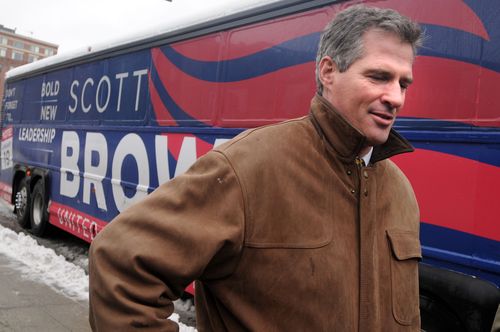
Reihan offers an explanation for Brown’s seemingly contradictory stances on healthcare reform:
I believe, and I get the strong impression that Brown believes, that health reform is an issue that should be handled differently in different regions of the country. The Massachusetts reform model might prove to be a decent fit for Massachusetts — the jury is still out, and it’s a commonplace that the model is in desperate need to delivery-system reform. But perhaps Hawaii will want to experiment with a single-payer system and Texas will want to experiment with universal catastrophic coverage and Minnesota will choose something in between.
He also challenges my take on Republican nihilism:
[T]here are some aspects of the Brown campaign that are discouraging, including the fact that he doesn’t balance talk of tax cuts with serious talk of spending cuts — indeed, he is adamantly opposed to even very modest Medicare cuts. […] There are many, many ironies in the Brownthusiam, but the most notable is the fact that this suburban father with a rather blandly centrist voting record has become the target of apocalyptic rhetoric from both sides. Really, the question is whether or not he has decent judgment. His record suggests that he’s good at making fine distinctions and voting in a pragmatic, constituency-focused manner. I’d prefer a more cost-conscious legislator myself, but he certainly doesn’t come across as a nihilist bent on the destruction of government.
No, that’s just the agenda his election will empower and he will never resist. But one can only admire Reihan for his continuing attempt to find reason in what’s left of the GOP. If anyone really thinks that Brown’s opposition to the health insurance bill is a function of a deep reflection on federalism (where the GOP position is actually for buying insurance across state lines), he’s a more trusting fellow than I am.
(Photo: Darren McCollester/Getty.)
Cartman Bait
A ginger kid throws down the gauntlet. Bitches.
 The Dish