What If Coakley Loses The 60th Vote?

Chait ponders the alternatives for healthcare:

1. Finish up the House-Senate negotiations quickly and hold a vote before Scott Brown is seated. Republicans will scream, but how could they scream any louder? It's a process argument of murky merits that will be long forgotten by November.

2. Get the House to pass the Senate bill, and maybe use a reconciliation bill (which only needs a Senate majority to pass) to implement as many House-Senate compromises as possible.

3. Go back to Olympia Snowe.

I have not seen any persuasive reporting, or even conjecture, about what Snowe is actually thinking. Her substantive demands have been met. By the end of the process, her only demand was to delay the bill by some unspecified time period, which is such a vacuous demand that it's hard to believe it represents her actual beliefs. Did she turn against the bill completely? Did she decide that she couldn't take the heat for voting yes? Or did she figure that, with sixty Democrats, her voted wouldn't really be needed so there was no reason for her to take the heat? If options 1 and 2 fail, we may find out about Snowe.

Obviously, the alternative is option 4: Crawl into a hole and die.

The Uber-Trendline

Matrends2

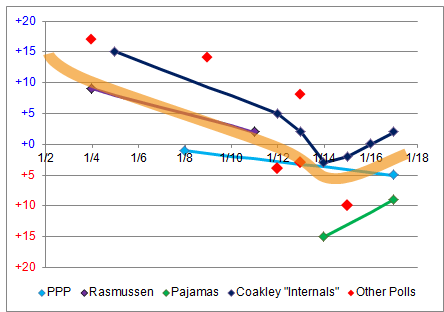
Nate Silver tries to make sense of all the polls in a special election – which is what he’s paid to do, I guess. For what it’s worth, here’s his explanation:

Guessing, guessing — I’m using that word a lot, guessing. When we’re looking at a Presidential race, we don’t have to guess as much, because we can look not only at polls in a particular state, but also at polls from other, similar states, as well as national polls, including several daily trackers. Under those circumstances, this method can be quite robust. Here, it is less so.

But this is also true for the Pollster.com approach. If you take the Pajamas Media polls out of their average, for instance, their characterization of the race goes from Brown +7.9 to Coakley +1.2! That’s not especially robust, either.

My suspicion is that Coakley is toast. But then I also thought that Hoffman would win NY 23. And that Obama would win New Hampshire in the primaries.

Map Of The Day

Oilimports

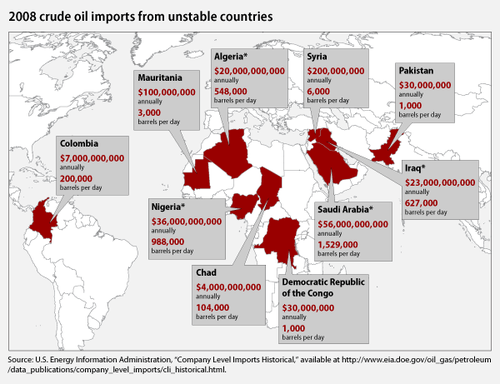
CAP has made a map showing US oil imports from "unstable countries." Brad Plumer studies the graphic:

That's from a new report titled "Oil Dependence is a Dangerous Habit," which estimates that the United States now spends $1 billion per day on oil imports, with most of that money going to unstable or dangerous regimes (although our two top suppliers are still Mexico and Canada). One thing to note is that, for these purposes, it doesn't really matter where we're buying from. Oil's extremely fungible—even though Iran can't legally sell crude to the United States, increased demand on our part (or shrinking supply) still benefits the regime in Tehran by driving up overall prices.

Quote For The Day

"How does one determine when a law is just or unjust? A just law is a man-made code that squares with the moral law, or the law of God. An unjust law is a code that is out of harmony with the moral law. To put it in the terms of St. Thomas Aquinas, an unjust law is a human law that is not rooted in eternal and natural law. Any law that uplifts human personality is just. Any law that degrades human personality is unjust. All segregation statutes are unjust because segregation distorts the soul and damages the personality …" – Martin Luther King Jr.

The Un-Cheney

The last president doesn't try to drag down the current president:

GREGORY: In some circles, the President’s been criticized for politicizing this disaster. Do you think that’s fair?

BUSH: I don’t know what they’re talking about. I’ve been briefed by the President about the response. And as I said in my opening comment, I appreciate the President’s quick response to this disaster.

The Iraq Surge’s Acid Test

IRAQBLOOD:AFP

Yes, the signs are almost text-book. Barring popular Sunni leaders from the March election; growing levels of violence; demonstrations that Sunni terrorists can destroy core ministries if they want to; no resolution to Kirkuk; even as the US prepares to withdraw. This, remember, is the acid test for the surge, according to Petraeus' own criteria. Has it managed to forge a new political settlement between the sects? Is that settlement durable? Now that we have armed and trained all sides, will an even more bitter civil war break out? If it does, we should not delay departing. We have done all we can for the ungrateful volcano, without being dragged back into decades of occupation.

Lynch reacts to the Iraqi government banning various Sunni politicians from participating in the next election:

The real significance of the electoral ban is not that it is likely to retrigger a sectarian war or lead to apocalyptic outcomes.  It's more a manifestation of ongoing, lingering problems that continue to erode confidence in the emerging Iraqi state and erode the legitimacy of the evolving political system.  It certainly doesn't mean that the U.S. should rethink its commitment to drawing down its military forces there, as some will likely suggest.

Indeed, the American commitment to withdraw did help to focus Iraqi minds, and some progress has been made on key issues — though clearly not enough.  These Iraqi problems have persisted and evolved despite the ongoing presence of large numbers of U.S. troops, and keeping them there longer wouldn't do any more to solve them.    It would also infuriate Iraqi public opinion, and violate the SOFA agreement.   The U.S. should remain politically engaged and supportive but military force levels really aren't the issue.

(Photo: An Iraqi man gestures as he explains his injuries while being brought into the emergency room of a hospital in the northeastern town of Baquba, 60 kms from Baghdad on January 11, 2010. Five people were injured in total when a road side bomb detonated south of Baquba as they passed by. AFP.)

Three Corpses In Gitmo: The Very Worst Seems True

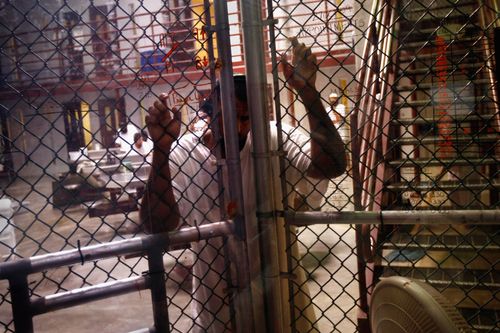
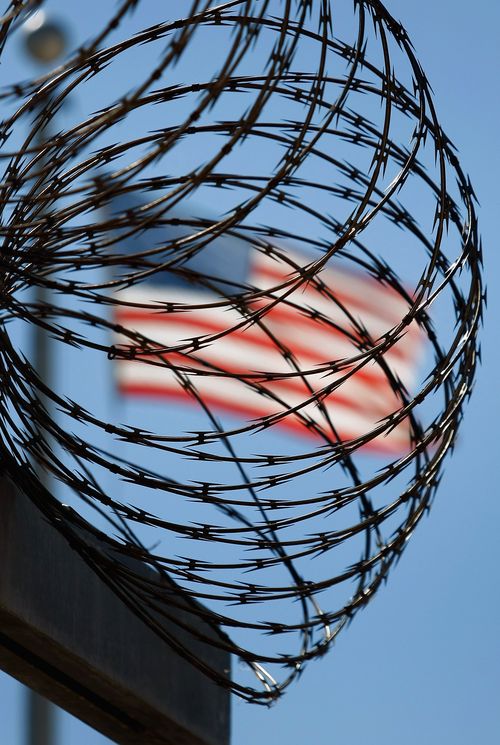
We have been told for so long that "enhanced interrogation techniques" are just "aggressive questioning"; that the ancient waterboarding technique is not torture; that Guantanamo Bay is a model prison facility GITMOFLAGJOHNMOORE:GETTY where detainees are, if anything, molly-coddled (in fact, Rudy Giuliani recently opined that "Guantanamo is better than half the Federal prisons.") We are also told routinely on Fox News that the United States has not and never would torture prisoners; we are told by the New York Times and NPR that use of the word "torture" is too biased; we have been told by many that to argue that George W. Bush and Dick Cheney are war criminals is such an extreme position it disgraces anyone who states it, and marginalizes them to the fever swamps of leftist haters and hysterics.
These are all lies. They are pre-meditated lies. They are attempts to lie about some of the worst crimes committed by a president and vice-president of the United States in history. Anyone with their eyes open and their mind not closed knows this somewhere deep inside. And the only reason we do not know more about this is because of the criminal cover-up under the Bush administration and the enraging refusal of the Obama administration to do the right thing and open all of it to sunlight.

In the past, the Bush-Cheney administration could cover up their total control of the torture program and their direct authorization of the techniques used at Abu Ghraib by several distancing moves: "we are shocked that this happened"; it was the work of a "few bad apples"; the techniques we use are "relatively benign"; waterboarding is only torture if the Communists do it, and so on.

But now we have a clear case of something that pierces through this mendacity like a dagger – Scott Horton's haunting report in Harpers on those three strange 2006 suicides at Gitmo.

In Gitmo, the most tightly controlled and directly monitored prison and torture camp under Cheney's control, we already had a report that casts extraordinary doubt on the story-line that three deaths in Gitmo in 2006 were suicides. Dish readers may recall my recent airing of it here. Now, we have guards who have given clear and powerful evidence that strongly suggests that the three prisoners who allegedly hanged themselves did no such thing.

There are now credible accounts that, far from being suicides, these deaths were either the result of serious negligence in treatment of prisoners under "enhanced interrogation" or that, quite simply, they were tortured IRFJohnMoore:Getty so badly in what appears to be a secret Gitmo black site that they died. Their deaths were then covered up and faked as suicides. Like some footnote in Daniel Jonah Goldhagen's work, these suicides were nonetheless described by the military as aggressive acts of asymmetrical warfare against the U.S. Many branches of government must have been involved in such an act of torture or negligence or both, and the subsequent cover-up – from the FBI, the Justice Department, the State Department, the Pentagon and the CIA, and JSOC. The cover-up appears to have been continued by the Obama administration – a staggering surrender to pragmatism that is in fact a cooptation of evil.
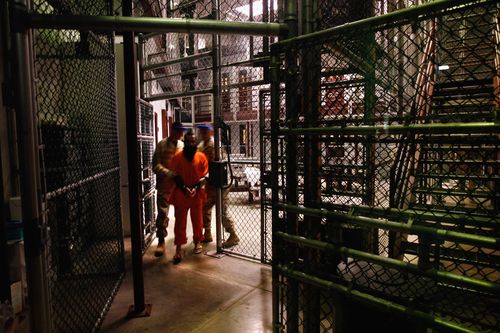
This deserves to be the biggest story on the torture issue since Abu Ghraib – because it threatens to tear down the wall of lies and denial that have protected Americans from facing what the last administration actually did. Notice that these torture sessions – so severe they killed three prisoners – were conducted in June 2006. Long after the original crisis was over. Long after we have been told real torture sessions occurred. They were part of an ongoing torture program whose methods were so extreme that the Pentagon has already conceded that over a dozen prisoners had been tortured to death and up to a hundred US authorized deaths-by-torture are alleged by many human rights groups.

This case deserves a thorough and complete and exhaustive inquiry and investigation. I no longer believe that any entity in the US government can be trusted with such a task. The investigation must be able to go right to the very top of the torture program and do so with no political influence whatsoever. The investigation must be conducted by an independent prosecutor – Patrick Fitzgerald comes to mind – or by the Red Cross or an international body. It must go up the chain of command to the very top to find the real people who are responsible for this war crime and three homicides.

Among those who need to be subpoenaed are the former president and vice-president of the United States.

(Photos: Gitmo, John Moore/Getty)
From Fishback To Hickman: The American Soldier Comes Through

GITMOHANGJohnMoore:Getty

The Harpers piece has many eye-opening details. Like so many in the military, FBI and CIA who stood up against the Bush-Cheney torture program, Army Staff Sergeant Joseph Hickman, stationed at Gitmo, is a proud conservative:

Hickman grew up in Baltimore and joined the Marines in 1983, at the age of nineteen. When I interviewed him in January at his home in Wisconsin, he told me he had been inspired to enlist by Ronald Reagan, “the greatest president we’ve ever had.” He worked in a military intelligence unit and was eventually tapped for Reagan’s Presidential Guard detail, an assignment reserved for model soldiers. When his four years were up, Hickman returned home, where he worked a series of security jobs—prison transport, executive protection, and eventually private investigations. After September, he decided to re-enlist, at thirty-seven, this time in the Army National Guard…

Sergeant Joe Hickman’s tour of duty, which ended in March 2007, was distinguished: he was selected as Guanta?namo’s “NCO of the Quarter” and was given a commendation medal. When he returned to the United States, he was promoted to staff sergeant and worked in Maryland as an Army recruiter before settling eventually in Wisconsin. But he could not for- get what he had seen at Guanta?namo. When Barack Obama became president, Hickman de- cided to act. “I thought that with a new administration and new ideas I could actually come forward, ” he said. “It was haunting me.”

This is the character of the witness who has come forward. Hickman got to know the Gitmo compound quite quickly. And he also noticed a separate building where prisoners were sometimes transported in a paddy wagon:

The compound was not visible from the main road, and the access road was chained off. The Guardsman who told Davila about the compound had said, “This place does not exist,” and Hickman, who was frequently put in charge of security for all of Camp America, was not briefed about the site. Nevertheless, Davila said, other soldiers—many of whom were required to patrol the outside perimeter of Camp America—had seen the compound, and many speculated about its purpose. One theory was that it was being used by some of the non-uniformed government personnel who frequently showed up in the camps and were widely thought to be CIA agents.

A friend of Hickman’s had nicknamed the compound “Camp No,” the idea being that anyone who asked if it existed would be told, “No, it doesn’t.” He and Davila made a point of stopping by whenever they had the chance; once, Hickman said, he heard a “series of screams” from within the compound.

This Is What Bush Called “Asking Some Questions”

GITMOPANEBreenanLinsley_AFP_Getty

New details about one of the Cheney torture techniques that may have killed three prisoners at Gitmo:

On June 9th, 2006, [Aamer] was beaten for two and a half hours straight. Seven naval military police participated in his beating. Mr. Aamer stated he had refused to provide a retina scan and fingerprints. He reported to me that he was strapped to a chair, fully restrained at the head, arms and legs. The MPs inflicted so much pain, Mr. Aamer said he thought he was going to die. The MPs pressed on pressure points all over his body: his temples, just under his jawline, in the hollow beneath his ears. They choked him. They bent his nose repeatedly so hard to the side he thought it would break. They pinched his thighs and feet constantly. They gouged his eyes. They held his eyes open and shined a mag-lite in them for minutes on end, generating intense heat. They bent his fingers until he screamed. When he screamed, they cut off his airway, then put a mask on him so he could not cry out.

The treatment Aamer describes is noteworthy because it produces excruciating pain without leaving lasting marks. Still, the fact that Aamer had his airway cut off and a mask put over his face “so he could not cry out” is an alarming fact. This is the same technique that appears to have been used on the three deceased prisoners.

This was Hickman's memory of the frantic scene after the alleged suicides:

He asked a distraught medical corpsman what had happened. She said three dead prisoners had been delivered to the clinic. Hickman recalled her saying that they had died because they had rags stuffed down their throats, and that one of them was severely bruised. Davila told me he spoke to Navy guards who said the men had died as the result of having rags stuffed down their throats.

But what really takes you into the realm of totalitarian states is the chilling fact that the bodies were returned to their families in pieces. One part of each body that had been removed was the neck:

The pathologists place the time of death “at least a couple of hours” before the bodies were discovered, which would be sometime before 10:30 p.m. on June 9. Additionally, the autopsy of Al-Salami states that his hyoid bone was broken, a phenomenon usually associated with manual strangulation, not hanging.

The report asserts that the hyoid was broken “during the removal of the neck organs.” An odd admission, given that these are the very body parts—the larynx, the hyoid bone, and the thyroid cartilage—that would have been essential to determining whether death occurred from hanging, from strangulation, or from choking. These parts remained missing when the men’s families finally received their bodies.

(Photo: In this photo, reviewed by the US military, an American flag waves, pictured through a broken window from inside a vacant airplane hangar used for media activities at Camp Justice, site of the US war crimes tribunal compound at Guantanamo Bay US Naval Base, Cuba, Thursday, July 16, 2009. By Brennan Linsley/AFP/Getty Images.)

The Weekend Wrap

This weekend on the Dish we primarily focused on tomorrow's special election. Reader perspectives from Massachusetts here, here, here, here, and here. More input here and here. Andrew's case against Scott Brown here and here. But he's not confident Coakley can win, partly due to awfulness like this, this, this, and this.

In other news, a prominent supporter of the Uganda bill is slated to attend the National Prayer Breakfast, Palin was caught in another lie, and pot prohibition got closer to its demise. In other coverage, David Dalrymple, Knutson, and a remixed BBC contemplated the internet and our reader-driven discussion of meth continued here and here.

Reflecting again on the president's first year in office, Andrew is still impressed.

— C.B.