Book Blurb Of The Day

From Rick Jacobs' live-blogging:

[Defense attorney David Thompson is] talking about a course [professor Nancy Cott] taught in 2007 on marriage. He tries to get her to say that Andrew Sullivan’s book is the best anthology on marriage today. She said it was “adequate” but she can’t say it was the best.

You can buy it here.

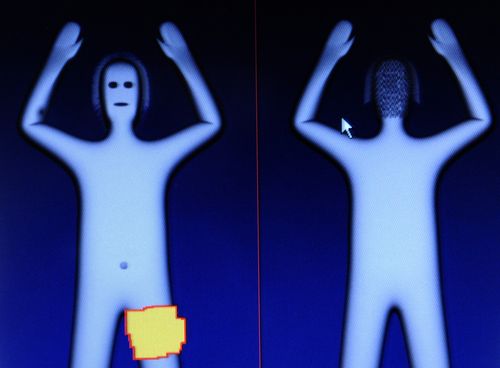
Does This Body Scanner Make Me Look Fat?

ScannerGetty

The graphics of a body scanner can be seen during its demonstration at Amsterdam's Schiphol airport on January 12, 2010. Schiphol airport currently uses 15 of the devices and has ordered 60 more after a flight traveling from Amsterdam to Detroit was targeted by a terror suspect on December 25, 2009. By David Hecker/AFP/Getty Images.

McGwire’s Steroid Use, Ctd

A reader writes:

Though I'm of the opinion that the only "steroid problem" is that steroids aren't good enough yet, I think I might be able to provide some insight on why the use of performance-enhancing drugs is excoriated in baseball and ignored in football. Statistics in baseball, as noted historian Bill James has said, have acquired the power of language.

Mention a statistic to a baseball fan (even stripped of all other context or presented as a simple number) and he or she will likely be able to connect it with an actual person or event. "60" and "714" are Babe Ruth. ".406" is Ted Williams. I work in the industry, so my experience may not be common to that of the typical fan, but if you gave me a baseball player's full statistical record completely stripped of any identifying details, I'd have a better than even chance of telling you when he played, what position he played, where he hit in the batting order — even more specific information like what he looked like or where he was from. In certain cases, I might even be able to simply give you his name just by looking at his stats.

To many fans or sportswriters, steroids disrupt the order of these statistics. They allow players to extend their careers, put up better numbers (steroids will not help you make contact with a curveball, but you will certainly hit it farther), and potentially break records that were previously held as sacrosanct. Baseball trades on its history — the idea that the game played today is no fundamentally different than the way it was played ten, twenty, or even a hundred years ago. That's never been entirely true, but with steroid use, it's rather obviously false.

Football has no such attachment to numbers (save for Wins and Losses). Unless a football record has just been broken or is on the verge of being broken, it has no place in a fan's consciousness. If a player who is using steroids breaks the all-time record for, say, sacks in a season, it doesn't carry the same emotional resonance as would a similar record being broken in baseball — because no one is able to recall the sack record number off the top of his head, or even who holds said record (I just looked it up: Michael Strahan, with 22.5).

The Year Of The Paywall?

The Economist calls it for 2010. Why?

Between the first quarter of 2003, when the Newspaper Association of America began tracking it, and the second quarter of 2007, online ad revenue consistently grew by more than 20% a year. Then it wobbled, and began to fall sharply. In the third quarter of 2009 American newspapers earned 17% less from online advertising than they had done a year earlier.

The opposite seems to be happening at the Atlantic, thanks to our amazing ad sales staff. I can see the value of some paywalls, but I just don't buy the business model long term. What the web values is connectivity as well as traffic. Paywalls kill off critical interaction with the wider blogosphere and reduce readership drastically. I can see why media moguls might want the paywalls as some kind of replacement for all the power and money they have lost over the last decade. But I fear that the moment has passed. There are too many amateurs out there as good as professionals; and the barrier to entry is minimal. Perhaps the media mogul is as endangered as the owners of record companies.

“It’s Shocking To Hear A Conservative Lawyer Espouse That Theory”

In case you missed it, Jon Stewart confronted war criminal John Yoo last night. The conservative defense of an executive branch with no limits to its powers at home or abroad is, well, as gob-smacking as it always has been. It is not, of course, a conservative argument at all. In its implications – in a war defined as unending and an executive defined as all-powerful – are proto-fascist: Jacksonianism with a waterboard.

I came away from the exchange, wondering if Yoo just isn't that smart, as well as shockingly ignorant of history, and morality. Maybe he was off his game. Or maybe Berkeley has lowered its standards. By the way, when on earth are we going to be able to read that OPR report on the shoddiness of Yoo's scholarship?

The full interview is here and here. Drum thinks that Yoo got the better of the interview:

The real problem with interviewing Yoo is this: once you start arguing about the legal basis of the president's wartime powers you've pretty much lost the game. That's a subject that's genuinely complex, and a guy like Stewart will never win an argument about that with a guy like Yoo. He'll just toss out yet another precedent and plow on. The debate really needed to be about the fundamentals: Stewart needed to graphically describe all the things that were done — multiple waterboardings, sleep deprivation, head slamming, stress positions, etc. — and get Yoo to defend those as permissible.
It’s Warm Outside. Somewhere.

Bradford Plumer counters climate change skeptics trumpeting the recent chilly weather in the eastern US:

Here's a handy animated map from NOAA showing all the places on the planet where it's unseasonably warm and unseasonably cool right now. Curiously, the freak cold seems to be occurring everywhere major media centers are located—the northeastern United States, Europe, Japan—so the chilly weather's grabbing all the headlines. But it's anomalously warm just about everywhere else in the world, especially the Arctic.

But this piece suggests that a cyclical pattern is cooling us temporarily even as the long term prognosis remains worrying. Which means that the politics of persuading people to move away from carbon just got even harder. Of course I once feared Ptown would disappear beneath the tide. Now it just seems like we'll have a lifetime of crappy summers.

Classic Palin

Her address to the Tea Party Convention will be sealed off from the press, according to this report. Like her campaign in 2008:

The restrictions apparently apply to the much-anticipated speeches by Sarah Palin and Minnesota’s own Michele Bachmann. Organizers say that journalists without passes will not be allowed into the convention at the Gaylord Opryland Hotel. (A Star Tribune request for a pass was denied, the paper’s interest in covering its home-state congresswoman notwithstanding).

There is something deeply creepy about this. But also deeply familiar. Populists who want to speak only to the inner circle? Yep, sounds like Palin. The marination of the far right in its own juices – see Ailes, Roger – intensifies.

Dissent Of The Day

A reader writes:

My god, where's your empathy on this?  Cats hate water and you can clearly see that they are terrified. They are forcibly thrown into a pool. Then the video makes fun of the idea of tossing them off a building.  Are you out of your mind?  This is exactly what psychopathic adolescents take pleasure in!  Please pull the video from the site and reassess your sense of humor.

I can see the reader's point, but the cats are not harmed and the swimming is designed to save their lives. Some cats, moreover, are not phobic of water. See here. I just thought it was weird, not funny. Still, on reflection it could be interpreted that way so we've replaced it with a video of cat self-empowerment. Thanks for the input. Our taste is fallible.

What Is Hurting Marriage?

Silver looks at divorce rates in states with gay marriage bans:

Over the past decade or so, divorce has gradually become more uncommon in the United States. Since 2003, however, the decline in divorce rates has been largely confined to states which have not passed a state constitutional ban on gay marriage. These states saw their divorce rates decrease by an average of 8 percent between 2003 and 2008. States which had passed a same-sex marriage ban as of January 1, 2008, however, saw their divorce rates rise by about 1 percent over the same period.

Maybe not allowing gays to marry accelerates the decline of heterosexual marriage? Of course, these things are almost certainly unrelated. But federalism is working its magic, allowing us to assess the reality of marriage equality. The reality is: the notion that it will in any way undermine heterosexual marriage is a total canard. But then I haven't heard a peep out of Stanley Kurtz in quite a while.