Hiding Behind Hypotheticals

Friedersdorf counters Jonah Goldberg:

Among the many problems with the ticking time bomb scenario is the fact that it is basically about what an individual should do in an awful circumstance, not what legal regime a country should adopt when weighing the treatment of prisoners. The United States not only should prohibit torture in the handling of detainees, it already has done so. Today’s torture advocates think that the law should state otherwise, but are unwilling to admit as much, so they construct Orwellian descriptions like “enhanced interrogation techniques” to describe water-boarding. The semantic debate about torture is their creation, and at bottom, it matters because if it’s proved that water-boarding is torture, they’ll have been proved to have broken the law.

I just believe that every neocon who says that waterboarding isn't torture should personally go to Cambodia and demand that the waterboard be removed from the torture museum. And every neocon should have the intellectual fortitude to point out that, by their definition, John McCain was never tortured in Vietnam. Just "aggressively questioned" to use Reuel Marc Gerecht's latest absurd and frankly disgusting euphemism.

“Fiscal Crisis Is The New Normal”

Stephen Goldsmith lays out the ugly, awful, no-good, alarming fact:

Under reasonable budget and economic assumptions, the federal debt, now at about 40% of GDP could reach 200% of our total annual economy by 2038. Systemic economic meltdown – a currency crisis, for example – would likely occur before lenders allowed debt to reach those astronomical levels.

I disagree with his notion that stimulus this year to avoid a global abyss was misguided. I think it was prudent. But I share his conviction that this has only made long-term matters far worse. We were headed off the cliff anyway, but this recession has accelerated our journey thither. I also understand Goldsmith's worry that tax increases simply aren't politically viable. But it strikes me as completely utopian to think we can get back to sanity without some reform on the revenue side. This is only the first article in the series. But it's serious in a way Tea Party populists are not. And that's a good sign for fiscal conservatism.

(Hat tip: Yuval Levin.)

Developed Countries Never Decline?

While responding to Fallows article on American power, Yglesias argues that almost all decline is relative:

It’s not just that America is resilient in the face of perceived pitfalls, but so are Switzerland and the Netherlands and everyplace else. The countries that were rich 100 years ago are basically all still the rich countries today. This isn’t an absolute law of nature since there is the case of Argentina, but the point is that it would be really bizarre for the United States to enter a sustained period of decline…The plausible range of future outcomes for the United States is between average living standards being a little bit higher twenty years from now, and average living standards being a lot higher twenty years from now.

If Iran Gets The Bomb

Kevin Sullivan takes issue with this post:

[U]nlike [Andrew] Sullivan, I don't believe American policy toward Iran should be dramatically affected by the ebbs and flows of Iranian unrest. I've made the case before, so I'll keep it shorter here: if Iran gets the bomb I believe it will enable the regime to crackdown on dissidents with never before seen impunity. Thus, to accept a nuclear-armed Iran and hope for the best, as Andrew seems resigned to doing, strikes me as wrongheaded and harmful for everyone invested in a better Iran–both inside and outside of the country.

Larison isn't so sure:

Kevin Sullivan argues that “if Iran gets the bomb I believe it will enable the regime to crackdown on dissidents with never before seen impunity.” This is possible, but I’m not sure that the two are all that closely linked. At present, Iran can already crack down on dissidents however and whenever it likes with impunity, and I don’t know that acquiring a nuclear weapon would add much to its willingness or ability to engage in such crackdowns. Outside intervention on behalf of Iranian dissidents will not be forthcoming anyway, so even the nuclear deterrent a bomb would provide would not make much difference.

The dissidents themselves disagree with Sullivan. I share Larison's skepticism. What the nuke does is balance Israel's regional hegemony and will allow Iran leadership to continue their harassment of the Jewish state – and Sunni Arab states – through proxies. I agree that that is a bad thing. I just find all the alternatives much worse, from the point of view of the interests of the United States.

The Europe vs America Debate

Krugman accuses Manzi of using inaccurate data when comparing Europe and the US. Manzi replies. Noah Millman finds the focus on European and American GDP surprising. His addition to the conversation:

[T]he EU has not had a static membership. Just as America has grown through immigration, the EU has grown – substantially – through adding more members. Just as immigration has put some strain on the American social fabric, EU expansion has put some strain on the political fabric of the EU – take a look at the French reaction to the influx of Poles, or the increasingly unviable CAP. But in both cases, growth has meant greater aggregate economic power, and therefore greater global influence – where political institutions have been able to harness that power.

Tyler Cowen weighs in here.

Ted Olson, A Conservative For Civil Rights

“I do not believe that our society can ever live up to the promise of equality, and the fundamental rights to life, liberty, and the pursuit of happiness, until we stop invidious discrimination on the basis of sexual orientation,” – Ted Olson.

I’ve spent much of the last decade being more and more depressed by the direction of American conservatism. Ted Olson reminds me why I should hold out hope. I wrote the conservative case for gay marriage twenty years ago, and am grateful for those heterosexual conservatives and libertarians – David Brooks comes to mind – who could see what I was getting at. But my being gay, of course, made this sound unavoidably self-serving. And the emergence of an establishment Republican figure who has the courage of his convictions was a dream that never quite happened. Yes, we had Weld, who is awesome. And we had Cheney – but he lifted not a finger to prevent the anti-gay putsch among Republicans, and never ever made a substantive argument in public against discrimination. He has never even publicly taken on Virginia’s GOP which has stripped his own family of basic civil protections. And then comes Olson. Olson is different – a man of impeccable establishment conservative credentials who sees the injustice and perversity of singling out gay couples for truly punitive government discrimination. And his lawsuit, which I began by fearing, seems to me to be a truly breakthrough event. His rationale is laid out in Newsweek. It is the best summation of the conservative case for marriage equality by a straight guy I have ever read. And I’d be lying if I didn’t find tears in my eyes by the end of it. Please read it. Its logic is so strong, its argument so solid, its empathy so vivid it reminds me of what a small government, inclusive, tolerant conservatism could truly be. It reminds me of how conservatism could and should be recast – and not as a p.r. message but as a reality – in defense of minority civil rights. It reminds me of when the GOP was not essentially a product of Dixie.

The arguments are mostly familiar to me, of course. But they are laid out with admirable candor and conviction. I have two money quotes, the first of which I’d never thought of in two decades of reading and writing on this:

The procreation argument cannot be taken seriously.

We do not inquire whether heterosexual couples intend to bear children, or have the capacity to have children, before we allow them to marry. We permit marriage by the elderly, by prison inmates, and by persons who have no intention of having children. What’s more, it is pernicious to think marriage should be limited to heterosexuals because of the state’s desire to promote procreation. We would surely not accept as constitutional a ban on marriage if a state were to decide, as China has done, to discourage procreation.

But what he also does is take into account both the fact of gay lives and the message marriage inequality sends:

No matter what you think of homosexuality, it is a fact that gays and lesbians are members of our families, clubs, and workplaces. They are our doctors, our teachers, our soldiers (whether we admit it or not), and our friends. They yearn for acceptance, stable relationships, and success in their lives, just like the rest of us.

Conservatives and liberals alike need to come together on principles that surely unite us. Certainly, we can agree on the value of strong families, lasting domestic relationships, and communities populated by persons with recognized and sanctioned bonds to one another. Confining some of our neighbors and friends who share these same values to an outlaw or second-class status undermines their sense of belonging and weakens their ties with the rest of us and what should be our common aspirations. Even those whose religious convictions preclude endorsement of what they may perceive as an unacceptable “lifestyle” should recognize that disapproval should not warrant stigmatization and unequal treatment.

When we refuse to accord this status to gays and lesbians, we discourage them from forming the same relationships we encourage for others. And we are also telling them, those who love them, and society as a whole that their relationships are less worthy, less legitimate, less permanent, and less valued. We demean their relationships and we demean them as individuals. I cannot imagine how we benefit as a society by doing so.

That is the core argument I made in Virtually Normal. To have it expressed and improved on and broadcast by a heterosexual conservative in 2010 is a moment to savor.

Know hope.
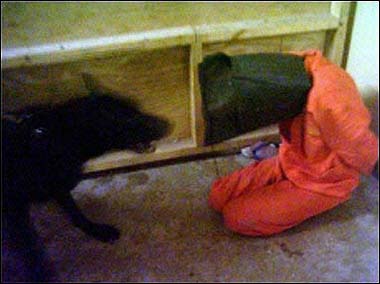
Sorry, Jonah, Conservatives Do Back Abu Ghraib, Ctd

Capt4

Last week, I countered Jonah Goldberg’s belief that all conservatives disdained and were horrified by Abu Ghraib, and argued that the magazine’s endorsement of almost all the techniques revealed at Abu Ghraib made Goldberg’s anti-Abu Ghraib position incomprehensible.

I know they have a policy of not responding to this blog but it does seem to me basic journalistic due diligence to respond to such a well-supported argument. So let me pose this question in the hope that someone cares enough about the reputation of National Review to respond.

Which of the techniques revealed at Abu Ghraib does NRO specifically disavow and which do they support? (To take one simple instance, does Goldberg support the technique shown above, with a hooded Muslim man being terrified by a dog he cannot see?) I summarize the techniques approved for us by Bush and Cheney in the post. Many of them were indeed used at Abu Ghraib as well as elsewhere.

So by what criteria do they distinguish what happened at Abu Ghraib from what Cheney and Bush mandated for prisoners in their “enhanced interrogation program”? This is an important question; and it deserves an answer.

Greenwald Bait

Who was the source for Harry Reid's comments about Obama that have caused such a kerfuffle? Harry Reid. To Heilemann and Halperin, according to Mike "Cheney spokesman" Allen. The question is: did Reid say it on background or off-the-record? John Heilemann (an old friend) said the following on GMA this morning:

“We did no off-the-record interviews and we have burned no sources with this book.”

In the book, John and Mark write:

“All of our interviews — from those with junior staffers to those with the candidates themselves — were conducted on a ‘deep background’ basis, which means we agreed not to identify the subjects as sources in any way.”

So I'm confused. Did this anecdote come from Reid on deep background? Or from someone else? Heilemann and Halperin won't say – on the record. Clear now?