A reader writes:
Larison wrote:
Most revolutions do have specific goals and demands, most of the successful ones do have organized leadership that can mobilize at least a dedicated cadre of followers, and most have some idea what means they will need to exact the concessions they desire and have some idea of how to acquire these means.
It's important to not let the future determine the past in the understanding of revolutions, or read the causes from the outcomes. Why the Bourbon, tsarist, Stalinist, Pahlavi states fell to popular revolt is a different question than why the Jacobins, Bolsheviks, liberals, and Islamists respectively won.
There was a long debate in the 1970s to 1990s about the causes and dynamics of revolutions. Names like Barrington Moore, Theda Skocpol, Nikki Keddie may be familiar to those who studied political science at the time.
But if we read not from outcome to past but from the uprising to when a successful revolution unfolds, we find it hard to discern clear patterns apart from the obvious, or definitional, like the state's security apparatus becomes ineffective.
If we're to take the criterion of organized leadership for example, we have a dearth in some revolutions and an embarrassment of riches in others.
Russian 1917: anarchists, social revolutionaries, left social revolutionaries, mensheviks, bolsheviks, constitutional democrats.
Iran: the fedayeen, the mojahadeen-e-khalq, various liberals, the islamist, the freedom movement of iran, the tuden (commies); among leaders it wasn't just Khomeini, but also Taleghani and Bazargan.
The various factions of the French Revolution gave birth to the observation that revolutions eat their own children.
Many of the East European revolutions have less clear leadership. (In Poland the leadership was clear, but then organized opposition to the regime started in 1980). They of course did have notable dissidents around whom revolutionaries (very, very quickly) organized, e.g., Havel.
There are revolutions where there are lots and lots of often non-compatible ideas of what it means to win or exact concessions–Russia, France, Portugal—examples of singular clear ideas–the communist revolution in China—no clear and/or explicit ideas explicitly until very near the end. And we can mix and match: the Cuban revolution had clear leadership, but Castro and Che embraced communism after they won. Iran 1979 is a case of few if any clear and/or explicit ideas, as Khomeini was famous about messages that were all things to all people, hence his support from secularists and Marxists like the Fedayeen.
My points are (i) again that there's a difference between asking what lead the tsarist state to collapse to opposition and why did the Bolsheviks win, and (ii) there are too many variations in the experience of revolutions to make general statements apart from fairly trivial ones.
Another reader:
Mr. Larison’s examples are faulty. Successful revolutions may well have organized groups with well-developed systems of ideas that express their desired outcome. They may well have a pre-existing cadre of leadership. The October Revolution in Russia and the Chinese Revolution spring to mind. But the example he chooses to demonstrate the significance of these factors, 1848, actually demonstrates the exact opposite of his claim.
The French portion of the 1848 Revolutions may well have been the most long expected and planned for revolution in modern history. Specific figures developed coherent ideologies of revolt, clandestine organizations etc. well before hand. Paris was notoriously legion with revolutionaries in the 1830s and 1840s. Early innovations in secret police work were famously associated with Paris. The 1848 revolution in France did not succeed in because of these revolutionary organizers and their various plans. It may have failed in June because of them. The revolutions in Italy and Hungary were able to draw on well established nationalist ideas and leaders to legitimate those revolutions. The essential demands of the German part of 1848 developed almost instantaneously with the Mannheim Demands in February 1848. All of these revolutions in 1848 were far better organized and led revolutions than the grand-daddy of them all, the 1789 French Revolution.
No one expected a revolution in 1789. The initial leadership certainly had no intention of permitting anything like the radicalism that developed. They had only very hazy positive ideas of reform. They got far more than that. So much so that one of the most important leaders in 1789, Mirabeau, began plotting against the revolution. Revolutions may be planned, but the plans are only tangentially relevant. Revolutions happen when the authority of the pre-existing regime collapses. Those ‘revolutionary’ ideas and programs are generally the efforts of ‘revolutionaries’ to organize and legitimate forces they cannot control.
Consider the German revolution of 1918. The “leadership” of that revolution (at least until January 1919) was a Majority SPD party that in reality did not really want a revolution . They had gotten all they really needed in the September reforms. All the Revolution in November did was saddle them with total responsibility for the mess that the Kaiser’s government had created. They were, as the SPD’s “leader” said, the “liquidators of the old regime”. And though they might not have wanted a revolution, they got one because they Kaiser’s government had become a hollow, useless husk. Similarly, the February Revolution in 1917 was essentially leader-less because it was, essentially, the collapse of the old regime’s ability to command consent. Who was the “leader” of East Germany’s revolution in 1989? Many people, but the key was the failure of the old regime. The key events of that revolution were the unwillingness of the SED to open fire on the Leipzig crowds in October and their inability to recover from a routine bureaucratic flub, i.e. the opening of the wall. Leadership, programs, plans are all well and good once the revolution has happened. They simply do not matter that much in starting it.

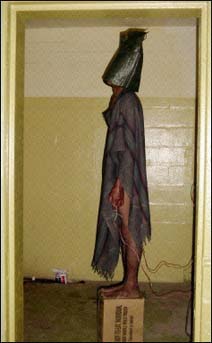 Sure. In fact, that’s been the “conservative” position for six years now. Let’s run down the Abu Ghraib techniques that we saw in those photos, shall we? Stress positions? Supported by NRO. Forced hooding and stripping? Backed by NRO. Mock executions? Backed by NRO. Forced nudity? Backed by NRO. Multiple beatings? Backed by NRO. Use of dogs to terrify? Backed by NRO. Sexual abuse? In some respects – such as smearing fake menstrual blood on the faces of naked, shackled prisoners – NRO found nothing wrong with that either. Now remember what other “enhanced interrogation techniques” National Review also now supports that did not actually occur at Abu Ghraib: freezing prisoners to near death with ice, water and naked exposure to very low temperatures; repeated near-drowning of human beings tied to a board; sleep deprivation up to 960 hours; slamming a human being repeatedly with a neck collar against a plywood wall; forcing human beings into upright coffins for long periods of time and tormenting them with phobias, like the rats in Orwell’s 1984. Any conservative who says he or she supports these “enhanced interrogation techniques” pioneered by Cheney therefore logically supports almost every atrocity at Abu Ghraib. So man up, Jonah. Quit the lies and own this or disown it. And no “well I haven’t thought about this that much” or ‘there’s no evidence linking Abu Ghraib to Cheney – when the Senate’s own bipartisan report directly and unanimously linked the techniques at Abu Ghraib to the Bush White House. In fact, in its support for “enhanced interrogation techniques,” NRO doesn’t merely support what happened at Abu Ghraib but believes that prisoners there were treated better than they should have been. On the same Corner blog, one NRO contributor last week actually proposed grouping prisoners in one ethnic group and murdering them in one go with a missile, even though many were admittedly innocent. And Jonah wants to say that conservatives at National Review oppose the techniques at Abu Ghraib!
 The Dish