The Leveretts Again

A reader writes:

An indication of the Leveretts' bias is revealed in the very quote you cite: compare "Antigovernment Iranian Web sites claim there were 'tens of thousands' of Ashura protesters" with "one Web site that opposed President Mahmoud Ahmadinejad’s re-election in June estimated the crowds at one million people."

Why is "tens of thousands" in quotes while "one million" is not?  Especially when there appears to be more than one site to support the former number, while only one to support the latter ("Web sites" vs. "one Web site").

Note, too, how they slip in that A'jad was "re-elected."  Why one should take them seriously given their demonstrably erroneous post-election analysis is beyond me.  

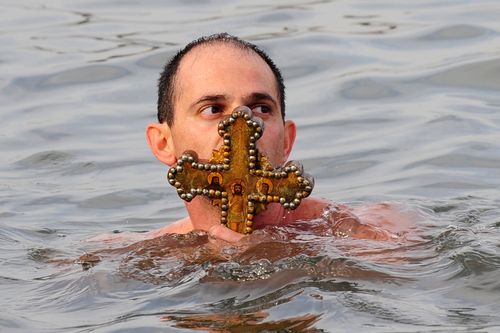
Face Of The Day

EPIPHMustafaOzer:AFP:Getty

Orthodox follower Ouzinos Panaiotis kisses the wooden cross thrown by Fener Orthodox Patriarch Bartholomew in the Golden Horn after a mass as part of celebrations of the Epiphany day at the Church of Fener Orthodox Patriarchiate in Istanbul, on January 6, 2010.The Orthodox faith uses the old Julian calendar in which Christmas falls 13 days after its more widespread Gregorian calendar counterpart on December 25. By Mustafa Ozer/AFP/Getty.

The View From “Jew Town”

A reader writes:

When I visited Cochin in late 2006, I experienced massive cognitive dissonance in the streets and alleys around the Pardesi Synagogue. Wrought iron security grills on windows are ubiquitous in Indian urban areas, and the Jew Town neighborhood is no exception. It is pretty common for these grills to be decorated as well as functional, and I had an extremely hard time wrapping my head around grills adorned with the Star of David immediately adjacent to grills with swastikas. Even knowing the Sanskrit origins of the symbol, it was a very jarring juxtaposition.

Another writes:

I am from Kerala and the Washington Post article about the "Jew Town" in Kochi didn't get the Kerala picture quite right. The whole article seems to portray a picture of ghettos where Jews live. This is quite contrary to life in Kerala. It is one of the most culturally diverse and open societies in India.

Kerala is a state which has the least animosity (in India) among the different religious communities. Reason being that Kerala is very diverse – 56% Hindus, 25% Muslims and 19% Christians. And Kerala has been ruled by kings of different religions at various times. The question about a Muslim being asked whether he minds working in Jew Town is extremely silly, because you cannot survive in Kerala if you start discriminating against people from other religions.

The question of Israel and Palestine is not on the radar screen on the average Malayalee. They have better things to worry about. Also, beef eating is very common in Kerala. This is unlike North India where beef eating is taboo. So the WP reporter just got it wrong.

Another:

I had heard of "Jew Town" from a business school classmate of mine who was from southern India (a Catholic who had been educated in British private schools and then served in the army in Kashmir, an interesting fellow to say the least) and was describing the ethnic mix in that region. Of course, I had the exact reaction to the term "Jew Town" as you'd expect. I quickly realized that there's no loaded connotation to that term among the Indians. They're not Louis Farrakhan and have no reason to suspect that such a term is charged in American discourse.

Why Marriage Matters, Ctd

It turns out I was wrong about David Cameron's proposal to reward marriage as an institution in the British tax system. A month ago, he said that the new tax rewards he's proposing would make no distinction between civil marriage and civil partnerships. More details here and here:

"I believe that a stable, loving home is the most precious thing a child can have. Society begins at home. Responsibility starts at home. That’s why we cannot be neutral on this.

Now I don’t live in some fantasy land where every family is happily married with 2.4 kids. Nor am I going to stand here and pretend that family life is always easy.

But by recognising marriage and civil partnerships in the tax system and abolishing the couple penalty in the benefits system, we’ll help make it that little bit easier."

I agree which is one reason I remain non-libertarian. And note that the Tory Party's official websites draw attention to this inclusive policy, and the embrace of the notion that gay couples too have a "home".

I believe in the institution of civil marriage as a way to nudge people toward more responsible, committed and healthy lives. No coercion, but gentle social encouragement. And since gays need this kind of support in our relationships as much as straights, of course we should be included in a genuinely conservative family policy.

And that's the difference between the Tories and Labour. Labour wants no special privilege for marriage. The Tories acknowledge the fact that marriage is a vital institution for a healthy society. And that's also the difference between the Tories and The Republicans. The Tories do not see the relationships of gay people as a threat. They see them as an asset. Imagine that. Imagine a conservatism that is not reliant on bigotry and fear and fundamentalism.
“Sick” Of The Israelis And The Palestinians, Ctd

A reader writes:

THANK YOU FOR SAYING THIS!  Right on the money.  I am with you all the way.  And of course Rahm said that.  That was probably a sanitized version of what he really said.  And any sane person would say the same thing. 

Another:

The White House may be sick of Israel and Palestinians. But you know what?  Obama and Rahm fucked this up royally (and I’m an Obama supporter). They went into office with good will on both sides, then without adequate planning made a politically impossible demand on Israel – a 100% settlement freeze, including Jerusalem and natural growth, contradicting written assurances from prior administrations. Do you have any conception how difficult a total settlement freeze would be to achieve for a newly elected Likud led government? Would such a policy have been sensible? Probably.

So, too, would renewal of the ban on semi-automatic weapons. What are the chances of getting that through Congress even with Democratic super majority? How about during a Republican administration? Middle East progress could have been achieved last year,  but it would have taken subtlety, and  careful planning, not the amateur hour stuff characterized by the pathetic approach to the Saudis. The result of all this has been that Abbas’s feet have been cut out from under him and Bibi is the most popular PM in years (and I’m not a Bibi supporter).

But if a total settlement freeze was essential to restarting the peace process and it is a sensible idea and it is simply impossible under the current Israeli government, then what do we do? At some point, it seems to me, we have to impose a settlement or walk away. Being dragged into their drama, which is what they live for, is a mug's game for a free people with other concerns and interests. The sooner we can do that the better. But it requires a serious non-carbon energy policy – and the Congress in the US will never be able to deliver that. So we're back to stalemate. And a deepening tension between the West and Islam, exacerbated by one of the US's closest allies that refuses to budge an inch.

This will have to change at some point.

Underestimating The Resistance

Dan Drezner tackles the Leveretts' shoddy analysis of events in Iran:

I'm not saying that there were more Ashura protestors than government protestors.  I would like to see more data on this .  I am saying that the Leveretts seem to be cherry-picking their protest numbers — which makes me seriously doubt the objectivity of the rest of their analysis.

“Colonization”

A reader writes:

Re: being sick of the Israelis and the Palestinians, as an old two-states-for-two-people hand, I couldn't agree more. But you used one word that I happen to have written to someone about today, and so it is much on my mind: "colonization."

It may seem like too much to focus on a single word, but I think that occasionally, individual words really matter, and while I am deeply, deeply opposed to the settlement project (and it is, indeed, as you describe, "brutalizing"), I find referring to it as "colonization" to be very problematic.

If I work from the assumption that Palestinian nationalism is legitimate, and that the Palestinians are as deserving as any other people to define themselves, and furthermore, if the international community accepts nationalism as the basis on which we're organizing international life (and I'm absolutely not certain that that's a good idea, but the fact is, that's what we've done), then I have to accept/acknowledge the story of Jewish nationalism, as well — and it's rooted in the land between the Jordan River and the Mediterranean.

This isn't like the English in Ireland or the French in Algeria, because the Jews aren't trying to establish a new, "civilizing" presence but are rather, in the terms of nationalist discourse, coming home.

Now, the fact is, we Jews have to get over ourselves. The Palestinians are in (already were in) their home, too. The fact is our home = their home and their home = our home. So, sharing is the only choice we have, and the Palestinians have already ceded the 78% of their home that they lost through war to us, so we have to be smart (and more aware that we actually WON the war) and cede 22% of our home to them.

Quote For The Day

"Some people expected the green movement to do miracles, to do the impossible. We wanted to make it clear that it's a democratic movement, and if it has a godfather, it is Gandhi. We are insisting adamantly that democratic, nonviolent change is at the heart of this movement. That will minimize the violence from the other side, which is ready to engage in any kind of violence." – Iranian philosopher, philosopher Abdulkarim Soroush.