Glenn Reynolds On The Shoe Bomber

Clearly in favor of a criminal prosecution in 2003:

TalkLeft notes:

The lesson is this: Our federal courts and our criminal justice system are well equipped to handle terror cases. There is no need to keep the suspects in military custody, cut off from lawyers –or to try them in secret military tribunals. Reid pleaded guilty to all counts and received no promises of leniency or other sentence concessions. Reid had excellent appointed counsel and a U.S. District Court Judge presiding over his case. The proceedings were open to the media and public. Important court filings by both the Prosecution and the Defense were available on the Internet. The Government got the conviction and the life sentence it sought.

For terrorists of the Richard Reid variety, I think this is right.

What is his position now? We don't know because his finger is still, as always, in the partisan wind. But he does passive-aggressively endorse torture-supporter Andy McCarthy's belief that we should seize any suspect and subject them to "lengthy interrogation" (but, of course, he's against torture), and links to every anti-Obama screed he can find. The entire gist of the linkage post is to oppose the position he explicitly took in 2003.

But we will get no accounting for the change. Because we never do.

Dissent Of The Day

A reader writes:

Your post assumes we are losing in the Middle East. We aren't.

Iraq so far is still going forward with our help. Iran is slowly self-destructing. Afghanistan has not been taken over. Pakistan still is not under the full control of Islamist extremists. Yemen is a new battleground which looks a lot like Afghanistan – rural, isolated mountainous. We are capable of containing it.

Iran can be very dangerous if it gets nuclear weapons. That alone will definitely change the balance of power in the Middle-East and increase the chances of global war. How far would Iran push terrorism if it had nuclear weapons to intimidate? Would we still have access to oil? A pre-emptive strike would be catastrophic, but to bet lives on the idea that Iran will act rationally if it gets nuclear weapons is a huge gamble.

Moreover, you don't grapple with the fundamental fact of our Middle East policy, which is that it is the greatest reserve of oil in the world. That is why we have a national interest to be there, as opposed to Central Africa etc. And as you know, we in the United States are extremely dependent on carbon energy.

This war is about Islamist terrorism and how we react to it and our energy interests and how we protect them. These issues are related. It is not being intellectually honest not to include these issues into your arguments.

Let's unpack this. Are we "winning" in the Middle East? Well, there does seem a decline in the appeal of al Qaeda in many countries, although it seems clear that this is primarily due to al Qaeda's barbarism against fellow Muslims, as opposed to the persuasive powers of US military force. In Iraq, we have indeed gotten rid of Saddam and that is an obviously, momentously good thing.

We have also set up an extremely fragile multi-sectarian democratic system of government in that blighted non-country.

We are not the first invaders to try to get Iraq's factions to cooperate and run the country. The Brits tried for decades, and largely failed. The question is simply if this new vulnerable order will survive when US troops leave (if they leave); if the massive fiscal and human costs will have been worth it even if it does survive; and if the consequence has mainly been a terrible blow to US moral standing, to the reputation of US military invincibility, and to the credibility of of US intelligence. It is also quite possible that al Qaeda, which was scarcely in Iraq before the invasion, will return to dominate alienated Sunni regions, whose militias are still not integrated into the national army. I fear they will, and we will have another sectarian civil war before too long, and the deserts full of the decapitated heads of Awakening leaders.

I am thrilled that Iran is self-destructing but I see only a small way in which the West has enabled it – Obama's election and Cairo speech. And I don;t believe that broad sanctions would do anything but give Khamenei a life-line.

As for the final point, yes, it is absolutely valid to raise the question of carbon-energy. That is one key reason we invaded Iraq and treat the Middle East as a vital region as opposed to the primitive, stagnant backwater much of it remains. But, frankly, I'd be willing to see another war-created oil crisis if it forced the US to get much more serious about non-carbon energy supplies. Since our political system seems unable to tackle our energy and climate crisis, maybe a massive spike in the price of oil would help. After all, I see our long-term strategic interest in getting off of oil and getting out of the Middle East as much as possible. 

My gloom is related simply to my view that after seven years of deeper and deeper military engagement with the Islamist and Muslim world, we have not moved the needle on the threats that remain. And we have lost a great deal of our own freedom, constitutional order and fiscal balance. This is how empires die. But I'd like to see the republic survive.
Quote For The Day

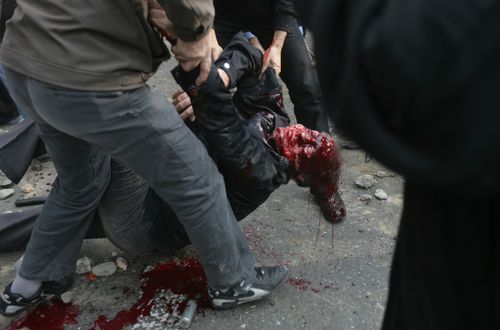
MARTYR1227AFP:Getty

"What greater misfortune for a state can be conceived then that honourable men should be sent like criminals into exile, because they hold diverse opinions which they cannot disguise? What, I say, can be more hurtful than that men who have committed no crime or wickedness should, simply because they are enlightened, be treated as enemies and put to death, and that the scaffold, the terror of evil-doers, should become the arena where the highest examples of tolerance and virtue are displayed to the people with all the marks of ignominy that authority can devise? ….

For when people try to take freedom of expression away, and bring to trial, not only the acts which alone are capable of offending, but also the opinions of mankind, they only succeed in surrounding their victims with an appearance of martyrdom, and raise feelings of pity and revenge rather than of terror. Uprightness and good faith are thus corrupted, flatterers and traitors are encouraged, and sectarians triumph, inasmuch as concessions have been made to their animosity, and they have gained the state sanction for the doctrines of which they are the interpreters.

Hence they arrogate to themselves the state authority and rights, and do not scruple to assert that they have been directly chosen by God, and that their laws are Divine, whereas the laws of the state are human, and should therefore yield obedience to the laws of GOD—in other words, to their own laws. Everyone must see that this is not a state of affairs conducive to public welfare. Wherefore, the safest way for a state is to lay down the rule that religion is comprised solely in the exercise of charity and justice, and that the rights of rulers in sacred, no less than in secular matters, should merely have to do with actions, but that every man should think what he likes and say what he thinks" – Baruch Spinoza, A Theologico-Political Treatise, 1670.

(Photo: a victim of the Khamenei junta, Ahura 2009, by AFP/Getty.)

The Upper Class Twits Of Al Qaeda

That's the spirit:

What I find most amusing about Al Qaeda’s finest is how familiar their journeys look. These were the guys in college who showed up on campus freshman year in the Jaguar mommy bought them for high school graduation, had their grandmas flown in on the Cessna for Parents Weekend, (because Granny flying commercial just isn’t done), refused to eat the cafeteria food, wouldn’t go to the football games because that many drunk people made them uncomfortable, kitted out their dorm rooms with obscenely expensive furniture, wintered in Palm Beach, summered in the Hamptons, took spring break on a private beach in the Caymans, and never EVER picked up the bar tab.

Because most of those guys were precisely as useless to society as the upper class twits in this Monty Python skit, they largely went on to become drug addicted, wife beating, yacht sailing, globe trotting exhibits of human wreckage. Looks like a few of them ended up in Al Qaeda, too.

Home News

The growth of the Dish has become harder to handle this year – a first-class problem, of course, but a real one. In 2006, we had 25 million pageviews. In 2007, we had 40 million. In 2008, that historic and exciting election year, the traffic soared to 120 million. As traffic quintupled, our editorial staff tripled to, er, three.

2009, we all expected, could not match 2008. The three-fold surge was so great it had to subside. We couldn't expect another round of sky-high traffic like that in the election months of the fall of 2008. But tallying up 2009 this morning – using the rough-and-ready Sitemeter counter, as in the other data – we ended up with around 110 million pageviews, a much smaller drop-off from last year than I expected. Our biggest month was last June, as the Iran coverage garnered a truly global audience of 13 million pageviews. But we've seen solid, consistent gains since then. This December, for example, produced 9 million pageviews; last December's total was 7.2 million. December 2007 gained 4.1 million. December 2006 racked up 2 million. Get the picture?

Keeping up with the audience and the pace has become extremely hard. Blogging for an annual audience of 25 million pageviews is just about possible for a lone blogger; catering to over a million unique monthly visitors is not. Without Chris and Patrick, I would have gone under this year with the sheer workload. Even with them, it is hard to contemplate a Dish future on this trajectory without adding more support. There's no other way. And we'll have to keep improvising.

So stay tuned. We have a plan.

Mousavi Anticipates His Own Death

As Iran continues to descend into a darker and darker crisis of legitimacy and order, Mousavi takes a stand:

I have no hesitation about becoming one of the martyrs for realizing the religious and national rights of the people … My blood is the same colour as that of my [killed] supporters, but imprisoning and killing the Moussavis and Karroubis would definitely not solve the problems as the people's protests have now developed their own momentum… "We have several times been told [by the establishment] that if you issue no statements, the people would not come to the streets, but neither me nor Mr Karroubi had issued any statement, but the people still came into the streets…. The establishment think that with killing demonstrators and arresting intellectuals and academics and blocking the media, they could remove the roots of the crisis, but they just deceive themselves as with such superficial methods, the opposition will just become stronger.

These are crucial days and weeks:

“In terms of longevity, this could go on for some time but could also unravel quite quickly if the government loses its nerve,” said Ali Ansari, a professor of Iranian history at St. Andrews University in Scotland. “In this respect Khamenei is the key. He’s the equivalent of the Shah and is similarly weak.”