by Patrick Appel
I agree with Yglesias about the health care reform choices in front of us.
by Patrick Appel
I agree with Yglesias about the health care reform choices in front of us.

by Conor Friedersdorf
Seen in stereotypes, the East Coast is where America’s elite is centered, the South is romanticized and denigrated, the West Coast is where Hollywood reigns and laid back people live, and the Midwest – well, the Midwest is forgotten, or else dismissed as flyover country. The City of Chicago aside, it isn’t a destination for vacation seekers or business travelers relative to other parts of the country, and its geography and aesthetic are hazy to most people who’ve never lived there, probably because it is seldom portrayed in television or movies, or shown on the news, or described in literature, though there are notable exceptions.
Last spring I drove across the Midwest, moved by an impulse to see it. Two distinct things inspired that impulse: the regional accents heard on This American Life and a notion I had during the 2008 presidential election that I hadn’t seen so much of this country, despite having traveled widely in others. I’d have loved to take a month or two to collect audiotape, edit it into something special, and persuade Ira Glass to give me my big radio break. Unfortunately I hadn’t the time for that, nor was I able to articulate as much about the Midwest as I’ve done after traveling to other places – I certainly formed a sense of the place, but found it unusually confounding to express it.
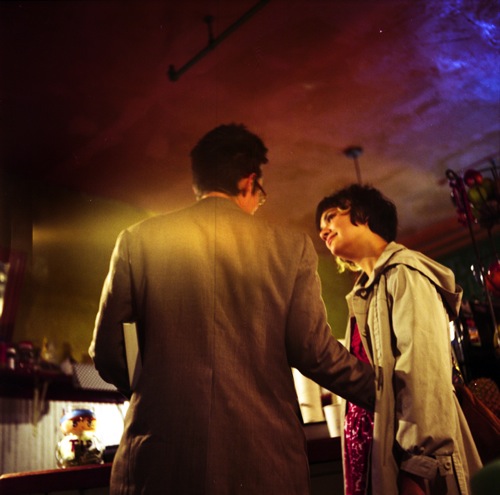
Last week, I traveled briefly to Kansas City, to visit a dear friend who I met a couple of years ago in Washington DC when she worked for National Geographic. The photographer, Lara Shipley, has since moved back to her home state of Missouri, embarking on a more informed effort to capture what I sought to learn about – the essence of the Midwest at this particular moment. The photo above is hers, as are those that follow – given how long it takes to accumulate a portfolio in art photography, and the poor remuneration in that field these days, I am indebted to her for permission to use images here that capture what I’m unable to say in words. Like me, she is always eager for feedback on her work – one of her photos was actually featured at The Dish once before – and also gladly accommodates offers to buy prints, so the least I can do is tell you is that she can be reached at lara.shipley@gmail.com, and that I expect her work to garner much more of a premium in future years.
The single aspect of the Midwest that one cannot help but notice is its emptiness—something due not only to the wide open spaces between cities, but to the decline of formerly booming cities less populated than they once were. In a region where real estate prices are far cheaper than on the coasts, land sometimes sits unused for long stretches, and isn’t subject to the constant regeneration seen in locales where space is at a premium.

As if to heighten one’s curiosity about what this place was like in its prime, it boasts thrift stores and estate sales that are the envy of folks who are into that sort of thing, often in houses whose aesthetic belongs to decades past.

One weird aspect of the country’s present cultural moment is the divide between ironic America and earnest America – having lived in Brooklyn, where the Williamsburg hipster set fawns over Pabst Blue Ribbon and wears second hand tee shirts from Great Plains high schools they didn’t attend, I am always conscious of seeing something that would in New York City be celebrated ironically, but that hangs in Kansas City earnestly.

The upside to a place that doesn’t do irony is that it can excel at a classic aesthetic – this photo portrays folks enjoying a diner during that time when the bars have closed and the night is winding down. “This kind of place connects the Midwest to rest of the country,” Ms. Shipley notes. “An all night diner is such an American scene, and the young people of Kansas City are just as much part of it as anyone.”

Though I ate quite well in Kansas City, especially at Arthur Bryant’s barbecue, I must concur that this patriotic desert distills a regional mainstay. As Ms. Shipley put it, “What buffet meal would be complete without blue jello, vanilla soft serve, and…red stuff. I salute!”

Though it is common to think of the Midwest as America’s white-bred middle, it is increasingly home to immigrant enclaves, and you see hints of their presence even outside them.

It is also common to associate it with salt-of-the-earth Jesus loving folk.

Stereotypes to the contrary, however, cosmopolitan cities are hardly the only places where sins of the flesh are indulged.

Ms. Shipley’s ability to generously but unflinchingly capture people has always been a feature of her work I’ve particularly appreciated. Let’s close with some characters she’s found in Missouri.
An elderly woman whose pants contrast nicely with a gray winter day.

There is Libby, a bar owner in Northland.

Richard:

And a couple, Shawn and Sienna, at an all night café featured in a photo that is my favorite for reasons I can’t quite figure out. Sienna works at YJ’s, where she is pictured. It is a popular gathering spot in a part of Kansas City that artists are transforming, taking advantage of the cheap cost of living and underused 1920s era industrial buildings that they’re reclaiming as lofts and studios.
by Chris Bodenner
A reader writes:
As a New Yorker, and a resident of the Financial District (the Tower will make for an exciting "View From [My] Window"), it's about damn time. The one thing Glenn Beck has ever been right about is that reconstruction should've started and finished by now. But I write to correct the name you gave the Tower. Although it's been referred to as the "Freedom Tower," official designs reflect that the final Tower will be "1 World Trade Center," mirroring former nomenclature. This matters: choosing continuity over cliche sends a strong message that we as a people will not be governed or altered by fear. Or so we hope.
by Chris Bodenner
The BBC asks the tough question.
by Chris Bodenner
And just when I thought Chuck Norris and Obama were friends.
by Chris Bodenner
A reader writes:
I'm so glad somebody finally wrote the "Politics of Tough" post. As an Illinois resident, it's been frustrating and extremely disheartening listening to all these jokers yack on about NIMBY all the time. Not all Americans are afraid of terrorists. Illinois is no stranger to housing some really bad people like John Wayne Gacy. Southern Illinois has quite a few prisons and is another area that would love the jobs and money that a super-max federal prison would bring. It should come as no surprise that IL Sen Dick Durbin and Former IL Senator Obama see no problem with bringing Gitmo detainees to American shores. Could anyone miss the symbolism and politics of the President's home state willing to take these guys on?
Please keep this up. Please keep this argument front and center. So many of us in Illinois hate all this NIMBY bullshit and our voices are not being heard.
Another reader scrutinizes a statistic from the earlier post:
There is a quote from a Tom George to the affect that the Willow Run plant produced 300,000 aircraft in WW2. The total production of all aircraft from all sources in the U.S. was 303,000 between 1940 and 1945. While the production totals of the Willow Run plant were extraordinary by any measure, the plant, erected in 1942, did not produce every aircraft, or anything near it. This is NOT the kind of rhetoric we need from weak kneed democrats or any one else.
It appears the state senator confused Willow Run's production with overall US production; the actual number of aircraft (B-24 bombers) produced at the Michigan plant was 8,685. Doh. Regardless, I think the senator's overall point holds strong. Another reader writes:
While we argue about whether America can handle terror suspects on our soil, we don't argue about whether we have the right to hold these suspects indefinitely without trial. Obama is institutionalizing a state of preventive detention on the homeland and we're not talking about it. The ramifications are historic. By suggesting we are tough for taking Gitmo prisoners in – by entertaining the argument - you play into the overtrumped myth that led to so much abuse and torture in the first place: that prisoners of Gitmo are guilty. If the people of Illinois welcome the prisoners as a gesture of patriotism, that doesn't make them brave – that makes them ignorant. The suspects being relocated to IL are the ones that the country doesn't have enough evidence to convict. In any other scenario, that would make them innocent.
The federal government is planning to build a courtroom at the site of the "new Gitmo" in order to process detainees. Thus, many will be convicted in military trials. But yes – it appears others will be held indefinitely (this Ambinder post is a must read). A troubling prospect. So is the alternative.
by Conor Friedersdorf
Jonah Goldberg's latest column at National Review is worth a read.
Opining on "reality tv," he writes:
Don’t get me wrong; it’s great television. But gladiatorial games would be great TV, too.
The Los Angeles Times reported the other day that the reality-show industry is suddenly having a crisis of conscience about its impact on the culture. That’s nice to hear, but it’s not nearly enough.
British historian Arnold Toynbee argued that civilizations thrive when the lower classes aspire to be like the upper classes, and they decay when the upper classes try to be like the lower classes. Looked at through this prism, it’s hard not to see America in a prolonged period of decay.
This reminded me that I've long had a thought about The Real Housewives series, the rare reality show I've watched consistently since having grown up in Orange County, California, I am always fascinated and horrified by its portrayal on television. The evil genius of that show's producers is their insight that some television shows attract an aspirational audience — see every high school soap opera about rich kids living somewhere — and other successful television shows attract an audience that revels in contempt for its characters.
"What if these audiences could be combined?" I imagine those producers asking themselves. Thus the portrayal of very rich, utterly contemptible families and single women: some audience members aspire to their opulent lifestyle, others are entertained by their nouveau rich vulgarity, still others enjoy feeling morally superior to the rich. It's something for everyone!
On a tangentially related subject, one characteristic shared among the shows that concluded the sitcom era and today's reality television shows is that they ignore, to an astonishing degree, all but the upper middle classes in American life. A group of friends in their early twenties living in New York City? Of course they have huge apartments! Of course when they worry about money the question is whether they can afford Hootie and the Blowfish tickets! But at least those stylized sitcoms didn't make a claim on representing reality. On "Reality TV," money is thrown around by the rich and lavished by feel good re-decorators on the poor, but it is rarely portrayed in a fashion that resembles the way average Americans experience it. Perhaps ruining the escapist nature of these shows is lethal to ratings.
Further thoughts on reality television are here.
by Chris Bodenner
He tells Chris Matthews: "I don't believe that we should limit waterboarding – or, quite frankly, any other alternative torture technique – if it means saving Americans' lives." Schock doesn't even bother to say "enhanced interrogation techniques," or maybe he just flubs the Orwellian talking point. Either way, it's Republicanism at its worst, and Matthews at his best – and worth watching in full:
Visit msnbc.com for breaking news, world news, and news about the economy
Congressman Hare does a solid job of making the case for the Thomson transfer, but fails to mention at several points the paramount practical reason for closing Gitmo: its use as a propaganda tool for terrorist recruitment.
Before this interview, I only knew two things about Aaron Schock: he was the youngest person in Congress and people gossiped about his great abs. Now, we learn that he thinks Americans are not strong enough or moral enough to refrain from torturing human beings in the face of a perceived threat. And note the degree to which he would treat detainees: "waterboarding – or, quite frankly, any other alternative torture technique." So, by his own words, Schock must subscribe to the Yoo standard:
Cassel: If the President deems that he’s got to torture somebody, including by crushing the testicles of the person’s child, there is no law that can stop him?
Yoo: No treaty.
Cassel: Also no law by Congress. That is what you wrote in the August 2002 memo.
Yoo: I think it depends on why the President thinks he needs to do that.
by Andrew Sprung
Robert Gates has attracted positive notice for his conspicuous contrition regarding past U.S. mistakes in Afghanistan and Pakistan (most recently from Maureen Dowd). On December 2, he told the Senate Arms Services Committee that the US “will not repeat the mistakes of 1989, when we abandoned that country only to see it descend into chaos and into Taliban hands.” Jake Tapper recalled that for Gates, this was a familiar note:
“I feel a certain sense of personal responsibility,” [Gates] testified before the House Armed Services Committee in December 2007.
“I was deputy director of CIA and then deputy national security advisor during the period when the Soviets did withdraw from Afghanistan, and the United States essentially turned its back on Afghanistan,” Gates said. “And five years later came the first attack on the World Trade Center. And so, you know, one of the lessons that I think we have is that if we abandon these countries, once we are in there and engaged, there is a very real possibility that we will pay a higher price in the end.”
Admitting mistakes generally wins one points for honesty. But according to Robert Parry, Gates is perpetuating a myth with these confessions. From 1989 to 1992, the U.S. did worse than "abandon" Afghanistan. In belated pursuit of Cold War aims, the administration of George H. W. Bush fomented further civil war.
After the Soviet pullout, the regime of Soviet-backed President Najibullah survived for another three years, in defiance of Gates' expectations. During that time, rather than support a negotiated settlement between Najibullah and the mujahedeen, the U.S. continued to fight a proxy war. Parry:
After the Soviets did withdraw in early 1989, some U.S. officials felt Washington’s geostrategic aims had been achieved and a move toward peace was in order. There also was concern about the Afghan mujahedeen, especially their tendencies toward brutality, heroin trafficking and fundamentalist religious policies.
Yet, the new administration of George H.W. Bush – with Gates having moved from the CIA to the White House as deputy national security adviser – chose to continue U.S. covert support for the mujahedeen, funneled primarily through Pakistan’s intelligence agency, the ISI.
However, instead of a fast collapse, Najibullah’s regime used its Soviet weapons and advisers to beat back a mujahedeen offensive in 1990. Najibullah hung on – and the war, the violence and the disorder continued…[snip]
“Najibullah would remain in power for another three years [after the Soviet pull-out], as the United States and the USSR continued to aid their respective sides,” Gates wrote in his memoir. “On Dec. 11, 1991, both Moscow and Washington cut off all assistance, and Najibullah’s government fell four months later. He had outlasted both Gorbachev and the Soviet Union itself.”
Parry perhaps overstates the degree of Gates' dissimulation. Looking back at his 1995 memoir, I believe that in Gates' mind the failure to pursue accommodation in 1989 is conflated (perhaps conveniently) with the aid cut-off in 1991. Here is his obliquely self-critical assessment in From the Shadows of the aftermath of withdrawal:
For a dozen years, under three Presidents, the United States– through CIA–had supplied and armed those who resisted the Soviet invasion of their country. For the first several years, few believed that Afghanistan would ever be liberated. The road to the Termez Bridge in 1989 would be opened by the blood and courage of Afghan patriots, an international clandestine coalition led by the United States, the zeal of President Zia of Pakistan, and the realism of Mikhail Gorbachev and Eduart Shevardnadze. It was a great victory. Afghanistan was at last free of the foreign invader. Now Afghans could resume fighting among themselves — and hardly anyone cared.
Gates' confession of "abandoning" the Afghans (and, in other contexts, the Pakistanis) after 1989 is a convenient catch-all for a series of policy decisions that helped bring down the Soviet Union while simultaneously building up the Jihadist terror machine. These include funneling billions in aid over a dozen years through the fundamentalist Pakistani dictator Muhamma Zia ul-Haq's ISI to brutes like Gulbuddin Hekmatyar; supporting continued Jihad against the communist Najibullah after 1989; and truly abandoning the warring factions to their own devices after 1991.
by Patrick Appel
"What would have happened if Mother Mary had been covered by Obamacare? What if that young, poor and uninsured teenage woman had been provided the federal funds (via Obamacare) and facilities (via Planned Parenthood, etc.) to avoid the ridicule, ostracizing, persecution and possible stoning because of her out-of-wedlock pregnancy? Imagine all the great souls who could have been erased from history and the influence of mankind if their parents had been as progressive as Washington¹s wise men and women! Will Obamacare morph into Herodcare for the unborn?," -Chuck Norris, Human Events.
 The Dish