Adjusting The Data

McArdle's citing Willis Eschenbach's "research" has attracted a flock of global warming deniers. Drum has seen this song and dance before:

[V]ia Tim Lambert, here's an excerpt from the original NOAA paper that explains how the homogenization was done:

A great deal of effort went into the homogeneity adjustments. Yet the effects of the homogeneity adjustments on global average temperature trends are minor (Easterling and Peterson 1995b). However, on scales of half a continent or smaller, the homogeneity adjustments can have an impact. On an individual time series, the effects of the adjustments can be enormous. [Italics mine.]

So, if you're a climate denier, what would you do?  You'd look for local effects and you'd look for an individual time series.  Look hard enough and you're bound to find some with large changes due to the homogenization.  And then you'd cry foul.  The books are being cooked!

On Funding Wars, Ctd

A reader writes:

Let me pile on in the Greatest Generation debate.  We Americans like to think WWII began on December 7, 1941.  It is telling that, despite the fact that Hitler had already conquered most of Europe and was driving deep into Russia, a majority of Americans on the eve of Pearl Harbor still opposed U.S. involvement.  People forget that in his famous “date which will live in infamy” speech, Roosevelt asked for a declaration of war only against Japan.  He wanted a declaration of war against Germany as well but feared the American public would not stand for it.  We entered the war in Europe  only after Hitler declared war on the U.S. several days later.

I appreciate all that the Greatest Generation did and fought for (my father was one of them), but let’s not turn them into superheroes of sacrifice straight out of a Marvel comic book.  Remember that the war in Europe raged for over two years while the Greatest Generation sat by and watched. And self-interest was at the heart of it.

Chart Of The Day, Ctd

Healthcare
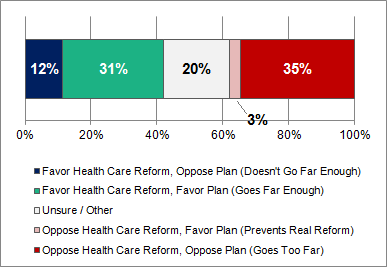
McArdle questions Nate Silver's analysis:

[T]he bigger problem is that Nate classified everyone opposing reform because it doesn't go far enough as opposing it from the left.  Undoubtedly, that's true of many, even most, of those respondents.  But I could go down to Cato right now and poll 65% support for the proposition that the health care reform doesn't go far enough–in the direction of taking away the employer health care tax exemption, means testing Medicare, and other ideas that no one would call "left".  Republicans who want liability caps and bigger HSAs might have similar complaints.

Nobel Day

A reader writes:

Just wondering if anyone on the right is admitting they were wrong when they insisted – do they even remember? – that the President would have to back off doing much of anything in Afghanistan because he wouldn't want to disappoint the Nobel Peace Prize committee.

Fallows's analysis of the speech:

As with his Philadelphia speech, he made the speech about the most awkward issue of the moment, rather than trying to avoid it. (In Philadelphia, the racially inflammatory rhetoric of Rev. Jeremiah Wright; in Oslo, his predicament as a war president getting a peace price.) I don't think he provided even a five-second passage of the speech that could be isolated by U.S. opponents to show that he was "apologizing" for America

A Question For AGW Denialists, Ctd

An AGW skeptic explains how he rationalizes the oyster guy:

Your question for "climate denialists", as to how we can explain the work of conscientious scientists detailing how a warming climate changes ecosystems, is incredibly simple. The world's climate has always been changing, and it has always represented a stressful environment for the ecosystem. In fact, that's one of the main sources of evolution – changing climate conditions. It's no accident that the the last three million years of human evolution, in which we developed our intelligence and culture, all occurred during a time of large climate instability. These stresses forced us to evolve in order to survive. So let's not presume that all climate change is bad for us, even when it's difficult.

More importantly, the "denial" in the anti-AGW crowd is not in relation to the "GW" (global warming), it's in relation to the "A" (anthropomorphic anthropogenic). Denialists don't question that warming has occurred over the last 150 years. They question the cause of it, and the implication that it will worsen if humans continue to burn fossil fuels. Scientists working on oysters have no idea what causes the temperature to go up, they only document the changes that occur in the ecosystem. Nothing in their work lends even the slightest support to the notion that human beings have caused these changes by burning greenhouse gases. I'm sure when the next ice age begins, the stress on the ecosystem will be even greater, just as it has been at many times in the recent past, but the cause won't be reflected in these kinds of studies.

One of the insidious aspects of switching from the term "global warming" to "climate change" to define this controversy is the notion that any form of change in our climate is unnatural and wrong. This is simply false. Climate has always changed, and it has always put stress on ecosystems. Ecosystems have always changed in response. That's what evolution is all about. It's ugly, messy, even cruel. We don't live in a temperature-controlled bubble. The real world changes all the time. That's part of what the email controversy is about – the attempt by a small group of climate scientists to massage the data about our recent past to make it seem that our climate has been an unchanging constant for a very long time, when it simply has not. Sympathies for polar bears and oysters not-withstanding, none of these studies has any bearing on the central claim that these changes primarily or significantly due to human activity. The group of scientists whose work supports this notion is actually quite small, and their methods and conclusions are the ones that "denialists" are addressing.

The Dish doesn't endorse all of these opinions, but we asked the question and it is only fair to post a response. Yglesias had some tangentally related thoughts about David Koch, climate change, and evolution a few days ago.
No Options Are On The Table

Frum is frustrated by the GOP failing to negotiate over health care or a carbon tax:

We’re getting worse and less conservative results out of Washington than we could have negotiated, if we had negotiated.

As is, we’re betting heavily that a bad economy will collapse Democratic support without us having to lift a finger. Maybe that will happen. But existing party strategy has to be reckoned a terrible failure. Most Republicans will shrug off that news. If polls are right, rank-and-file Republicans feel little regard for the Washington party, and don’t expect much from it. But it’s the rank-and-file who are the problem here! Republican leaders do not dare try deals for fear of being branded sell-outs by a party base that wants war to the knife. So we got war. And we’re losing. Even if we gain seats in 2010, the actions of this congressional session will not be reversed. Shrink Medicare after it has expanded? Hey- we said we’d never do that.

I hear a lot of talk about the importance of “principle.” But what’s the principle that obliges us to be stupid?

The Anti-Liberty Conservative

Kathleen Parker uncritically quotes Rick Santorum calling himself a "limited government" conservative. David Boaz points to an old NPR interview of Santorum:

He declared himself against individualism, against libertarianism, against “this whole idea of personal autonomy, . . . this idea that people should be left alone.” Andrew Sullivan [in 2006] directed our attention to a television interview in which the senator from the home state of Benjamin Franklin and James Wilson denounced America’s Founding idea of “the pursuit of happiness.” If you watch the video, you can hear these classic hits: “This is the mantra of the left: I have a right to do what I want to do” and “We have a whole culture that is focused on immediate gratification and the pursuit of happiness . . . and it is harming America.”

Parker says that Santorum is “sometimes referred to as the conscience of Senate Republicans.” Really? By whom? Surely not by Reaganites, or by people who believe in limited government.

“It’s Insane”

Senators Kent Conrad and Judd Gregg have teamed up to create a bipartisan commission to reduce the federal budget deficit. Chait scrutinizes the plan:

Let me get this straight. You have a commission proposing a package of highly unpopular legislative changes. And, in addition to having to surmount the 60-vote barrier in the Senate, which is nearly insurmountable for major legislation and which was avoided for both of the last two major deficit-reducing bills, it's also going to impose a new supermajority requirement in the House and a 78% threshold in the commission itself?

To say that this procedure "is designed to get results" shows a very odd understanding of American political institutions. Conrad and Gregg seem to think that instituting major reforms in the public interest is rare because the threshold for passing legislation is too low.

Fact-Checking Gonzales

The former attorney general tells Esquire:

All the internal investigations are over with, no finding of wrongdoing, no finding that I misled Congress.* So I'm gratified by that, but I'm certainly not surprised by it. But anyway, it creates impressions. And yeah, it takes some time to work through that. And that's what I'm trying to do now.

And that asterisk?

*Editor's note: A 2008 Department of Justice investigation was referred to a federal prosecutor and remains ongoing.

Keep "trying," Alberto.