A Better Mousetrap

Steven Teles joins the carbon tax vs. cap and trade debate:

Some people assume that because the actual incidence of cap and trade and a carbon tax are the same, that the political bargains that would be necessary to get them through are the same. I disagree, strongly, because all of the evidence of the policymaking literature suggests that policy design actually matters, even when holding the actual substance of policy constant.

The Daily Wrap

Today on the Dish we caught late-breaking coverage of the still-simmering student protests – here, here, here, and here. Enduring America and the Newest Deal summarized yesterday's drama, and Juan Cole raised the specter of Kurdish involvement. In other foreign coverage, Ignatius worried Andrew over a potential split between the US and Israel, Max Boot fueled his fears about indefinite occupation in Iraq, and al Qaeda explosions further stoked sectarianism there. We also listened to a suicide bomber.

In assorted commentary, Fallows analyzed climate-gate coverage, Weigel showed the success of Obama's Afghan speech, Hanna Rosin explained why divorce has dropped, Ta-Nehisi mulled reparations, David Link pondered bigotry, David Sessions condemned the capitalization of homophobia, and Harry Reid actually injected the history of slavery into the healthcare debate.

An apostate liberal blogger triggered reader debate here and here, a pair of Palin postings elicited a history lesson from readers here, her treatment of Trig peeved a parent with a special-needs kid, a reader extolled James Hansen's approach to carbon, another reader fisked him, and a Brookings scholar fisked cap and trade. Manbearpig wrote a poem.

The Dish received more great feedback on the window book here and here. Andrew's appearance on "The Joy Behar Show" is here if you missed it.

— C.B.

Walking Back From The Beatings

The Dish's go-to Persian-speaking reader translates:

The voice: "It's Tuesday 6:10 PM Tehran time…These guys you see walking on the pavement are Basiji brothers [by "brothers" he is being sarcastic] … some still carrying their batons …they all look tired after a full day of beating the students … [he becomes sarcastic, poking fun at the officials who calls the militia "students"] …oh and surrrre they are all "students" at Tehran University … except they don't go to the dorms like other students … they come here … at the old American embassy … but these "students"!!! are going inside this place to find out how much they're getting paid for beating people … well of course they count how many students they beat up so they could be paid accordingly … this is the shameful and blatant evidence of how the people who came Tehran University campus today are not students and this where they actually end up at night."

On Funding Wars

A reader writes:

History and facts, again, escape this woman. The top marginal tax rate in 1941 was 81 percent on incomes greater than $5 million (about $72 million in today's dollars). In 1942 and '43, it was 88 percent on $200,000 per year ($2.6 million today). In '44 and '45, it was 94 percent on $200,000 ($2.3 million today). The Greatest Generation did more than just save pennies to buy war bonds… most everyone paid more in taxes and some 40 million people paid taxes for the first time. From the Treasury's Web site:

Even before the United States entered the Second World War, increasing defense spending and the need for monies to support the opponents of Axis aggression led to the passage in 1940 of two tax laws that increased individual and corporate taxes, which were followed by another tax hike in 1941. By the end of the war the nature of the income tax had been fundamentally altered. Reductions in exemption levels meant that taxpayers with taxable incomes of only $500 faced a bottom tax rate of 23 percent, while taxpayers with incomes over $1 million faced a top rate of 94 percent. These tax changes increased federal receipts from $8.7 billion in 1941 to $45.2 billion in 1945. Even with an economy stimulated by war-time production, federal taxes as a share of GDP grew from 7.6 percent in 1941 to 20.4 percent in 1945. Beyond the rates and revenues, however, another aspect about the income tax that changed was the increase in the number of income taxpayers from 4 million in 1939 to 43 million in 1945.

See the complete history of tax tables here.

Another writes:

I love the right's worship of "The Greatest Generation," which of course earned its reputation for sacrifice under America's only three term president, who governed the economy in ways that even most liberals would today find shocking, shipped a generation of American men overseas to fight and die using a conscription policy that no politician would dream of suggesting for our pampered culture, rationed consumer goods including food (can you imagine how Americans would react to a ration on sugar today?), told Americans to go outside and plant vegetables in their yards (and then eat them!), and yes, saved America from the Great Depression and the world from Hitler.

The Greatest Generation did indeed earn the respect of those of us who follow, but let's not forget that we were lucky enough to have leadership that made the sacrifice mean something profound.

Leaving The Left, Ctd

A reader writes:

In defense of the “loud mouths on the left” as your other reader nicely put it, we need these people to continue to be as loud and vocal as possible.

We’ve seen how the right in this country gets things done today.  They get on TV and scream out “DEATH PANELS DEATH PANELS KILLING GRANDMA”, and you know what happens?  Rather than trying to explain themselves, the Democrats remove a perfectly reasonable part of their bill.  Like it or not this is how it works. 

This is why you have Democrats ceding huge parts of health care legislation without even debating their merits. Before this debate even started Democrats told us that Single Payer was not even on the table and we already know Obama has cut a deal with Pharmaceutical companies to make sure their prices don’t go down too much (consequently this year has also seen one of the largets rises in pharmaceutical prices ever).   This is why you have Democrats in the Senate willing to change large parts of the bill just to get one, I repeat, ONE Republican to vote for it (which will never happen). Negotiations are a compromise between 2 sides, but from my vantage point it just looks Democrats keep taking things out of the bill chasing that elusive “bi-partisanship” that just isn’t there.

In all fairness this probably has more to do with the Senate than Obama but they both need to feel heat from their base to match the decibel level of the Republicans.  As Obama is fond of saying, “don’t let the perfect be the enemy of the good.” Well, usually in a negotiation you begin negotiating for the perfect and settle for the good.  In this debate it seems that they started with the good and are now settling for the even less good.  And if the left stopped “bothering” them, they’d gut this thing even more.

Many years ago a voter approached FDR urging him to act on a cause that he felt was important.  In response FDR said “I agree with you, I want to do it, now make me do it."  Obama needs a vocal left to get this done.  If for nothing else to point them out to the public and say, “look, these crazy people want single payer, but I’m going to meet with you in the middle and pass a public option instead.”

Another writes:

The discussion on your site regarding the left's reaction to Obama is very interesting. I like that subsequent commenters have brought up their support for Obama, but perhaps I could lay out the left's case that our 'defection' from Obama is not equivalent to the right's automatic rejection of Obama is nearly every way, shape, and form.

I did not expect to get everything out of Obama that I wanted, and while surely those who are crashing the most in his eleventh month in office are those who invested him with the full measure of their hopes and dreams for a better America, I don't think that this characterizes the left as a whole. Those people (and I speak from the gut here) are more likely to be ones who are not familiar with politics, who either chose not recognize to or were ignorant of the inherent limitations in the system that would prevent Obama from sweeping in and achieving his goals.

But by the same token it is difficult even for those of us who on the left demanded no more than good governance to not be disappointed with Obama. The most basic things that we demanded are also the easiest to fix in procedural terms, the closing of Guantanamo, the repudiation and prosecution of torture, and the ending of Abu Ghraib like practices at Bagram. Surely these things are not in reality easy and carry with them a very real political cost, but Obama as commander in chief and the executive has the power to do these things (and indeed has pursued some of them) without entering the political landmine of Congress. This is an area where one would think Obama's strengths would give him an advantage of his opponents, his ability to speak to the better nature of America, to rally his supporters and given one heckuva speech.

Yet Obama chose not to. He refrained from the battle. To get back to the commenter's point I brought up, Obama has refused to lead, and the democrats in general have refused to govern.

I use 'war on terror' issues merely as an example. I appreciate that you believe that Obama is playing a longer game against opponents trapped in short term thinking (meep meep), but those of us on the left are rather uneasy with Obama's apparent hands-off strategy. Liberals are harsh on Obama not because we are selfish or because we are cry babies, endlessly demanding all or nothing, but because we recognize that the country is at a critical moment that demands a kind of leadership and activism that has been missing in Obama's early presidency. If not now, when? If not Obama, then who?
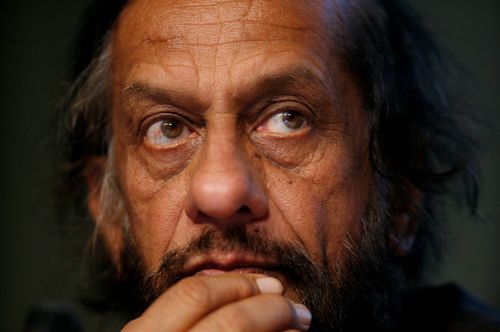

Face Of The Day

RajendraKumarPachauriMiguelVillagranGettyImages

Rajendra Kumar Pachauri, Chairman of the Intergovernmental Panel on Climate Change, looks on during a press conference at the second day of the United Nations Climate Change Conference 2009 on December 8, 2009 in Copenhagen, Denmark. Politicians and environmentalists met for the United Nations Climate Change Conference 2009 that runs until December 18. By Miguel Villagran/Getty Images.

“It Gives Me A Different Perspective”

A reader writes:

Just got my copies of your book.  FAB-U-LOUS!  Love it.  One copy is for my dad for Christmas.  He's a retired foreign service officer with the State Department and has been to many of the locales pictured.  Truly, a strangely mesmerizing "read."

Another writes:

I have been anxiously awaiting this book, since the daily feature on your blog is one of my favorites.  In March, while on my honeymoon, I found myself taking pictures of views out of windows constantly.  We visited Milan, Venice, Florence, Amalfi and Rome.  I would take COVER-front pictures of views from museum windows, hotel windows, anywhere there was a window my camera would get a shot.  It gives a different perspective and I like how it makes me look twice at that picture.  It is real life, no staging.

The book itself arrived a short while ago, and I'm happy to see how small it is, since I will be able to put in my enclosed front porch – more like a sun room, since it is all windows and glass.  No matter where you sit in that room you must look through a window, or glass door, making every view from that room like the pictures you post daily.  It is my favorite room, and this book is perfect for it.

Thank you so much, this brightened my day.

Another:

I got my book yesterday, a gift for my brother. But I was very disappointed! The reason? It's wrapped in plastic, so I can't look inside before I give it to him!  I just know I won't be able to stand the suspense and will open the plastic for a peak before I gift-wrap it. I should have gotten myself one too.

Preview the book online here. Buy it here. But do so quickly; only 41 copies remain at the crowd-sourced price of $16.25, after which it will cost $29.95, the regular price.

As I Feared

The neocon camp is demanding that the exit from Iraq be delayed indefinitely if the sectarian melt-down that could be looming seems imminent:

All we can know for sure is that the presence of U.S. troops provides a vital stabilizing element that prevents Iraq from going off the rails entirely. That is why it is so important that the Obama administration continue to show flexibility in its troop drawdown and not get locked into a premature exit that could jeopardize all the progress that has been made so far.

The hardest thing in Obama's presidency, in my view, could be withdrawing from Iraq as that country descends into a fresh bold piece of hell. The only silver lining is that Iraq's looming chaos could help destabilize the military junta now running Iran. Of course, I could be wrong, and everything will be peachy in the election and after. After all, we've already been told that the Iraq war has ended in victory. But it seems to me worth remembering that Iraq was constructed by the Brits precisely to facilitate sectarian tension – divide and rule – and that its borders have not changed.

Not Home In Time For Christmas

U.S. Army infantry captain Tim Hsia quotes his counterpart in the unit who was returning home as Hsia was shipping out:

He told me he had a feeling his unit would be extended but that despite it all, his unit handled it better then the unit it had replaced. “When they were told they were extended, some of the soldiers had already flown back home. The Army made those soldiers come back after hugging their families, and extended them another three months. Well, what do you think? A lot of people in that unit just mentally gave up. They were physically here but mentally and spiritually elsewhere."