"Instead of joining us on the right side of history, all the Republicans can come up with is, 'slow down, stop everything, let's start over.' If you think you've heard these same excuses before, you're right. When this country belatedly recognized the wrongs of slavery, there were those who dug in their heels and said 'slow down, it's too early, things aren't bad enough,'" Harry Reid, on healthcare reform.
The People Lead
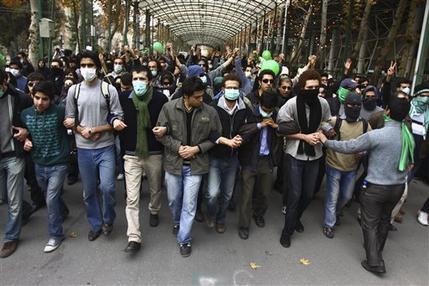
Josh Shahryar summarizes yesterday's protests:
Reports confirm dozens injured; however, no one was reported to have been killed. By the end of the day, reports emerged that at least three dozen people and possibly many more were arrested by the security forces. There were reports of guns being fired in some parts of the city, but all shots were confirmed to have been fired in the air to scare the protesters. The only major opposition figure that took part in the protests was former president Hashemi Rafsanjani’s daughter, Faezeh Hashemi. […]
It is fairly difficult to estimate how many people joined the protests. However, by looking at pictures and videos from different parts of the city and universities, it can be safely said that somewhere between five to ten thousand people took part in protests throughout the day. It is worth noting that there was a government-sanctioned protest in Tehran University as well and more than a thousand government supporters took part in that.
The Newest Deal adds:
Yesterday's demonstrations were organized by a fractal grassroots whose structure is horizontal rather than hierarchical. That is to say, it has no leader.
These were protests that saw Iranian flags whose white centers were bare, missing the iconic 'Allah' written in form of a red, martyr's tulip. Gone was the silent marching of peaceful demonstrators holding up 'V's' in the air. Instead, pockets of protesters confronted the Basij physically, and at times, overwhelmingly. And protests were not just limited to Tehran, either. Demonstrations have been verified in Mashhad, Shiraz, Rasht, Kermanshah, Hamedan, Arak, Kerman and Najafabad.
Though impossible to tell with the blanket censorship draped over Iran at present, it appears that the size of yesterday's protests were smaller than what was seen on 13 Aban, and on Qods Day before it. No matter. The demonstrations of 16 Azar signaled a shift — if not response — on the part of the Green movement to the tyranny and brutality that the regime has come to represent. The message was clear: there is no turning back.
(Hat tip: Mojtaba Samienejad)
The Genius Of James Hansen’s Carbon Fee
A reader explains:
One of the key differences between Krugman and Hansen is where the price on carbon is attached. Often when talking about cap-and-trade, the pricing of carbon is attached somewhere in the middle of the stream, not at the extraction of fossil fuels and not at the emission point. Because the price is attached in the middle, the policy gets wrangled between interest groups.
What Hansen is talking about is upstream pricing, or at the point of harvesting fossil fuels. Pricing carbon this way greatly reduces the amount of interest groups involved in making the policy to
coal, oil, and gas companies.
As both point out, the companies will pass on the price downstream ultimately to consumers, but think about the policy-making ramifications. Do you write a policy that basically involves every interest group on the planet (current cap-and-trade proposals) or do you write a policy that targets the fossil fuel industry, which is already pretty easy to pick on given, among other things, their ridiculous record profits. Cap and trade can also be made to work upstream, just as a carbon tax can be made for downstream. What Hansen and Krugman argue about is not only how to price carbon, but where, and the "where" has serious policy ramifications.
[This post's headline originally had Robert Hansen, the spy, not James Hansen, the scientist. Brain fart. Apologies.]
The Looming US-Israel Split
That's the likeliest consequence of the current awful choices the West has with respect to Iran's nuclear weapon capacity. In a diplomatic war-game at Harvard, various experienced officials tried to game out future negotiations, sanctions and alliances. Iran's revolutionary guard junta, which now runs almost all the country's key institutions, wins every time. Broad sanctions won't work; specific sanctions bring Russia and China again to Iran's defense; and in the end, the US comes to the obvious conclusion that, absent launching a war we can neither afford nor accomplish, the best strategy is containment of an Iran with nuclear latency or even a few nuclear bombs. This is certainly no riskier a strategy with respect to America's vital interests than letting Pakistan have a nuke. But it leaves an obvious problem: Israel. David Ignatius:
The trickiest problem for our imaginary Obama was his relationship with the fictive Netanyahu. As Burns and Gold played these roles, they had two sharp exchanges in which America asked for assurances that Israel wouldn’t attack Iran without U.S. permission. The Israeli prime minister, as played by Gold, refused to make that pledge, insisting that Israel alone must decide how to protect its security. Whereupon Burns’s president warned that if Israel did strike, contrary to U.S. interests, Washington might publicly denounce the attack — producing an open break as in the 1956 Suez crisis. The two key players agreed later that the simulation highlighted real tensions that the two countries need to understand better.
One reason I have been focusing on Israel lately is because I can see this conflict coming and do not believe it can be contained or managed without a more open and honest public dialogue than the cramped and emotional one that occurs in Washington. The truth is: Israel and the US have very different interests with respect to Iran, and if Israel launches a war on Iran, against US wishes, then the alliance will never be the same.
Gary Sick, who played the Iranian regime in the game, had the following to say on his blog:
This game provided an opportunity for me to test my understanding of the dynamics propelling each side in the Iran debate.
And the result, I am sorry to say, was even more depressing than I
would have imagined.
The fact that it was seasoned veterans of the policy process playing these roles makes it even more significant. The lesson was not so much that Iran could “win” this game so easily; it was that the US and its allies were unable even to imagine any alternatives.
The game was structured to inject maximum “reality” into the scenario: the real world as it existed on the day we started, real professionals with real experience playing the roles of real governments, total freedom of action, and an open-ended scenario.
Under those circumstances, the outcome was simply depressing!
The Use Of An Infant With Down Syndrome
A reader writes:
I’m sorry but every time I see a picture of Trig on the book tour I cringe. As the mother of a Special Needs child, I know that Trig should be home getting intensive speech, physical and occupational therapy at this point in his young life. He shouldn’t be used as his mother’s prop to boost her favorability with a certain segment of voters who appreciate that she didn’t abort him.
Sarah Palin is potentially setting her child’s potential progress back by years. Any parent of a Special Needs child can vouch that early, intensive therapies are key to future development. Every time I see her with him on her hip, instead of with a speech or other therapist, I keep wondering what she’s thinking.
Me too. And then I try not to think about it any more.
Gay-Baiting As Fundraising
The far right, including even educational establishments like Patrick Henry College, is now conjuring up visions of an America where the government banishes Christianity or criminalizes its free expression in all its many varieties. A Patrick Henry alum, David Sessions, objects here. It's a brave and nuanced piece. As the Christian right, in the Vatican and Colorado Springs and Uganda and Saddleback ratchet up the demonization of gay people, the following words seem particularly apt:
More disturbing is the willingness to take a bristling, irrational stance toward homosexuality, an issue that the church—with a few notable exceptions—has already failed to address with any sort of grace. I have resisted the bullying characterization of all gay marriage opponents as bigoted yahoos, but to take a religiously conservative stand on the issue requires almost superhuman amounts of love, humility and nuance. The firebrand tone of these fundraising letters is exactly the opposite; it is openly comfortable with capitalizing financially on unfounded fear of the men and women next door. Regardless of where you stand on the politics of gay marriage, we can all agree that making up wild tales of a government-assisted invasion by people God has commanded you to love is an egregious perversion of the Christian gospel.
Leaving The Left
A blogger explains why reading the liberal blogosphere's routine attacks on Obama has led her to rethink where she stands.
Visualizing Unemployment
A chilling interactive map of America showing the transformation of the economy in the past three years.
Interviewing Evil
Adil Najam of All Things Pakistan tries to reason with a suicide bomber:
The Tea Party Poll, Ctd
Weigel recalls that this isn't the first time:
It’s the latest in a tradition of Rasmussen polls that attempt to find the angry center of American politics. It was Rasmussen, remember, who asked voters back in 2006 whether they’d back a “pro-immigration enforcement” third party candidate in a presidential race. Thirty percent said they would, and therein lies the rationale for a 2012 Lou Dobbs vanity campaign.
 The Dish