The Good Side Of Using Trig On The Book Tour

A reader argues that the visibility of a child with special needs trumps any worries that he is being subjected to too much too young:

I share concerns with your reader related to Palin's use of Trig as a prop. But:

1.  Perhaps this is powerful for families of special needs children to see.  Perhaps the more Palin uses Trig as a visual prop or references him in talks the easier it becomes for these families.  Perhaps it makes them feel more accepted (not sure if these families feel un-accepted – just reflecting). 

2. While I don't know, I suspect that many women/families have struggled with the choice to give birth to a special needs child.  I also suspect that while many continue with the pregnancy there are many who have decided to have an abortion. 

Perhaps these decisions related to the difficulties this child would pose in one's family, in one's general routines of life or otherwise.  If this were so, then I wonder if seeing a special needs child so openly, proudly and even normally apart of someone's life is meaningful for these folks (those who had the child or are going through this decision now). 

These are just the thoughts that come to mind as I see more and more pictures of Palin with Trig on stage.  Could it be that despite her motives, in this one instance, she is actually advancing a positive end by using Trig as a prop? 

To me it was a bigger deal when she appeared to use Trig as a prop during the campaign…
Bypassing The Clampdown

Josh Shahryar rallies:

Already the government has banned as many reformist news sites as it possibly can, jailed reformist journalists and bloggers and restricted internet access across the country. As if that were not enough, it also banned all foreign media journalists in Iran from leaving their residences and revoked their permits from December 7 to 9. But this is all they can do to stop the flow of news. […] There is literally an army of these people who in a few hours will be doing only one thing — spreading news about the protests on Twitter, Facebook, Blogger, LiveJournal, YouTube, MySpace, Photobucket and every available bit of space on the internet they can get their keyboard and mouse on.

Enduring America is already doing a fantastic job of aggregating. Follow their coverage here. (They found the clip above.)

“A Necessary Chance To Come Up For Air”

Azar

Masoud at the Newest Deal sets the scene for the Green movement today:

The question remains, will the regime's response to the protests be similar to what was witnessed on Qods Day, where massive turnout caught the regime off-guard, or will it instead be in the vein of 13 Aban, where gatherings were systematically and ruthlessly broken up by Basij and Revolutionary Guard agents? If events leading up to today's demonstrations are any indicator, the regime is undoubtedly preparing for a clash with protesters: student leaders and activists have been arrested en masse, internet access has been all but disconnected as of yesterday, and most recently the mothers of 21 victims of killed by the regime in post-election violence have been arrested for congregating in Tehran's Leleh Park. (The mother of Neda-Agha Soltan, who recently and explicitly blamed the regime for her daughter's death, is rumored to be among those arrested).

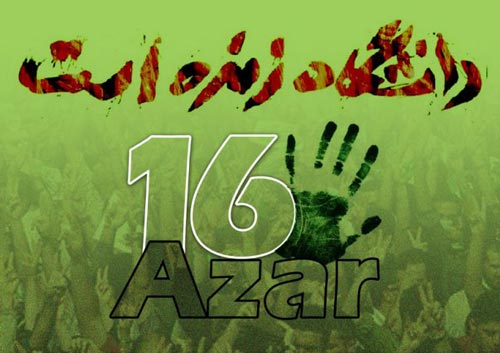
16 Azar

Tehran Bureau provides some historical background on the 7th of December – "Iran's Student Day":

After the CIA/MI6 coup of August 18, 1953, when the popular government of Dr. Mohammad Mosaddegh was overthrown and Shah Mohammad Reza Pahlavi was put back on the throne, Nixon-tehran campuses became even more political. In the immediate aftermath of the coup, an extremely repressive and oppressive environment prevailed in Iran. The universities remained the most important places where protests against the anti-nationalist and foreign-sponsored coup were taking place.

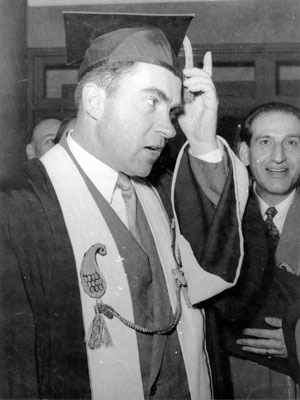
On November 15, 1952, the coup government announced that Richard M. Nixon, then Vice President to U.S. President Dwight D. Eisenhower, would pay a visit to Iran on December 9, 1953, presumably to celebrate with the Shah the demise of the Mosaddegh government and restoration of the monarchy. Nixon's visit was also supposed to demonstrate the Shah's full support for the United States. At that time however, anti-American feelings were running very high in Iran. Despite the extreme repression, the Shah had not been able to completely crush the opposition. The news of Nixon's trip angered the frustrated population, especially the opposition. […]

On the morning of December 7, 1953, the guards entered [the University of Tehran], the heart of the protests, to prevent any repeat demonstrations.

Though there had not been any demonstrations yet that day, the excuse given was that some students had mocked the police, and the police wanted to arrest them. Two soldiers and an officer went to a class to make the arrests. But the professor, Shams Malak Ara, asked them to leave. As they arrested two students, one student jumped on a desk and began shouting for help. Shams Malak Ara notified the Dean of the FOE.

The soldiers and the officer then went to the office of Dean of the FOE, Mohandes Khalili [who was later active in the National Front]. He also protested the intrusion, and his deputy, Dr. Rahim Abedi, was ordered to ring the bells to notify the students. Students gathered in the hall on the first floor of the school. The guards who had been on alert invaded the FOE building. According to Dr. Abedi, 68 bullets were fired. Three young students — Mostafa Bozorgnia, Ahmad Ghandchi, Mehdi Shariatrazavi — were killed.

Students-azar

Much more here.

Quote For The Day II

"Frankly, this town and the way the political dialogue is structured right now is not conducive to what we need to do to be globally competitive. And all of you are leaders in your communities — in the business sector and the labor sector, in academia, we even have a few pundits here — it is important to understand what's at stake and that we can't keep on playing games. I mentioned that I was in Asia on this trip thinking about the economy, when I sat down for a round of interviews. Not one of them asked me about Asia. Not one of them asked me about the economy. I was asked several times about had I read Sarah Palin's book. (Laughter.) True. But it's an indication of how our political debate doesn't match up with what we need to do and where we need to go," – president Obama, calling us out.

Face Of The Day

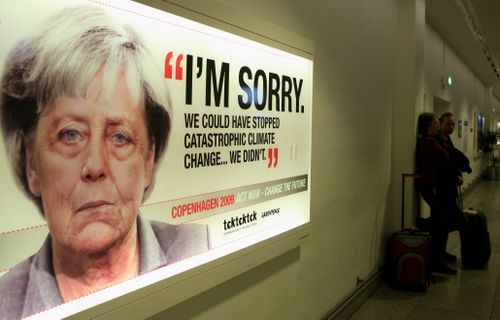
MERKELMiguelVillagran:Getty

Travelers wait for their baggage next to an advertising sign showing a picture of grown old German Chancellor Angela Merkel and reading 'I'm sorry. We could have stopped catastrophic climate change…we didn't' at the Copenhagen airport on December 6, 2009 in Copenhagen, Denmark. Politicians and environmentalists will meet for the United Nations Climate Change Conference 2009 which opens on December 7 and runs until December 18. By Miguel Villagran/Getty Images.

The Liberal Reagan

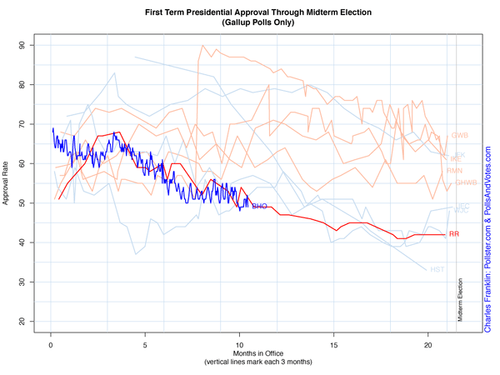
The Dish has noticed the uncanny resemblance between Obama's early job approval and Reagan's. They both inherited disastrous legacies – although Bush had the chance to double the disaster with two terms. They both had deep recessions early. They were both lionized and loathed, and both had problems with their base early on. Anyway, I didn't realize how close the parallels were until EarlyPresPopOverlay2-thumb-600x450

And Anita Dunn Resigned

"In 1939, in a stadium much like this, in Munich Germany, they packed it out with young men and women in brown shirts, for a fanatical man standing behind a podium named Adolf Hitler, the personification of evil. And in that stadium, those in brown shirts formed with their bodies a

sign that said, in the whole stadium, "Hitler, we are yours." And they nearly took the world. Lenin once said, "give me 100 committed, totally committed men and I'll change the world." And, he nearly did.

A few years ago, they took the sayings of Chairman Mao, in China, put them in a little red book, and a group of young people committed them to memory and put it in their minds and they took that nation, the largest nation in the world by storm because they committed to memory the sayings of the Chairman Mao.

When I hear those kinds of stories, I think 'what would happen if American Christians, if world Christians, if just the Christians in this stadium, followers of Christ, would say 'Jesus, we are yours' ?

What kind of spiritual awakening would we have?" – Rick Warren, April 17, 2005.

Ron Paul’s Vindication

569-6

My column this week is on the remarkable rise of isolationism in American polling, and the deep ambivalence many feel toward the president's quick surge in Afghanistan:

To have experienced the blow of 9/11 and to watch almost a decade later as young Americans die for a kleptocracy in Kabul and a sectarian bazaar in Baghdad is to experience a deeply demoralising and discouraging morass. Osama Bin Laden, moreover, remains at large — eight years after the worst mass murder in US history. And he is sheltered by a supposed ally that has received enormous sums of aid. Americans see all of this as they lose jobs in vast numbers, or see their wealth vanish in a collapsing housing market, or struggle to send their children to college or even a doctor. They know, too, that even with all this sacrifice and effort, their security remains tenuous. That’s why no president could have announced, as some Republicans wanted, an indefinite massive campaign in Afghanistan. It simply isn’t sustainable — politically or economically. The country is more broke than at any time since the second world war in a global economy still vulnerable to another relapse.

The upshot:

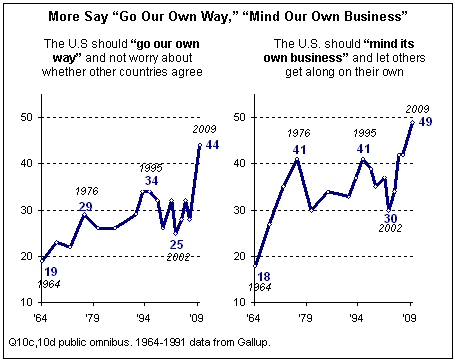
The Pew survey has polled Americans for decades on their attitude towards the wider world — measuring how unilateralist and isolationist the mood is, or how multilateral and interventionist. The latest results, announced last week, were striking.

The percentage of Americans now saying that the US should “mind its own business” and let the rest of the world get on with it is now higher than it ever was during the Vietnam war and higher than it was in the low point of the Carter era. A full 49% of Americans now favor isolationism. The previous peaks were 41% in 1995 and 1976; at the height of the Vietnam war, the isolationist position mustered only 35%.

For the first time, most Americans also see China as the pre-eminent economic power; and 47% believe that Afghanistan will revert to the Taliban once the US leaves.

I wonder if the neocon right has a strategy for the predicament their own over-reach precipitated. The whole column is here.