Chart Of The Day

Racegap
 
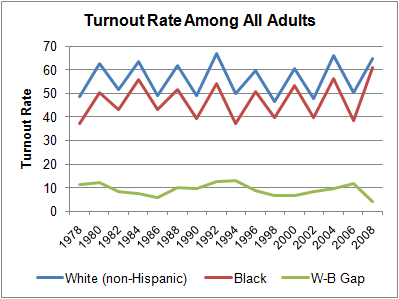
Nate Silver frets over a Daily Kos/Research 2000 poll from last week about whether voters intend to vote in 2010:

Whereas 68 percent of white voters told Research 2000 they were definitely or probably planning to vote in 2010, just 33 percent of black voters did. Although whites have almost always turned out at greater rates than blacks, the racial gap has never been nearly that large, and indeed was at its smallest-ever levels in 2008 with Barack Obama on the ballot.

After New York III

DiA takes stock of marriage equality:

Washington is likely to legalise gay marriage next week, so the momentum has not completely changed direction. And one could argue that the Washington vote is more important than the defeat in New York for the sole reason that federal lawmakers will be confronted with the issue at close range, forced to witness what I believe will be the non-disastrous affects of two men or two women marrying.

The Daily Wrap

Today on the Dish we continued to bring together perspectives on the Afghan escalation. Joe Klein investigated the speed of the surge, Packer and Frum looked at the style of the speech, Balko bemoaned the success of bin Laden, Jake Tapper delved into the psyche of Gates, McArdle mulled over the war tax, a reader joined her, another reader praised Obama's lack of fear, and another interpreted his core intent. Also, we received an impassioned email from Kandahar.

In the ongoing Climategate saga, Popular Mechanics caught us up, we took a look at the coding used for the data, and Andrew bolstered a leading scientist's call for a carbon tax. In the fallout of the New York vote, David Link looked at the dearth of debate from the winning side, a courageous senator articulated the case for equality, another backed her up, and Andrew and Hot Air gazed at the terrain ahead. Next up: New Jersey.

In other assorted coverage, we spotlighted a gay Ugandan blogger, Netanyahu reassured the settlers of coming expansion, another Palin story seemed on shaky ground, tea-partiers set off another hathos alert, and James Lipton offered his creepiness to a phone company.

In home news, the first batch of Window View books shipped out today. However, you can still buy one in time for Christmas at the limited price of $16.25. Speaking of windows, we posted another particularly great one today. And speaking of successful print ventures, the Atlantic is on a roll.

— C.B.
Progressive Taxes Worsen Inequality?

 Felix Salmon has a counter-intuitive thought:

[W]hen you have a progressive tax system, especially when there are surcharges on people making seven-figure incomes, you also have a system where for any given level of national income, the greater the inequality, the greater the government’s tax revenues. And indeed federal revenues have been rising faster than median wages for decades now, thanks to the rich getting ever richer.

Given the government’s insatiable appetite for cash, it’s only natural that it would prefer to tax plutocrats, spending some of that money on poorer Americans, rather than move to a world where poorer Americans earn more (but still don’t pay that much in taxes), and the plutocrats earn less, depriving the national fisc of untold billions in revenue.

The government’s interests, then, are naturally aligned with those of the plutocrats — and when that happens, the chances of change naturally drop to zero.

(Hat tip: Tyler Cowen)

“A Translucent Exercise In Public Relations”

Ambinder takes on today's job summit:

[T]he White House does not seem to believe that (a) anything sensible to meaningfully reduce the unemployment rate can be proposed, completed and paid for — and executed — by next November. Nothing, in any event, that wouldn't jeopardize recovery in the long-term. This frustrates people in the party to no end, as well it might.

But it's responsible governance. What a refreshing change. Not that Obama will get any credit for it from the right.

Paying For The War, Ctd

A reader writes:

I suggest that the war tax be put on gas. The primary reason we are in a war with either Afghanistan or Iraq is that our economy is dependent on oil from that region. We would not have had the troops in or near Saudi Arabia that so offended bin Laden had it not been for oil. I recommend that the tax float, depending on the cost of oil, to gradually raise the price so that we are not giving the economy sticker shock, but we are making sustainable energy more worth investing in.

I don't agree with McArdle's idea that the tax should sunset when we "only" have 20 advisers overseas. Bush ran these wars for nearly 8 years without budgeting for their cost at all. I suggest that the tax sunset when the wars have been paid for in toto, including the ongoing & long-term cost of the veterans benefits. Where are all the tea partiers who worry about the bill that their grandchildren will be paying for the stimulus?

I also recommend that we finance a re-engineering of the military readiness plan to eliminate the use of contractors or at least cut them back considerably, that we deny any current or future president the right to use the military reserves for more than 1 year without activating a draft, and that women become eligible for a draft. I understand a president requires flexibility to use the military in an emergency, but an 8 year war stopped being an emergency a long time ago and should have been planned for.  If the American people do not feel invested enough in a war to sustain a draft, then it's not our fight.

Is The Medicare Commission Dead?

Karen Tumulty provides a health care reform update:

When Obama began his push for reform, he asked Congress to create an independent commission to regulate Medicare costs. Medicare, which spends more than $450 billion a year, is such a huge health care player that any changes it makes can lead the way for reforms in the private market. As originally envisioned, the new agency would essentially take over Congress's current authority to set Medicare payment rates for hospitals, doctors, nursing homes and other health care providers. It would use a process like the military-base-closing commission, whose recommendations automatically go into effect unless Congress votes to block them.

As it turns out, however, lawmakers are reluctant to cede the power to steer extra money to hospitals in their own districts, and the House rejected the commission idea outright. While the Senate bill does contain a version of the commission, it has become weaker at every turn in the process.

Ezra Klein has more on the subject.