Paying For The War

Yglesias sighs:

I haven’t seen anyone even really attempt to persuade me that this policy makes sense in cost-benefit terms. And I think the reaction to David Obey’s “war tax” idea is telling—nobody seems to really think there are national interests at stake that are critical enough to be worth paying slightly higher taxes for. But if a war’s not worth paying for, how can it be worth fighting?

Ezra Klein has more on the cold reception Obey's "war tax" weathered. And imagine if there were a draft. DO you think anyone would back this surge?

The Ailes Line, Ctd

Greg Sargent shows how my instinct as to the GOP response to a big surge in Afghanistan is being borne out. They are framing all the courageous aspects of this as McChrystal's and Obama as a follower.  They want to leverage the military leadership against its commander-in-chief. Why? Because if it works, they can credit McChrystal. If it fails, they can blame Obama. But either way, it is essential to make Obama look "weak."

Obama, Trimmer

OBAMATimSloan:AFP:Getty

Massie flags this passage from E.D. Kain:

Conservatism is not only about limited government, and where it seeks to limit government it does so because it sees government as a force of instability.  But what about those times when government is instead a force for stability?  Defense leaps to mind.  Conservatism, I would argue, is first and foremost about preserving or regaining a stable society.  Liberty and prosperity are two of the most profound ways we can achieve a stable civilization.  Limiting government often leads to both these things, and thus it is a means to an end, not an end in and of itself. 

And when limiting government actually brings about social chaos rather than social stability, then it’s outworn its use. Perhaps this is why anarchy is such an impossible goal.  At some point the benefit of removing the state from the equation no longer outweighs the cost.

The underlying principle here is an Oakeshottian one: the coherence of a polity matters more than any single ideological approach to politics. This was Oakeshott's critique of Hayek after a fashion. If the market Character_of_a_Trimmer becomes an ideology in itself, it ceases to be conservative. The real conservative tilts from intervention to laisser-faire depending on the circumstances. He may lean in the long run toward less government as a more stable principle in a free, self-reliant and increasingly diverse country than more government. But he is always seeking the right prudential balance from exigency to exigency, from era to era, from year to year. And government is never the enemy tout court. It is a necessary means to an end.
Oakeshott saw the politics of faith and the politics of skepticism as the two core principles guiding modern Western politics. He favored in his own day of government planning, rationalism and left-liberal triumphalism the unfashionable tradition of freedom, mystery, markets and personality. But he was always aware that government needed to act strongly sometimes and swiftly too. He was skeptical of excessive skepticism. A conservatism of doubt might be too sluggish in emergencies, as Oakeshott scholar Paul Franco explains here, or deemed too frivolous at times. It could be incapable of summoning the necessary love or gratitude or patriotism from its subjects. So it can embrace government at times, to save civil society; and vice-versa.

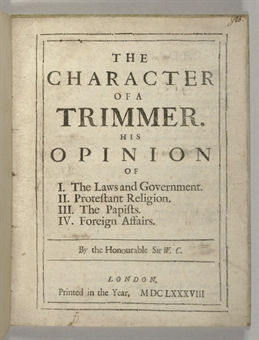
What the conservative is about, in other words, is balance. And that's why Oakeshott's famous metaphor for the kind of  politician he admired was a "trimmer." And one of his treasured works of political writing was Halifax's sadly neglected "The Character Of A Trimmer". Today we regard a trimmer as a flip-flopper. But a trimmer in the nautical sense was a man simply tasked with trimming the sails and balancing the weight of a ship to ensure, as different winds prevailed, that the ship stayed upright and on an even keel. The role of the conservative statesman is, in Oakeshott's sense, to do the same thing – sometimes expanding government in discrete ways to ameliorate or adjust to new circumstances; sometimes restricting it for the same reasons. Here's his own description:

"The 'trimmer' is one who disposes his weight so as to keep the ship upon an even keel. And our inspection of his conduct reveals certain general ideas at work…Being concerned to prevent politics from running to extremes, he believes that there is a time for everything and that everything has its time — not providentially, but empirically. He will be found facing in whatever direction the occasion seems to require if the boat is to go even."

I think you can see the critique of left-liberalism in the 1970s as a classic conservative trimming of the excessive delusions of a liberalism become too powerful, too smug and too ideological. That's why the original neoconservatives – Kristol, Bell, Glazer et al – were heroes to me.

But I also think you can see Clinton and Obama as necessary attempts to balance the excesses of this movement which inevitably succumbed to hubris, calcification, and ideological purism over time. What Bush and Cheney then did to the system in panicked response to the emergency of 9/11 – a massive and radical attack on constitutional norms, a conflation of religious certainty and government, and a huge expansion of government power and spending – requires now a very intense period of Halifax-style balancing. Obama's moderation may, in fact, not be radical enough on Oakeshottian grounds. For trimming is not about always finding the middle option. It is about restoring balance, which may sometimes mean radicalism if it is preceded by serious imbalance.

This is a prudential task, not a theoretical one (the other core conservative insight). And we should judge this president and his opponents on the wisdom of their prudential decisions and positions. So far, it seems to me, Obama is the only game in town. Whether his judgment is right will only be determined by history. But his instincts, it seems to me, are genuinely that of a trimmer.

In the best possible sense of that term.

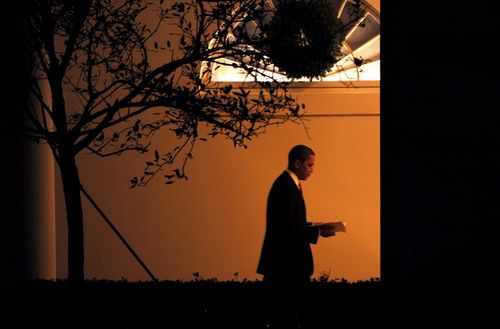
(Photo: Obama leaving for West Point last night by Tim Sloan/AFP/Getty.)
The Role Of Surge Skeptics

As always, Marc Lynch's analysis of Obama's speech is worth reading:

[W]hen things don't go their way, will they really follow through on their promises to draw down?  Few people believe that. And if they don't believe it, then the mechanism of pressure doesn't operate. So it seems to me that the best way for skeptics such as myself to help this strategy to succeed is to keep a sharp focus on the proposed mechanisms of change, demanding evidence that they are actually happening, and to hold the administration to its pledges to maintaining a clear time horizon and to avoiding the iron logic of serial escalations of a failing enterprise.

Amen. And will do.

The “Begin” Loophole

Fred Kaplan homes in on the central point of contention, and confusion, in Obama's speech – the July 2011 date:

Critics say that this sends the wrong signal to the Afghan people; that if they think we're leaving in less than two years, they won't trust us to protect them in the first place; and that, in any case, the Taliban will simply lie low and "wait us out." This complaint misreads the policy. The key word in Obama's speech was that in July 2011, the United States will "begin" to transfer responsibility for security to the Afghan forces. The pace of this transfer—how quickly we will continue to withdraw and at what point we'll get out altogether—will be determined by "conditions on the ground." (Obama may not have underscored this phrase, but in a background press briefing earlier in the day, "senior officials" emphasized it strongly; one predicted that it would be the most misunderstood and misreported part of the speech.)

The Morning After

I think this strategy is doomed. But then I think any strategy that does not pledge to colonize Afghanistan, pour trillions of dollars into it and stay for a century is doomed. So why do I end up this morning feeling rather similar to my colleague, Jim Fallows, who OBAMAWESTPOINT2JimWatson:AFP:Getty financed by opium – is simply unhinged. It means an empire in the Muslim world for the rest of our lives. And the idea that permanent Western occupation of Muslim lands will decrease Jihadist terror is so insane only Dick Cheney could still believe it.

This war is already eight years' old and will soon have lasted longer than Vietnam. Its rationale today is very different than what it was in 2001 – 2002. Al Qaeda is based in Pakistan, not Afghanistan. The US, thanks to Bush and the recession, is bankrupt and facing a long and brutal period of high unemployment and soon huge cuts in entitlements or big tax hikes.

Our enemy already knows that the US cannot sustain neo-imperial control of a vast inhospitable country on the other side of the planet for more than a decade. And if the US were to do so, it would be becoming the imperial power the neocons and the Islamists truly want. What Obama was saying last night is that he is determined to return America to normal, to unplug this vast attempt at global control in Muslim countries that Bush and Cheney unleashed. He is trying to unwind the empire, not expand it.

How best to unwind the empire? By giving McChrystal what he wants and giving him a couple of years to deliver tangible results. If McChrystal delivers, fantastic. I will do a ritual self-flagellation and bow down to the man with no body-fat and a close relationship with 33 Kagans of various generations and genders. If McChrystal does his best and we still get nowhere, Obama will have demonstrated – not argued, demonstrated – that  withdrawal is the least worst option.

The far right will accuse him of weakness – but they will do that anyway. All he need do is remind Americans of what the far right version of "strength" is: engaging an enemy on his own turf, sustaining an insurgency by our very presence, draining the Treasury of trillions, sacrificing more young men and women to shore up one of the most corrupt governments on earth, and basically returning to Bush-Cheney land. And that will be a very telling argument in 2012: do we want to go back to Cheneyism? To torture and endless occupation and a third war with a Muslim nation, Iran?

On reflection, Obama was saying something quite simple: one more try, guys. We owe it to those who have sacrificed already to try and finish the job. He has given the effort the full resources it needs at a time of real scarcity. He has given COIN doctrine one more chance to prove itself. He has put Petraeus and McChrystal and the 45 Kagans on notice: prove your case. And in this, I think Obama has found a middle balance that reflects where a lot of us are on this and that also offers a good faith chance for progress – with a good sense exit ramp after a reasonable length of time.

The final piece of the puzzle strikes me as this: the big ramp up in CIA activity in Pakistan. This is the second channel, the one Obama barely mentioned last night. It may be the more important one. My sense is that Obama wants to get bin Laden. Well, of course he does. Which president wouldn't? But the international and domestic impact of such a coup is hard to overstate and Obama's sense of how it would transform him and the entire dynamic of the terror war is typically cunning. I see the Afghan effort as one last chance to get al Qaeda's leadership, to bring justice to the 9/11 perpetrators, while hoping, in the medium term, to tamp down the raw civilizational conflict that empowers them.

As always with Obama, look a little deeper. He has made the very best of a very bad situation. And he is playing a long game for a win or a necessary withdrawal or both. I retain all my doubts; but I give him and Gates and McChrystal and Clinton and the troops all my support for the two years ahead. This much he and they deserve.

One more try, guys.

For The Record

"I've been so focused on state government, I haven't really focused much on the war in Iraq. I heard on the news about the new deployments, and while I support our president, Condoleezza Rice and the administration, I want to know that we have an exit plan in place," – pre-Kristolized Sarah Palin, March 1, 2007.

"Talk of an exit date also risks sending the wrong message. We should be in Afghanistan to win, not to set a timetable for withdrawal that signals a lack of resolve to our friends, and lets our enemies believe they can wait us out," – Kristolized Sarah Palin, last night.

“An Utterly Serious President”

A reader writes:

As I was watching the President’s speech and post-speech coverage last night, two thoughts really struck me. The first is that Obama strikes me as a President who is utterly serious about making what he thinks is the best decision. It seemed very apparent to me that this Afghanistan situation is something he looked at from every angle, and like it or not, is making what he believes is the best decision possible. Like you, I’m not sure I agree with him, and also like you, I will support the troops, give Obama the benefit of the doubt for now, and then want to see him held accountable for what he’s laid forth. I wanted Obama to be President because I thought he had the best judgment, and on this, I admire the fact he’s proposing something that is clearly not popular (especially with his base), because he thinks It’s the right thing to do.

The second thought occurred to me after watching the post-speech coverage on CBS. They had on John McCain.

McCain, who was so glib in attacking Obama during the campaign for offering nothing but platitudes, said he didn’t agree with Obama’s approach because it “emboldens our enemies” and “we have to stay until we win.” Well, those are helpful guideposts, and basically what the strategy has been in our two wars for the last eight years that has pretty much gotten us nowhere. I then got to thinking about McCain and his choice of running mate, Sarah Palin. I thought about what it would be like if she were President and having to determine a policy and give a speech in a situation similar to Obama’s. That thought literally caused me to shudder. And the fact that McCain chose Palin as a running mate, and a sub-segment of the current Republican party believes she actually has the chops to hold the highest office in the land shows the type of judgment that will not allow a left-leaning moderate like me to even consider voting for a Republican anytime soon.

The only honorable position for a man like McCain who unleashed Palin on the country is to resign. Someone who was prepared to see her as commander-in-chief at a moment's notice, after no vetting of her past or character, has no business being on television discussing foreign policy let alone the Senate. He's a deeply unserious man.