Chart Of The Day, Ctd

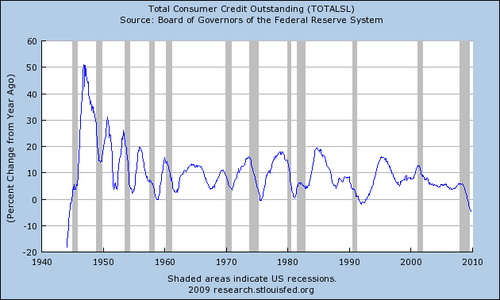
The graph the Fredgraph

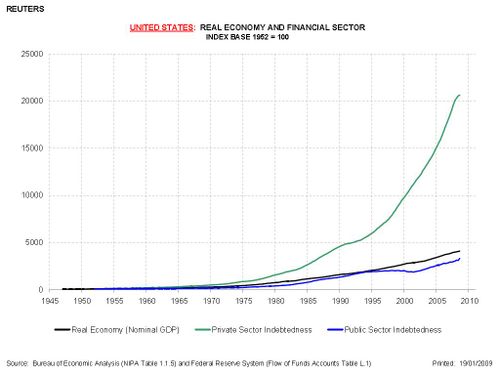
When you look at a graph of private sector indebtedness since 1950, you can see how the era of thrift really did collapse most profoundly in the last two decades – beginning in 1980 and growing fastest under George W. "Deficits Don't Matter" Bush. Under Bush public debt also went up again after a period of restraint in the Clinton-Gingrich years:

Growth-of-private-debt-burden

The Prosperity Gospel And The Subprime Collapse, Ctd

Rosin-prosperity-gospel-wide

A reader writes:

As so often, Tocqueville got there first:

"Not only do the American practice their religion out of self-interest, but they often even place in this world the interest which they have in practicing it. Priests in the Middle Ages spoke of nothing but the other life; they hardly took any trouble to prove that a sincere Christian might be happy here below. But preachers in America are continually coming down to earth. Indeed they find it difficult to take their eyes off it. The better to touch their hearers, they are forever pointing out how religious beliefs favor freedom and public order, and it is often difficult to be sure when listening to them whether the main object of religion is to procure eternal felicity in the next world or prosperity in this."  Tocqueville, Democracy in America, Vol. II, Part 2, ch. 9

It actually struck me as curious Rosin didn't mention this passage or others. Well, not really.

Notice a few pages later Tocqueville has a moving section on how American are "Restless in the Midst of Prosperity." A brief passage:

"When everything is more or less level, the slightest variation is noticed. Hence the more equal men are, the more insatiable will be their longing for equality…That is the reason for the strange melancholy often haunting inhabitants of democracies in the midst of abundance, and of that disgust with life sometimes gripping them in calm and easy circumstances."

In short, there's almost an intrinsic connection between the Prosperity Gospel (and the broader culture of which it is a part) and Prozac Nation. Ha.

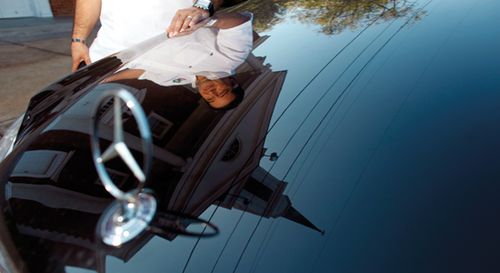
(Image: Mark Peterson/Redux.)

Paper And Pixels Coming Together

A reader writes:

It took a few posts to convince me but I ordered the book today, not for myself but as a holiday gift for my mother. I am still relatively young and try to be rather mobile, thus another book to unpack and repack each year holds limited appeal, especially seeing that I have saved most of my favorite "views" on my laptop. My mother, on the other hand, was initially excited when I explained the concept behind the idea of the pictures, but lacked the internet skills to track back through your blog and see the old posts.

This brings me to my point though, which is that I hope her exposure to the book will create an urge for her to get accustomed to visiting your blog more often and broadening her media appetite as well. Even for those who see little utility in collecting books on paper (namely those of us already inundated with graduate school reading), they can use the Dish's book to shamelessly draw an innocent friend or relative into your blog.

From new media to old media to new media: it's the content that counts.

Chuang Tzu And Christianity

Chaff

A reader writes:

I wonder if you realize what you may have have unintentionally affirmed. Chuang Tzu did not believe that even someone as close to him as his own son could grasp the essence of his craft through words. But one could imagine that his boy, watching and imitating for years in kata-like fashion would also have experimented and honed his own senses enough to become a creditable wheelright. Similarly, Chuang Tzu wrote beautiful metaphoric hints, not a definitive manual on wheel-craft for future aspirants to live by.

If Chuang Junior wrote such a manual, it would not have his father's approval. And the further from the source such manuals appeared, the dodgier they would become. In fact he knew that his own writings on Taoism became truth-less the moment they hit the page.

So how does this sit with Christianity?

A few hundred years after Chang Tzu, Jesus also attracted a flock of seekers. In whatever time they had with him, they witnessed and absorbed some of the seriousness of his commitment to the Lord. The most blessed of these apprentices eventually became journeyman or master sages in their own right. But to spread this gospel to larger populations, they had to resort to the written word. Let's even ignore the misinterpretations, additions, subtractions and purposeful distortions that dogged this written account through the past 2000 years.

According to Chuang Tzu's logic, once Jesus died, anything written by or about him became chaff and dregs. Shouldn't the Taoist, or Oakshottian/Conservative opinion be that the Christian Bible qualifies only as a an intriguing collection of allegories/koans (with some additional factors of of historical or aesthetic interest)? It might serve as a guide to social morality (more Confucian than Taoist).

But as a substitute for having a real-time mentor in the flesh to submit to and model oneself after — zippo. And as a manual for developing one's own actual craft of spirituality, or preaching to others — hardly worth thinking about. Why listen at all to ministers purveying the "popular, degenerate amalgam" of politics, prosperity magic, xenophobia, and bland pop-psychology that Christianity has become? Or priests who insist on the traditional, "original" approach? Or anyone who claims authority by linking to Jesus?

Why not emulate Jesus or Chuang-Tzu the best we can instead of worshiping them, or their written chaff? Or if we want mentoring, why not befriend a living sage (they are out there), someone who is steeped in the riches of silent contemplation rather than silk vestments, flashy cars, social taboos or political crusades?

Andrew, I know so many people want to bust your chops for not leaving the Catholic church. I think that's begging the question. Why assume that an edifice with another style of architecture will make the critical difference? Every extant religion has a mystical core, and at the deepest level, those cores all point in the same direction. That's not the problem. It's all the other layers of mindless extrapolation that have gummed up the works in the days since the Original ascetic/mystic left this world.

This is surely where Merton was heading when he died. Oakeshott, for his part, was a Christian modernist, a believer that any religion that clung to ancient doctrines rather than present practice was in effect dead. His life and writing began and ended with this question (and, if you want to read my first take on this, see Chapter 5 in Intimations Pursued, "The Claims Of Religion). I fear that much of what Jesus would have understood as being-with-God is in crisis within the current church, in all its forms. And the challenge for Christians today is to recover being-with-God in ways liberated in part from the chaffs and dregs of ecclesiastical corruption and evil.
Huckabee Sweats

The suspect in the murder of four cops in Seattle coffee shop has a history:

Maurice Clemmons, the 37-year-old Tacoma man being sought for questioning in the killing of four Lakewood police officers this morning, has a long criminal record punctuated by violence, erratic behavior and concerns about his mental health. Nine years ago, then-Arkansas Governor Mike Huckabee granted clemency to Clemmons, commuting his lengthy prison sentence over the protests of prosecutors.

The base won't like that, will they?

That Pielke Quote In The Times Piece

It reads as if it were offered yesterday in response to "news" that UEA had somehow destroyed its original data:

“Can this be serious? It is now impossible to create a new temperature index from scratch. [The unit] is basically saying, ‘Trust us’.”

In fact, the quote was from a blog-post written months ago in response to CRU conceding that it had used data for some climate stations that it did not physically possess. This is very old news, in fact, dressed up to add hysteria to the latest story. Pielke explains all here. And stands his ground:

I suggest instead being open and simply saying that in the 1980s and even 1990s no one could have known that maintaining this data in its original form would have been necessary. Since it was not done, then efforts should be made to collect it and make it available (which I see CRU is doing). Ultimately, that will probably mean an open-source global temperature record will be created. If you believe — and I see no reason to suspect otherwise — that such an open-source analysis will confirm the work of Jones et al., then you should be welcoming it with open arms.

Yes they should. And if this sorry tale helps bring all the original data to light in one open-source place – so anyone can pore over it with as much attention to detail as they wish – it will have a happier ending.

Iran’s Revolutionary Guards Double Down

It's hard to read exactly what is going on and who is calling the shots in an Iranian regime that is divided within itself, despised by a large majority of its population, and veering from one signal to another. But the working hypothesis that what has really been going on these past few years is an internal coup by the Revolutionary Guards, made brutally manifest by the response to the Green Revolution, is confirmed by news today of a defiant upping of the nuclear ante with a pledge by Tehran to build ten more nuclear enrichment plants and to decrease cooperation with the IAEA. Whether this is a serious threat or not is in dispute:

Some saw the actions as saber-rattling against the United States, its allies, and the International Atomic Energy Agency, and even doubted whether Iran could build 10 plants. "They don’t have the capability. They’d like to have it," said David Albright, president of the Institute for Science and National Security in Washington. “You have to look under the surface. They’re mad about the IAEA resolution.” “It’s playground behavior in a way," he said of the Iranian statements.

Practically speaking, it means that Iran has now all but completely isolated itself from international support.

With China, Russia and India backing Friday's IAEA admonishment of Iran, the mullahs have thrown a tantrum. I tend to share Juan Cole's skepticism that Putin or Hu will ever agree to real sanctions on Iran, but recent events have certainly made real international sanctions more likely. Indeed, if you support such sanctions, you will surely have to admit that Obama's steady diplomacy, his work with the Chinese and Russians, and his willingness to let France and Germany take the lead at times has isolated Iran more successfully than Bush's sabre-rattling ever did.

So Was The Data Destroyed?

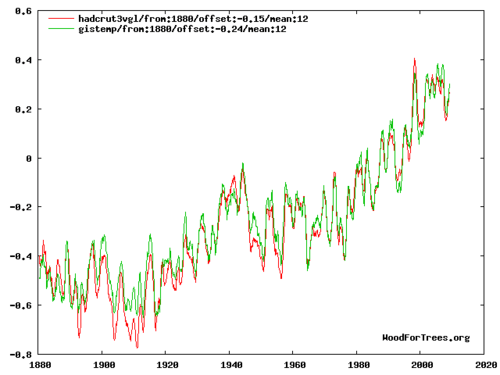
Mean_12

The Times article says so. CRU says not. The implication of data destruction is actually misleading:

The research unit has deleted less than 5 percent of its original station data from its database because the stations had several discontinuities or were affected by urbanization trends, Jones said.

“When you’re looking at climate data, you don’t want stations that are showing urban warming trends,” Jones said, “so we’ve taken them out.” Most of the stations for which data was removed are located in areas where there were already dense monitoring networks, he added. “We rarely removed a station in a data-sparse region of the world.”

Refuting CEI’s claims of data-destruction, Jones said, “We haven’t destroyed anything.The data is still there — you can still get these stations from the [NOAA] National Climatic Data Center.”

In fact, according to RealClimate, all the original raw data can still be found at the meteorological services where they originated. This discussion and the many comments were helpful to me and may be to you. More raw data here and here. I generated the graph above from here.