
Kribi, Cameroon, 3.02 pm
Kribi, Cameroon, 3.02 pm
A reader writes:
Now that we have the benefit of almost a year of track record,
which you didn't have when you wrote in January, we can say that your headline, at least, was wrong. Yes, Obama takes a liberal position on some issues. But he also takes what is, on any reasonable definition of the term, a conservative approach on other issues. He is, in short, a moderate.
And that, I suspect, is what really frightens the far-right.
Because a political realignment towards the center would be a far greater threat to them than a realignment which went all the way to the left. After Reagan, the Democrats had to break down and nominate a fairly conservative candidate (Clinton) before they could win an election. After Obama, the Republicans won't face nominating a liberal candidate, which would be unlikely any time soon. But they would face having to nominate a moderate candidate — which would mean taking the party out of the control of the would-be theocrats and giving it back to the center-right which controlled it pretty much from 1952-1992.
And that, in contrast, is a real possibility.
Legalizing medical marijuana is spreading globally as fast as marriage equality.
David Knowles investigates the use of marijuana to treat ADHD:
While [Lester] Grinspoon concedes that the evidence of marijuana’s effectiveness in treating conditions like ADHD is mostly anecdotal, he believes that practitioners would be wise to start listening to the everyday experiences of their patients. “It has been hard to collect hard data because the federal government has, for so long, said, no, marijuana is not a drug.”
[Stephen Hinshaw, professor of psychology at the University of California at Berkeley] is intrigued by success stories of patients treating ADHD with marijuana, but he cautions against euphoria in the absence of data. “People with ADHD are terrible at self-reporting, that’s one of the things that characterizes the condition. Still, this is worth looking into. Any hypothesis that adheres to the proper ethical limits is worth investigating.”
A reader notes another drug irony:
Nitro glycerin, the potent explosive, is a common anti-angina med. As Nobel worked on making dynamite, he noticed his chest pain diminished when he handled nitro. Thus one of the most lethal substances became one of the most life preserving.
All we are saying is give research a chance. If that makes me a goddamn hippie, pass the patchouli.
George Packer notices some Obama supporters are feeling down:
The most disappointed people I meet are under thirty, the generation that made the Obama campaign a movement in its early primary months. They spent their entire adult lives under the worst President of our lifetime, they loved Obama because he was new and inspiring, and they felt that replacing the former with the latter would be a national deliverance. They weren’t wrong about that, but the ebbing of grassroots energy once the Obama campaign turned to governing suggests that some of his most enthusiastic backers saw the election as an end in itself. The Obama movement was unlike other social movements because it began and ended with a person, not an issue. And it was unlike ordinary political coalitions because it didn’t have the organizational muscle of voting blocs. The difficulty in sustaining its intensity through the inevitable ups and downs of governing shows the vulnerability in this model of twenty-first-century, Internet-based politics.
Yes and no. The decision for change – deep, real change – is always going to be a different thing than implementing change in a deeply sclerotic system at a moment of simultaneous and paralyzing global crises. The former is inevitably more energizing than the latter. I don't think most under-30s saw the election as an end in itself (although it was more cathartic than most). I do think they are depressed and frustrated at how maddeningly difficult real change is.
But to my mind, the difficulty of the change is not a reason to abandon it.
In some ways, it's a sign that the proposed changes are real. If they weren't real, there would not be such resistance. For me, the critical areas for change were foreign policy, climate change, fiscal responsibility and torture. (Health insurance reform was not one of my top reasons for backing Obama.) In all of these areas, I can see a genuine effort at real change. And I think most Obama supporters see it too. The way Obama has handled Iran and Afghanistan could not be more different than the bravado and bullshit of his predecessor (especially before 2006). The Rove-Cheney mantra that "deficits don't matter" has been finally retired, even by the Republicans. The US government is no longer denying the reality of human-made climate change and, while still a laggard, is no longer a huge obstacle to solving the problem. The United States no longer tortures prisoners and is slowly dismantling the regime that allowed such things at the behest of one unaccountable, all-powerful executive branch. The one-size-fits-all rubric of freedom-or-tyranny is no longer the guiding principle of foreign policy. And next year – in the real test – we will see if Obama is serious about long term fiscal reform.
This is an ocean liner that was boarded by a bunch of insurgents in a dinghy. You can't captain the liner the way you did the dinghy. But if you wonder if the liner has changed direction, look at the apoplexy of the old regime. They're not fools. And they know they're losing.
A father and a son like this.
Ben Smith scoffs at the softball "questions" Greta lobbed at Palin last night. It seems to me that Fox is no longer a news channel and no longer an opinion channel. It's a propaganda channel in which the hosts are actual leaders of various Republican party constituencies or mouthpieces for certain Republican politicians (van Susteren long ago abandoned any pretense of not being a p.r. employee for the Palins) and use the channel for political organizing. So we don't even have feisty debates any more. We have cloying propaganda events.
It's a free country and they can do what they want. But Fox News isn't even opinion journalism in any normal sense any more.
Susannah Vila sketched out the meta-narrative of Brownstein's White House-recommended post:
Critics will undoubtedly suggest that this is another sign of Obama giving preferential treatment to the reporters who are more supportive of his policies. Or, as one TPM commenter suggested , perhaps this was a carefully crafted ploy by both Brownstein and Obama to prepare "liberals for the dropping of the public option." On the other hand, when a president regularly links out as well as getting linked to, it's also a sign that he gets the "ethic of the link–connecting people to knowledge wherever it is;" he's paying attention, and hopefully responding, to the comments, criticisms and suggestions that are buzzing around the public sphere.
Maureen Dowd's column today hits on something she's been tuning into for a while. Dowd's instincts about human character are foolish to bet against. She has essentially read every recent president correctly from the get-go as types. And she has always seen Obama as a bit of a cold fish, aloof, too unwilling to punch back, too arrogant to explain himself too much. MoDo worried about that in the campaign as the Clintons brought more raw human emotion to the trail and Obama often seemed to coast too cockily only to right himself, usually with some spell-binding speech or shrewd piece of campaign management. I generally trusted Obama's instincts. In the campaign, MoDo was nearly right (Obama did let the Clintons get back off the mat a few too many times) but in the end, wrong (look who got elected). But in government? The coolness has yet to be proven effective – as Kissinger has noted.
You see this in the almost clinical way Obama has assessed the politics of taking on the Bush administration's interrogation, detention and rendition policies. The way in which both Greg Craig and Phil Carter have been dispatched for insisting that Obama live up to his campaign promises (no, I don't believe the personal reasons line) is chilling in its raw political calculation. Ditto Obama's disciplined refusal to fulfill his campaign pledges on civil rights any time soon. And his rhetorical restraint during the Green Revolution. The determination to figure out the very best and most detailed way forward in Afghanistan, even during a war in which allies are waiting and enemies are watching, and to take his time … well this is also a sign that we are dealing with one very, very cool character here.
Since I've always had a soft spot for cold fish in realpolitik – which high Tory (pun fully intended) doesn't get a frisson from Bismarck or Kissinger? – this impresses me. Since I'm also a red-blooded Irishman, eager for a fight and a little romantic about my ideals, this also angers me at times.
As readers remember, I wasn't exactly staying aloof during the Green Revolution or being cold-blooded defending gay equality. But that's why I'm a writer and not a statesman. We all have our roles to play. And in politics, I prefer cool to hot, other things being equal. In today's populist, emotional climate, coolness is a virtue in getting things right. Especially when it has been rarely more important to get things right – from Afghanistan to climate change to health insurance reform.
The paradox is: in today's populist, emotional climate, coolness can be eclipsed in the political drama, and thereby rendered moot. In many ways, Palin is the extreme counter-example. She plays a short game of around ten minutes in duration. She deploys no substantive policy content and no interest whatever in actual government. But she channels pure emotion, identity and rage very effectively. As such, she is a political nightmare, someone whom most Americans would never entrust with actual responsibility (yes, that means John McCain is the biggest cynic in Washington, but that's another story). But she is a cultural phenomenon who thereby wields political power.
Will this kind of heat – however irrational, however impulsive – overwhelm the cool emanating from the White House in this period of discontent? Not should it – but will it? That is the question. Is Obama a political version of Anderson Cooper up against a Bill O'Reilly repeat? Can he win a political ratings war in this atmosphere? Of course, Obama's campaign was very hot – but its heat came from its insurgency and its moment, not from the temperament of its figurehead. In government, the coolness makes policy sense, but does it make political sense?
In all this, Obama reminds me of George H W Bush in government, and of Ronald Reagan in campaigning. It's a dream combo in many ways. In theory. It's the practice thing that we're beginning to test. My sense remains the same as in the campaign. He's got this. Americans aren't that crazy. If he avoids major errors (and so far, it appears he has) and if we are not simply entering such a depressed economic era that any president is helpless, then my money is on him. An attempt to fake populist emotion would be as damaging as when Bush Senior tried. And Obama has a much stronger tie to his own party than Bush I ever had with his.
But this is history. Anything can happen. And probably will.
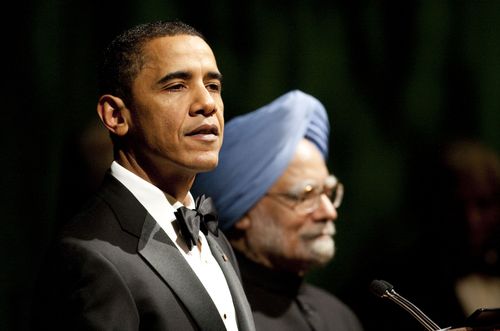
(Photo: Obama last night from the Getty pool.)
A reader writes:
The first thing that struck me about these "unity principles" is the fact that they have largely framed themselves in opposition. While I know that a minority party usually takes this sort of stance, it still makes them sound partisan and petty. Seven of the 10 include the word "oppose."
The second is how nonsensical the wording of some of the points comes across. How do you develop/support/have market energy reforms THROUGH opposition to the prevailing option? You have to offer a solution. "Workers'' rights? Why choose this wording, which is classically associated with Communist and socialist movements? I guess it's the populism taking over. I can only hope these are the draft forms of these points, because they are such a cobbled together mess of partisan sniping and minor issues and as someone who used to consider herself conservative. It drives me crazy.
Compare the current commandments with the policies laid out in the '94 Contract with America. It's the difference between a party interested in governing and a party interested in venting.
 The Dish