“Send It To Lake Right Away!”

The neoconservatives have been having a difficult time of late. In particular, the possibility that the American people, via the election of Obama, and the Iranian people, via the Green Revolution, may be moving toward a grand bargain that would avoid war alarms them. That's why Daniel Pipes wanted Ahmadi to win the election beforehand  (a view he alone had the admirable intellectual honesty to air in public). The emergence of a Green Movement in Iran that does not share the worldview of the neocons is a terrible threat to the solipsism of the neocon right, in which every global conflict is really about religious war "for ever," to quote Irving Kristol, and in which the Iran-Israel question is actually a "Fourth World War," to quote Norman Podhoretz. If you are an Israeli, this might be plausible. If you are not an Israeli, less so.

In all this, a figure like NIAC's Trita Parsi is dangerous. Charismatic, telegenic, close to the Obama administration and yet a man whose credentials during the Green Revolution are impeccable: he suggests that neocon Manicheanism is far too crude to understand let alone resolve this crisis. Parsi opposes sanctions, for example, as do Karroubi and Mousavi. And, more relevant with respect to the neocons, he opposes war. And so if you want to understand the motives behind the leaked documents behind Eli Lake's recent fair story, you need look no further. Smearing the non-neocon Green opposition as essentially pro-Khamenei solidifies the neoconservative war project. 

This is pretty obvious but we now have some rare and clear proof of how the neocons operate.

An email error gives the entire game away:

The central neocon smear of Parsi was that he was actually an agent for Kamenei. The absurdity of this is underlined by the fact that Eli could find no evidence for it whatever in his expose. But the origin of the story came from the neocon right, engaged in a defamation suit with NIAC and Parsi. And we now have, via Josh Rogin, the details of the strategy:

Previously unreported documents provided by NIAC to The Cable show that Daioleslam was working with neoconservative author Ken Timmerman as early as 2008 and that their moves on Parsi were part of a larger effort to thwart Obama's Iran policy.

"I strongly believe that Trita Parsi is the weakest part of the Iranian web because he is related to Siamak Namazi and Bob Ney," Daioleslam wrote in one e-mail dated April 2, 2008, "I believe that destroying him will be the start of attacking the whole web. This is an integral part of any attack on Clinton or Obama."

Namazi is a fellow at the National Endowment for Democracy with whom Parsi has worked. The e-mails show that Parsi and Namazi coordinated efforts to make recommendations to administration officials.

Tim Kapshandy, a lawyer for Sidley Austin LLP, came to represent Daioleslam in 2009. Upon seeing the e-mails about Parsi and Namazi, he accidentally sent a note to both of them. The note read, "Send it to [Washington Times reporter Eli] Lake right away!"

It's just a rare and small glimpse of how neocons operate. It is warfare abroad and warfare at home. It is a philosophy of attack and force, not dialogue and thought. And if we are to find a sane way through our current perilous global environment, it must be exposed and resisted as thoroughly and as relentlessly as we try to resist its mirror image among the extremists within the Iran coup regime.
Cost Control, Cost Control, Cost Control

Tyler Cowen argues that "the proposed reforms will make the core problems of U.S. health care worse not better" after reading a new Center on Medicare and Medicaid Services (CMS) report (pdf). The report warns that the health care bill could reduce the profitability of treating medicare patients and that some providers might therefore stop taking medicare patients. Yglesias and Ezra Klein counter. Ezra:

Medicare cuts are a crude tool. The more damning conclusion from the CMS report is that the House bill has little else to control costs, and that's largely accurate. This report shouldn't lead reformers to abandon efforts to trim Medicare, but it should convince them that the bill can do more on the cost control front.

And that is a critical measure by which to judge the final bill. In this legislative process, this to and fro is vital. And what I admire about Obama's handling of it is what so many are horrified by: letting the debate unfold through the deliberative process, in full view, with as much input as possible.

The health insurance battle should not be a zero-sum war between Obama and the Republicans. It should be a non-zero-sum dialogue about how we can get the best practicable reform now. Of course, it will always be both. But we can do what we can to promote the latter.

Parsi And The Regime, Ctd

Larison's reaction to the story:

Lake does not produce anything that clearly puts NIAC in violation of any laws. Everyone who seems to be in a position to judge such matters appears to have concluded that there are no violations. Indeed, the documents used as sources for the article come from the defendant in a defamation suit that NIAC initiated against him because he made this same claim of lobbying for Tehran. It would be very strange behavior for an organization engaged in lobbying for Tehran to invite legal scrutiny of whether or not it was lobbying for Tehran. So the story doesn’t really show that NIAC lobbies for the Iranian government, and it doesn’t really show any evidence of lawbreaking, but other than that it’s definitely “groundbreaking.”

But it does reveal a classic neoconservative move. They are essentially trying to accuse Iranian-Americans who disagree with them of dual loyalty. Even as they rightly scream blue murder if that is ever applied to them. You realize after a while that they have no principles but the maintenance of their own power and the destruction of their perceived enemies. War for ever indeed – within American and outside it. At any cost. Whatever it takes.

What Is Jonathan Foer For?

One joy of the Internet: fearless, skewering reviews of otherwise well-received books. Money quote:

[Foer] doesn’t have time to mention [Peter] Singer, but he compares himself to Kafka, quotes Derrida (more than once), and mistakes graphic design for profundity. One chapter begins with the boldfaced words “Speechlessness / Influence / Speechlessness / Influence” densely repeated for five whole pages. There are times when you can almost hear Foer thinking: Yes, these arguments have been made dozens of times before, but they’ve never been made in this font.

The Jihadists Who Have Recanted II

A critical insight from Johann's piece on Western Jihadists:

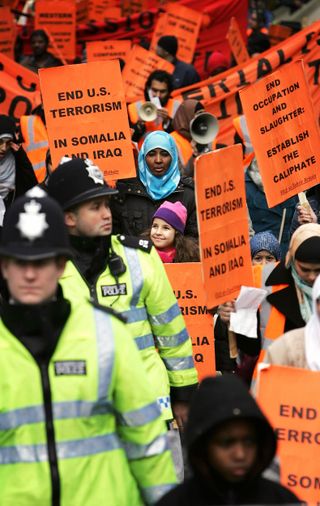
Once they had made that leap to identify with the Umma – the global Muslim community – they got angrier the more abusive our foreign policy came. Every one of them said the Bush TAHRIRLeonNeal:AFP:Getty administration's response to 9/11 – from Guantanamo to Iraq – made jihadism seem more like an accurate description of the world. Hadiya Masieh, a tiny female former HT organiser, tells me: "You'd see Bush on the television building torture camps and bombing Muslims and you think – anything is justified to stop this. What are we meant to do, just stand still and let him cut our throats?"

But the converse was – they stressed – also true. When they saw ordinary Westerners trying to uphold human rights, their jihadism began to stutter. Almost all of them said that they doubted their Islamism when they saw a million non-Muslims march in London to oppose the Iraq War: "How could we demonise people who obviously opposed aggression against Muslims?" asks Hadiya.

Britain's foreign policy also helped tug them towards Islamism in another way. Once these teenagers decided to go looking for a harder, tougher Islamist identity, they found a well-oiled state machine waiting to feed it. Usman Raja says: "Saudi literature is everywhere in Britain, and it's free. When I started exploring my Muslim identity, when I was looking for something more, all the books were Saudi. In the bookshops, in the libraries. All of them. Back when I was fighting, I could go and get a car, open the boot up, and get it filled up with free literature from the Saudis, saying exactly what I believed. Who can compete with that?"

He says the Saudi message is particularly comforting to disorientated young Muslims in the West. "It tells you – you're in this state of sin. But the sin doesn't belong to you, it's not your fault – it's Western society's fault. It isn't your fault that you're sinning, because the girl had the miniskirt on. It wasn't you. It's not your fault that you're drug dealing. The music, your peers, the people around you – it's their fault."

Guantanamo Bay was the biggest victory for Jihadism since 9/11. In fact, Cheney's war crimes have endangered our civilization more profoundly than 9/11. That disgraced and disgraceful vice-president gave Jihadism the symbol of Western evil it desperately needed to recruit and grow. Abu Ghraib and the vast web of the torture regime both destroyed our ability to prosecute Jihadists, destroyed the possibility for truly accurate intelligence and gave al Qaeda the critical oxygen it needed to flourish.

And the corollary is true. The more the West lives up to its values the more lethal an enemy we are.

This does not mean giving Islamism the slightest quarter; it does not mean avoiding an aggressive and persistent attempt to identify and monitor Jihadist groups and individuals; it does not mean softening a global campaign to find and target and if necessary kill Islamist enemies bent on our destruction. And it does not mean denying the real murderous intent of these people, or their vile anti-Semitism or their religious inspiration. It does mean using our strengths as a Western civilization to defang a corruption of true religious faith:

All of them said doubt began to seep in because they couldn't shake certain basic realities from their minds. The first and plainest was that ordinary Westerners were not the evil, Muslim-hating cardboard kaffir presented by the Wahabis.

Usman, for one, finally stopped wanting to be a suicide bomber because of the kindness of an old white man.

Usman's mother had moved in next door to an elderly man called Tony, who was known in the neighbourhood as a spiteful, nasty grump. One day, Usman was teaching his little brother to box in the garden when he noticed the old man watching him from across the fence. "I used to box when I was in the Navy," he said. He started to give them tips and before long, he was building a boxing ring in their shed.

Tony died not long before 9/11, and Usman was sent to help clear out his belongings. In Tony's closet, he found a present wrapped and ready for his little brother's birthday: a pair of boxing gloves. "And I thought – that is humanity right there. That's an aspect of the divine that's in every human being. How can I want to kill people like him? How can I call him kaffir?"

(Photo: Supporters of Hizb-Ut-Tahrir, the Islamic political party, march from Paddington Green to the American Embassy in London to protest against the recent US decision to deploy 20,000 further troops into Iraq, 20 January 2007. By Leon Neal/AFP/Getty.)