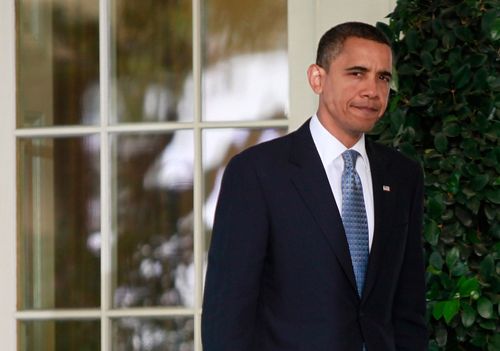
Obama, Deficit Hawk

OBAMA09MarkWilson:Getty

For much of this year, I've been arguing that the Obama administration needs to pivot swiftly from health insurance reform to fiscal responsibility in the coming months. The recession made deficit cutting in the here and now imprudent in his first year; but now addressing the long-term debt is itself necessary for stabilizing the economy – and reassuring independent voters that he, unlike his predecessor, gives a damn about fiscal health. Well: the good news is that he's going to do exactly that:

President Barack Obama plans to announce in next year's State of the Union address that he wants to focus extensively on cutting the federal deficit in 2010 – and will downplay other new domestic spending beyond jobs programs, according to top aides involved in the planning. The president's plan, which the officials said was under discussion before this month’s Democratic election setbacks, represents both a practical and a political calculation by this White House. On the practical side, Obama has spent more money on new programs in nine months than Bill Clinton did in eight years, pushing the annual deficit to $1.4 trillion. This leaves little room for big spending initiatives. On the political side, Obama can help moderate Democrats avoid some tough votes in an election year and, perhaps more importantly, calm the nerves of independent voters who are voicing big concerns with the big spending and deficits.

This classic Politico piece – in as much as it regurgitates almost comically process-oriented Beltway wisdom – fails to mention a few things about Obama's spending in his first year.

Item one: the recession.

To treat the stimulus package as if it were something he just felt like doing – because he's a big government maniac – is a lie, a piece of propaganda that has seeped into the lazy Beltway desire to describe everything – even now – into the big government/small government, red-blue paradigm.

Item two: The health insurance reform almost painfully tries to pay for itself – something that Bush's Medicare entitlement didn't even pretend to do. 

Item three: there's a big big difference between spending on green and infrastructure investment and slashing taxes or increasing Medicare entitlements.

The way in which cynical and amnesiac Republicans have tried to portray this as classic big government liberalism is a lie. You can debate the merits of each initiative, but this is obviously not an administration as fiscally reckless as the last one. Mercifully, they have a chance to show it in earnest next year. And to call the bluff of those Republicans yelling about spending while having absolutely no plans or ideas for cutting it.

(Photo: Mark Wilson/Getty.)

“A Fundamental Disconnect”

The CBO tells us what we already knew:

I concluded the talk by emphasizing that fiscal policy is on an unsustainable path to an extent that cannot be solved by minor tinkering. The country faces a fundamental disconnect between the services the people expect the government to provide, particularly in the form of benefits for older Americans, and the tax revenues that people are willing to send to the government to finance those services. That fundamental disconnect will have to be addressed in some way if the budget is to be placed on a sustainable course.

Are Too Many Students Going To College?

The Chronicle hosts a debate. As usual, Charles Murray bucks the conventional wisdom:

It has been empirically demonstrated that doing well (B average or better) in a traditional college major in the arts and sciences requires levels of linguistic and logical/mathematical ability that only 10 to 15 percent of the nation's youth possess. That doesn't mean that only 10 to 15 percent should get more than a high-school education. It does mean that the four-year residential program leading to a B.A. is the wrong model for a large majority of young people.

Two Decades Later

Pivoting off a Pew report, Joshua Tucker checks in on public opinion in nine post-communist countries:

We can see that in eight of the nine post-communist countries, a majority of the population continues to approve of the change to democracy; in four of these countries at least 70% of respondents approved. Ukraine is the clear outlier here, with support having dropped by 42% to only 30%. Particularly interesting in these findings is the fact that a greater proportion of Russians than Ukrainians continue to approve of the change to a multiparty system, despite the fact that the latter actually has functioning multiparty politics while one would be hard pressed to claim anything of the sort exists in the former.

Don’t Let The Gays Marry, Or The Homeless Get It

A reader writes:

I'm truly at a loss for words at this story. I was raised Catholic my whole life, but was between parishes when it came time to make confirmation in middle school. I took charge of my religious life in high school and college and decided to finally be confirmed earlier this year because I cannot live my life any other way except by the tenants of the Gospel. This "threat" is so contrary to everything I've learned about service through the Church that I'm just completely numb

Ahmadi’s Green Herpes

Graeme Wood's feelings about the green revolution:

It would be awfully difficult to grind down the opposition so thoroughly that even the graffiti ceased. (After all, there is anti-government even in North Korea.) My sense is that the government regards the opposition now as something like herpes, capable of being managed but never cured. After all, the Mousavi opposition has — unlike the Kurdish, Sunni, and Mujahedin-e Khalq oppositions — never entered a violent phase, and successful political non-violence normally requires unsuccessful political violence as a prerequisite. The 2009 election will be always remembered as stolen, particularly by the young, but fury about the theft doesn't appear to be enduring enough to instigate change on its own. This generation's activists knew hope, briefly, but will have to get a little better acquainted with despair before they know it again.

What The Tories Can Teach The GOP

Frum has a lesson plan:

The leader you want is someone who appeals to the voters you need to gain, not the voters you already have.

American conservatism is in trouble for many reasons, but the most direct and immediate is the swing away from conservatism by edu­cated and professional voters, once the backbone of the Republican party, and especially by educated and pro­fessional women. American conservatives have become very skilled at speaking to the swing voters of a genera­tion ago: northern white ethnic Catholics and southern white Protestants, the famous “Reagan Democrats.” Conservative Democrats today make up only about 6 percent of the American electorate. By contrast, college-educated white women make up more than 15 percent of the electorate. It is foolhardy to choose leaders who woo the first group if they repel the latter.

The Daily Wrap

Today on the Dish, Andrew reacted to the president's startling decision not to decide, yet, on Afghanistan, while Exum, Ackerman, and Sully addressed Eikenberry's anxiety. Andrew also addressed the surprise move by the LDS to support gay rights and tackled the Catholic Church for overemphasizing abortion in healthcare. A reader added her thoughts on the latter. Laura Rozen updated us on US-Israel relations.

In other news, the Onion exposed the real reason for Lou Dobbs' departure and Matt Cooper pondered his political career. AMA and DiA chipped away at marijuana classification, Dan Savage brought the wisdom on marriage, and Charles Johnson and Marty Beckerman shared their recovering Republicanism. And some rraders gave their perspective on Muslim-Americans. 

In a historic moment for the Dish today, Andrew blogged from 35,000 feet.

— C.B.

Dissent Of The Day

A reader writes:

In “The Other Lesson of Fort Hood” you once again you throw out the claim that Muslims in Europe are more violent or dangerous then Muslims in the United States. I don’t think you’ve really thought this through.

The Muslim population in Europe is many times the size of the Muslim population in the US. As your reader points out, their are less then two million Muslims in America, or considerably less then 1% of the population. That’s compared to something like 10% in Paris and London, and over 20% in Amsterdam and Marseilles. Muslims are the largest minority in Europe. Despite that fact, incidents like the Ft. Hood shooting remain incredibly rare.

Yes, there are occasional acts of violence carried out by lone nuts, like the murder of Theo Van Gogh. These incidents happen in the States as well (the attack in El Al at LAX, the murder of an army recruiter in Arkansas). Do you have any data or research that such acts happen with greater frequency amongst Muslims in Europe? I’d love to see it.

Yes, there may be more social tensions with Muslims in Europe. Remember, as the largest minority, Muslims are the equivalent of Latino immigrants in America, and think for a second of the cultural and social resentment that they face. Muslims in America don’t face such tensions to the same extent because as a smaller minority they are less visible, and because America is more pluralistic and less moralistic about culture (no one in the States would seriously suggest the banning of the Hijab in public schools like in France).

What writers like Christopher Caldwell get wrong is that they think European Muslims are somehow more of a threat because of these tensions and issues, not considering that they are bound to come with being the largest and most visible minority in any society. But when you consider the size of the population, I don’t see any evidence that European Muslims are individually more prone to Jihad then American ones (and they certainly don’t have the same easy access to weapons). Yes, there have been terrorist plots broken up (some of them, like in the States, exaggerated by law enforcement). Yes, there have been European Muslims who have committed individual violent acts like Major Hasan did (though rarely as effectively). And yes, walking through, say, the 19th Arrondissement of Paris gives you the same cultural dissonance as walking through, well, 80% of Los Angeles. But to reflexively tar European Muslims with being more prone to violence and separation then those in America is facile.

Face Of The Day

AfghanWomanShahMaraiGetty2
An Afghan woman sits in her cave early in the morning in Bamiyan on November 10, 2009. The cave dwellers here are all Hazara, who are religiously and ethnically distinct and survivors of intense persecution by the Taliban. Bamiyan, some 200 km (124 miles) northwest of Kabul, stands in a deep green and lush valley stretching 100 km through central Afghanistan, on the former Silk Road that once linked China with Central Asia and beyond. The town was home to two nearly 2,000-year-old Buddha statues before they were destroyed by the Taliban, months before their regime was toppled in a US-led invasion in late 2001. By Shah Marai/Getty.