Lou Dobbs Leaves CNN

The Onion has the best response, naturally:

Acting on anonymous tips from within the Hispanic-American community, U.S. Customs and Border Protection officials on Wednesday deported Luis Miguel Salvador Aguila Dominguez, who has been living illegally in the United States under the name Lou Dobbs for 48 years.

Leonhardt recalls Dobbs habit of not telling the truth, and Jason Zengerle predicts the future:

[N]ow that Klein has released Dobbs from the CNN quarantine, what's to stop Lou from teaming up with Ailes, who is reportedly considering him for the Fox Business Channel? And then, well, we've already seen this play before. Anyone want to bet that a year from now, Dobbs will be flourishing with millions of viewers at Fox and the whole country will be a lot worse off for it? And CNN, of course, will still be mired in last place–which would be perfect, save for the fact that, thanks to Klein, Beck and Dobbs won't be stuck there with them.

We Have A President

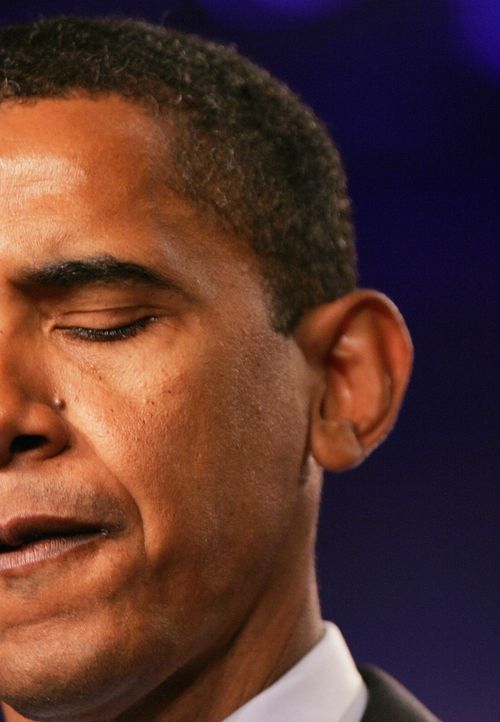
OBAMATimSloan:AFP:Getty

The news that Obama has refused to sign off on any of the four major options presented to him in Afghanistan reminds me of why he was elected president. This critical decision – arguably the most critical of his young presidency – is one that will not be rushed the way such decisions often are. His insistence that the civilian branch truly control policy there and that empire not be passively accepted as a fait accompli are real signs of strength in the struggle to recalibrate American foreign policy. Can you imagine Bush ever holding out like this on the military? Or for these reasons:

Administration officials said Wednesday that Obama wants to make it clear that the U.S. commitment in Afghanistan is not open-ended. 

The stunning honesty of Eikenberry has undoubtedly concentrated minds on the core pillar of any counter-insurgency strategy: the Karzai government. But, of course, no options have been closed off yet:

The White House says Obama has not made a final choice, though military and other officials have said he appears near to approving a slightly smaller increase than McChrystal wants at the outset.

Among the options for Obama would be ways to phase in additional troops, perhaps eventually equaling McChrystal's full request, based on security or other conditions in Afghanistan and in response to pending decisions on troops levels by some U.S. allies fighting in Afghanistan.

What we are seeing here, I suspect, is what we see everywhere with Obama: a relentless empiricism in pursuit of a particular objective and a willingness to let the process take its time. The very process itself can reveal – not just to Obama, but to everyone – what exactly the precise options are. Instead of engaging in adolescent tests of whether a president is "tough" or "weak", we actually have an adult prepared to allow the various choices in front of us be fully explored. He is, moreover, not taking the decision process outside the public arena. He is allowing it to unfold within the public arena. Others, moreover, are allowed to take the lead: McChrystal, or Netanyahu, or Pelosi, in the case of Af-Pak, Israel-Palestine and health insurance, respectively. Obama encourages the process but hangs back, broadly – and persistently – pursuing certain objectives without tipping his hand on specifics or timing.

So the troop question is rather like the public option question.

Obama's position – almost a year into his presidency – is yet to be revealed. The president waits, prods, allows the parties to reveal their hands, and keeps his final detailed position to himself. By allowing the debate to continue in public, he also tries to get the public more, rather than less, involved. So we too get to show our hand as the debate continues. And the polls show Americans pretty evenly – and understandably – divided  on the excruciating and ultimately prudential question of what to do next.

What strikes me about this is the enormous self-confidence this reveals. Here is a young president, prepared to allow himself to be portrayed as "weak" or "dithering" in the slow and meticulous arrival at public policy. He is trusting the reality to help expose what we need to do. He is allowing the debate – however messy and confusing and emotional – to take its time and reveal the real choices in front of us. This is politically risky, of course. Those who treat politics as a contact-sport, whose insistence is on the "game" of who wins which news cycle, or who can spin each moment in a political storm as a harbinger of whatever, will pounce and shriek and try to bounce the president into a decision. And those who believe that what matters in war is charging ahead regardless at all times will also grandstand against the president's insistence on prudence.

But he won't be bounced and his concern seems to be genuinely to do the right and the most sustainable thing. Which is a kind of strength we haven't seen in a president since Reagan.

Glory, Ctd

A reader writes:

Just before I read your post on black soldiers in the Civil War ("Glory"), I read this post on the Letters of Note blog: It's a hand written letter from Abraham Lincoln about just that, him allowing "blacks" to fight in the war. Quite a coincidence.

Money quote from Lincoln:

When, early in the war, Gen. Fremont attempted military emancipation, I forbade it, because I did not then think it an indispensable necessity. When a little later, Gen. Cameron, then Secretary of War, suggested the arming of the blacks, I objected, because I did not yet think it an indispensable necessity. When, still later, Gen. Hunter attempted military emancipation, I again forbade it, because I did not yet think the indispensable necessity had come. When, in March, and May, and July 1862 I made earnest, and successive appeals to the border states to favor compensated emancipation, I believed the indispensable necessity for military emancipation, and arming the blacks would come, unless averted by that measure. They declined the proposition; and I was, in my best judgment, driven to the alternative of either surrendering the Union, and with it, the Constitution, or of laying strong hand upon the colored element.

I chose the latter. In choosing it, I hoped for greater gain than loss; but of this, I was not entirely confident. More than a year of trial now shows no loss by it in our foreign relations, none in our home popular sentiment, none in our white military force, — no loss by it any how or any where. On the contrary, it shows a gain of quite a hundred and thirty thousand soldiers, seamen, and laborers. These are palpable facts, about which, as facts, there can be no cavilling. We have the men; and we could not have had them without the measure.

President Obama, your time for the same act of courage is now. History will long remember it.

Why Baby Jesus?

The brilliant British humorist, Craig Brown, does a classic Malcolm Gladwell parody:

Why baby Jesus? Research confirms there were upwards of 157 hotel-cum-stables in Bethlehem that night, with estimated 97 percent occupancy levels. So why did that star shine so brightly over his?

Imagine that I were to ask you to dress up as a baby and lie in a manger. Would you attract a comparable crowd of shepherds plus livestock and anything upwards of three kings from the East?

In a hugely influential 2004 experiment at the University of Colorado at Bollocks Falls, Professor Sanjiv Sanjive and his team asked 323 volunteers to wrap themselves in swaddling clothes and spend the night in a stable, lying in a manger. Logic would dictate that at least one of them would be visited by shepherds, wise men, or kings from the East, right?

The answer – which I'm sure will shock and alarm us and make millions of dollars for Malcolm – here.

(Hat tip: Clive.)

It’s Only Really About Abortion

Here is a classic document from Benedict's church. It is a public dressing down of a Catholic by his bishop because the Catholic, Patrick Kennedy, supports the right of women – of all faiths and none – in a secular society to abort an unborn child:

Your rejection of the Church’s teaching on abortion falls into a different category – it’s a deliberate and obstinate act of the will; a conscious decision that you’ve re-affirmed on many occasions. Sorry, you can’t chalk it up to an “imperfect humanity.” Your position is unacceptable to the Church and scandalous to many of our members. It

absolutely diminishes your communion with the Church.

Congressman Kennedy, I write these words not to embarrass you or to judge the state of your conscience or soul. That’s ultimately between you and God. But your description of your relationship with the Church is now a matter of public record, and it needs to be challenged. I invite you, as your bishop and brother in Christ, to enter into a sincere process of discernment, conversion and repentance. It’s not too late for you to repair your relationship with the Church, redeem your public image, and emerge as an authentic “profile in courage,” especially by defending the sanctity of human life for all people, including unborn children.

I am struck by the emphases of the American hierarchy these past few months. On health insurance, there is far more public emphasis on preventing anyone who wants to get an insurance policy from the new government-run exchanges from getting an abortion (even if she pays for it herself) than on the core principle of health care as a human right (in Catholic doctrine).

I can see that both principles are valid, but the intensity of the campaign against one compared with the lackadaisical interest in the other seems unbalanced to me. The hierarchy's growing fusion with fundamentalist Republican politics is becoming harder and harder to ignore. They can turn a blind eye to state-sanctioned torture, and to the suffering of those without healthcare, but when it comes to ensuring that gay couples are kept stigmatized or that non-Catholic women can't have access to abortion in a secular society, they come alive. There are times when it appears the only real issue for the Catholic church is abortion.

The Other Lesson Of Fort Hood

A reader writes:

I love my mother, but she exasperates me sometimes. She told me today that no Muslims should be allowed in the military. I told her that people used to think that about Catholics. To which she said, “That’s different. We’ve proved ourselves. The Muslims haven’t.”

If I’d had the presence of mind at the time, I would have pointed out something that occurred to me afterwards. There are an estimated 1.1 – 7 million Muslims living in the United States (I don’t think there’s an exact estimate). Our country has been at war with Afghanistan (a war I supported with mixed emotions) for eight years. We have been at war with Iraq (a war based on a lie) for almost seven years. If Muslims match the caricatures bandied about by today’s right-wing talking heads, wouldn’t Fort Hood be just another day in America? Where are all our Muslim American suicide bombers?

It occurred to me (too late for my argument with my mother) that maybe the most important news about America’s Muslims isn’t what we hear, it’s what we *don’t* hear. I hope I don’t sound like I’m damning with faint praise. “Good for those Muslims, they’re not blowing themselves up in shopping malls!” I don’t mean to. I mean to make a point: We have occupied one or more largely Muslim nations for several years, led by the dunderhead who described himself shortly after 9/11 as “on a crusade.” And yet Fort Hood stands out precisely because of the rarity of Muslim American attacks on fellow Americans. This matters.

Yes it does. And it stands in stark contrast with much of Western Europe.

Deconstructing Sarah, Ctd

A reader writes:

My son, Calvin, has Down syndrome. We did not find out until after his birth, but it would have been nice to know. My wife and I love our son more than anything in the world. When you receive the diagnosis, though, you go through a mourning. You mourn the loss of the future you thought you had. Knowing before-hand would have allowed us to go through the grieving process before his birth. We would have been able to just enjoy him. We look back now and wonder what we were even mourning. Our future, and his, is nothing but bright. I think you might be overstating things with the amnio. A recent study has shown the risk to be very low.

Also, I want to point out that my son was not a “Down syndrome baby,” nor was Trig Palin. The are people who have Down syndrome, just like you are not an HIV man – you have HIV. You are not defined by HIV, it is something you have. Calvin and Trig are not defined by Down syndrome; it is a condition they have. Trust me, to people who are involved in the disability community, whenever you write “Down syndrome baby” it comes across as ignorant.

Thanks for the link to the 2006 study. As for terminology, it was shorthand and not intended to offend. But we won’t use it again and are grateful for the input.