Is Peak Oil Near?

It's not a new question but there are some new answers:

"The IEA in 2005 was predicting oil supplies could rise as high as 120m barrels a day by 2030 although it was forced to reduce this gradually to 116m and then 105m last year," said the IEA source, who was unwilling to be identified for fear of reprisals inside the industry. "The 120m figure always was nonsense but even today's number

is much higher than can be justified and the IEA knows this.

"Many inside the organisation believe that maintaining oil supplies at even 90m to 95m barrels a day would be impossible but there are fears that panic could spread on the financial markets if the figures were brought down further. And the Americans fear the end of oil supremacy because it would threaten their power over access to oil resources," he added.

A second senior IEA source, who has now left but was also unwilling to give his name, said a key rule at the organisation was that it was "imperative not to anger the Americans" but the fact was that there was not as much oil in the world as had been admitted. "We have [already] entered the 'peak oil' zone. I think that the situation is really bad," he added.

The Right’s Answer To John Kerry

Reihan compares political campaigns, past and future:

Conservatives delighted in the ideological exuberance of Howard Dean's progressive youth, and they were unprepared for Barack Obama's slickly post-ideological campaign that drew on the left's energy while running a disciplined centrist campaign. We'll see if history repeats itself. Like a lot of people, my gut tells me that Sarah Palin or perhaps Mike Huckabee will be the Howard Dean of 2012. Of course, that would suggest that the Republican nominee in 2012 will be the right's answer to John Kerry, which is a prospect too disturbing to contemplate for very long.

Deconstructing Sarah, Ctd

A reader writes:

The other piece of the new Trig-diagnosis story that doesn’t make sense is that I don’t know an ultrasound tech anywhere who would tell a person that there’s an abnormality. I’m bringing this up because I assume you and your husband haven’t been in this situation. They’ll tell you the gender (but they let the doctor confirm it). But no tech doing a real test on something that might be serious would tell you what they see.

They are not radiologists. I’ve had discussions with several stenographers (as they are apparently called in the trade) about this, because an ultrasound will make the patient nervous, just because it’s new data and you worry about what they might see. (In my case, I was recently in getting a test for fatty liver and I immediately wanted to know whether the student stenographer or her coach, who did it separately, were seeing anything. They politely demurred, but we ended up talking about how everybody wants to know their results during the ultrasound and they cannot diagnose or give any suggestions.)

I don’t spend much time thinking about Palin, but whenever I read bits of her narrative on Trig, it just smacks of what my wannabe novelist friends and I used to call book-description. Meaning, you wrote or told something based on information that you got out of a book or somewhere else but that you haven’t really lived it, and it shows. My guess is that Palin has had ultrasounds, but only good ones, which is the only time they’ll tell you anything, and she’s improvising about the rest.

Calling For Blood, Ctd

DiA joins the death penalty debate:

I think "revenge" is a well-defined term, whereas "justice" is a bit of whatever you think it means. Justice certainly requires that guilt be certain, the crime clearly defined, and the offender aware of the law and its general consequences before committing the offence. Malice of forethought, and all that. All those being present, the question of punishment is an argument over values, and many answers are possible. William Petit Jr wants the death penalty for the men who tortured and killed his family in his presence. The death penalty remains on the books in the state of Connecticut, though it is rarely enforced. Perhaps this should be one of those rare cases. But if so, we do need what Sonny Bunch suggests: a generalised way to distinguish between cases where guilt is truly certain, and those where it is probable. And that doesn't seem to be on anyone's agenda for legal reform.

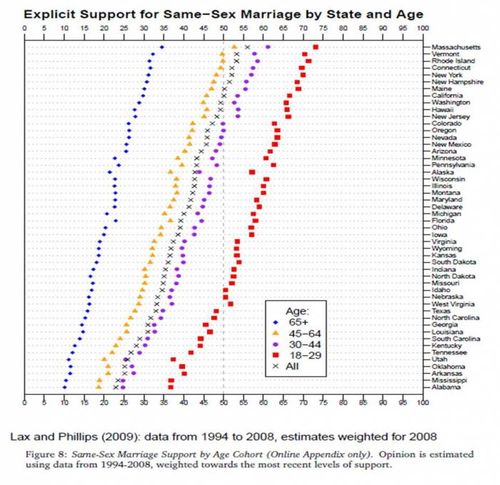
Marriage And The Generations

Here's a graph that puts the generational shift on marriage equality in stark relief:

Age1
A clear majority of the under-30s favor marriage equality in all but 12 states. This doesn't make defeats any easier, and it doesn't make those constitutional amendments any easier to reverse. But it does add some perspective and may help us keep our cool. We're winning where it counts. And the future will arrive some day.

A Failed Social Experiment

WestPointSpencerPlattGetty

Will Saletan wants the ban on women in combat scrapped:

The question isn't whether men are physically stronger than women on average. Of course they are. The question is whether to translate that average into a rule against women in combat. The 2009 Navy policy, for example, states that women must be barred from jobs whose "physical requirements would necessarily exclude the vast majority of women service members." Why should some women be excluded based on the performance of others? Would you tolerate such an average-based rule against any racial or religious group?

(Photo: Cadets in the graduating class of the United States Military Academy at West Point participate in commencement exercises on May 23, 2009 in West Point, New York. By Spencer Platt/Getty.)

Identity Politics On The Right

Napoleon Linardatos reads Matthew Continetti’s 4,700 word missive to Sarah Palin so you don't have to:

The

sole legitimizing force behind Sarah Palin is the persecution that her

supporters perceive that she is subjected to. It’s a movement – if we

could call it that – animated by its sense of victimhood. The quantity

and ferocity of criticism directed at Palin, right or wrong, is the

ultimate arbiter of her worth as a political figure; what she has done,

what she promised to do, what she could do, don’t seem to matter.

And so it is with Matthew Continetti’s “The Palin Persuasion”, an essay of more than 4,700 words trying to make the case for Sarah Palin in American politics. It’s extraordinary that in this long essay we don’t have any arguments for Sarah Palin emanating from things that Sarah Palin has done. After more than a year in the national political stage, the dynamism of the Palin phenomenon is entirely dependent on the convulsions it generates in the two extremes of the political spectrum.