Slogging Towards 2013

One of Josh Marshall's readers notes that many parts of the health care bill, should it pass, won't be implemented until after 2012. Josh worries:

[F]ew of the structural changes go into effect before the 2012 election. Bans on denial of coverage for pre-existing conditions, dropping people as soon as they get sick ("recision") will go into effect earlier, basically new regs cracking down insurance companies' behavior. And those should be popular for a lot of people. But the stuff that really tackles cost and other aspects of availability won't go into effect during this presidential term. That's problematic politically for the Democrats. And I think it also raises the real prospect that the insurance companies will start pulling various pricing shenanigans in advance of 2013, hoping they can create the political climate for repeal before those parts of the legislation come into effect.

Can The Prisons Be Reformed?

David Cole wonders:

[T]he prison boom has high costs for all of us. A new prison opens somewhere in the United States every week. Imprisoning a human being in this country costs a minimum of $20,000 a year, far more than tuition at any of our state universities. National spending on prisons and jails was $7 billion in 1980; it is $60 billion today. Several states now spend more on state prisons than state colleges. We literally cannot afford our political addiction to incarceration.

Moreover, the incarceration boom means that there is also now a boom in prisoners being released. In 2008, approximately 700,000 prisoners were released. At current rates of recidivism, 469,000 of them will be rearrested within three years. We all have an interest in helping this at-risk population avoid a return to a life of crime.

Von Hoffmann Award Nominee

"Q: Mr. Secretary, on Iraq, how much money do you think the Department of Defense would need to pay for a war with Iraq?

Rumsfeld: Well, the Office of Management and Budget, has come up come up with a number that's something under $50 billion for the cost. How much of that would be the U.S. burden, and how much would be other countries, is an open question. I think the way to put it into perspective is that the estimates as to what September 11th cost the United States of America ranges high up into the hundreds of billions of dollars. Now, another event in the United States that was like September 11th, and which cost thousands of lives, but one that involved a — for example, a biological weapon, would be — have a cost in human life, as well as in billions, hundreds of billions of dollars, that would be vastly greater," – January 19, 2003.

More Government = Less Choice?

Frum argues that "Obamacare could ban abortion." His thoughts on the bill more broadly:

Small employers can now escape the obligation to provide health care for their employees by paying an 8% payroll tax. Many small employers will seize that offer. Their employees will have to go shopping for themselves in a very complicated and confusing marketplace. Many will opt for the seeming security of the government-run plan. Over time, the public option will grow, setting private insurance on the road to extinction – or at best to a tightly regulated new role as the health equivalent of public utilities. The big decisions will be made in Washington; the insurers will comply.

At any rate, that’s the House leadership’s hope: not a single payer, exactly, but a single administrator.

The Children Of Soldiers, Ctd

A reader writes:

Call me a spoil sport. But I think at least some critical analysis should be offered up of this growing trend of surprising the children of soldiers with their parents return from deployments into war zones. Think for a minute about what these children are deprived of because of these staged episodes. Of the celebratory knowledge that their parent is safely on their way home. Of 2 – 3 days (maybe even more) of carefree living as they no longer need worry about what might happen to their parent. Of the growing anticipation of the impending return, and of assisting in the planning and preparations for that return. To exchange all of that for a candid camera moment to share and rack up hits on YouTube suggests – just perhaps – that our priorities have gone a little bit screwy.

Leverage Against Netanyahu

The Israeli government's clear intent to do nothing to jump-start peace negotiations – and to threaten to launch a war against Iran if Washington doesn't – leaves the US in a bind. How to push Israel to end all their settlement provocations and fundamentalist intransigence in Jerusalem and the West Bank? Obviously, in a rational environment, the US would look to the massive aid that American tax-payers send to Israel, especially the illegal military aid to a country secretly possessing nuclear weapons which it insists on denying to any regional neighbors. If you're trying to pressure an ally, aid is one of the obvious ways to do it.

Of course, the idea of using the lever of suspending aid has long been a non-starter in Washington so strong is Israel's support in the capital. But Tom Friedman today urged a policy of American withdrawal from the conflict altogether until the two/three parties show some minimal interest in moving forward:

If the status quo is this tolerable for the parties, then I say, let them enjoy it. I just don’t want to subsidize it or anesthetize it anymore. We need to fix America.

That no-subsidies-for-Middle-East-intransigents line would have real traction for many Americans, sick of spending their money and risking the lives of their sons and daughters in religious conflicts far away. (It could be used against Egypt as well). More interestingly, as Greenwald notes, Joe Klein now thinks using aid as leverage is a good idea:

It is in the best interests of the United States for the Israelis to make this deal. It is also in the best interests of the Israelis. The Neocon-Likudniks have neither Israel's nor our best interests at heart. Boot is right: The Obama Administration may have to be a bit less "grandiose" in dealing with Netanyahu's irredentist government. It should start by putting a hold on all economic and military aid to Israel; the aid should not be discontinued, just held, for a nice long review until the Netanyahu government comes to understand that Jerusalem must be the capital of both Israel and Palestine, and that if you actually want peace, you don't build illegal settlement colonies in the Palestinian capital.

Remember also that American tax-payers helped finance the Gaza assault. At some point, the US has a right to say: no mas.
Where Death Once Lay

Morsleben-germany-1253pm

A reader writes:

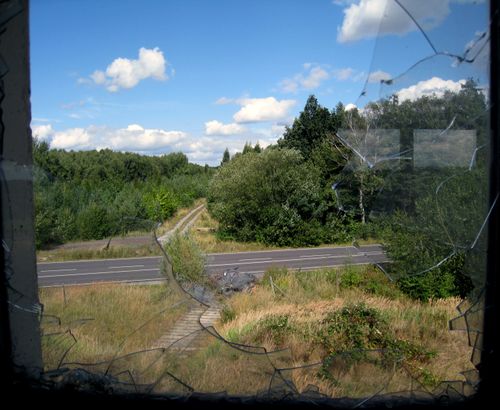
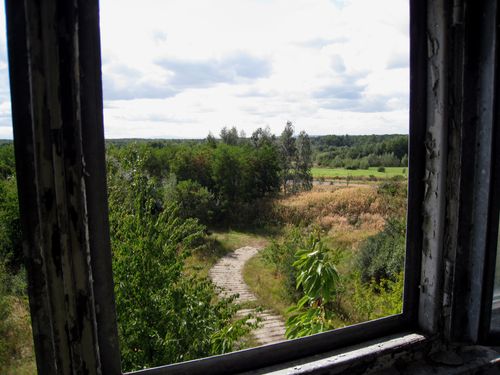
Here are two views from the same place – the windows of a semi-ruined East German watchtower on the former border between West and East Germany. The first view [above] is looking north, the second view [after the jump] is looking south. Both show the former "death strip", which has now been reclaimed by nature. Twenty years ago today, the people seeing this view would have been armed and with orders to shoot on sight. The pictures were taken at 12:53 and 12:54 pm near Morsleben, Germany. This would be a nice choice for today, the 20th anniversary of the fall of the Wall and the opening of the inner German border.

Please also note that Inner German Border will be Wikipedia's featured article of the day on November 9th, tying in with the 20th anniversary of the revolution in East Germany. You might find it an interesting read. (Disclaimer: I wrote the article).

There's something deeply comforting about seeing nature reclaim an arbitrary human divide created by ideology. It reveals the transience of even the most horrifying isms in the context of the planet we live in, and the hubris of humans who think their own vision has now supplanted everything that came before. For me, the end of the Wall meant the beginning of a chance to live without ideological war or the fear of ideological war, a moment for the peace dividend to take hold and the idea of US global hegemony given a break in a more stable, less fraught and much less ideological world. How wrong I was. 

But the second view lifts one's spirits. It shows a path ahead, and fields and trees beyond:

Morsleben-germany-1254pm