Obama Gets Serious About Climate Change, Ctd

Power Plants Limits

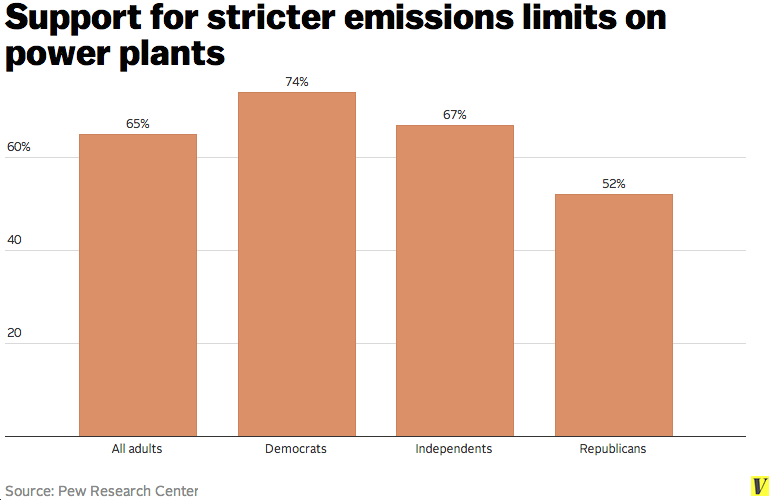
Back in January, Pew asked “US residents whether they support new carbon dioxide emission rules for power plants — the exact sort of rules that were proposed Monday”:

Most American adults don’t agree that these sorts of emissions are causing the climate to change. But strangely, majorities supported these rules. This cut across party lines: 74 percent of Democrats supported the rules, but 67 percent of Independents and 52 percent of Republicans did as well.

One caveat is that with this sort of question, phrasing is extremely important. That’s because most people aren’t familiar with these proposed regulations, so the way they’re explained can make a huge difference.

Ben Adler lists “nine things you need to know about Obama’s new climate rules.” Here’s #4:

What do states have to do? Each state will be required to submit its own plan for complying with the rules by June 2016, although they can request a one-year extension, until June 2017. States can also create a multi-state plan, thus encouraging more interstate compacts like the Regional Greenhouse Gas Initiative, a cap-and-trade system in Northeastern states; for such multi-state plans, they can request a two-year extension. If states don’t submit a compliant plan, EPA will make one for them.

EPA lays out four main approaches that states can use: make coal plants more efficient (for example by reducing their heat loss), increase natural gas-burning capacity, increase non-carbon energy producing capacity (that’s mainly renewables, but also nuclear), and reduce demand for electricity through improved efficiency. States don’t have to pick just one. “There is no one-size-fits-all option,” said EPA Administrator Gina McCarthy when announcing the rules at EPA headquarters Monday morning. “It’s up to states to mix and match to meet their goals.” They can also submit a plan with a whole other approach, such as a carbon tax.

Jonathan H. Adler doesn’t think the EPA rules will accomplish much:

The stark reality is that the world will not come close embarking on a course toward stabilizing atmospheric concentrations of [greenhouse gases] until it is [cheap] and easy to do so. And this, even more than meeting the 80 by 50 target, requires a technological revolution in energy production 0r carbon mitigation.  Such transformations are possible — consider how fiber optics and then satellite and wireless replaced traditional copper wire for telecommunications — but they are rarely driven by regulatory mandates.  And although tradeable emission credit schemes are supposed to incentivize innovation, there’s little empirical evidence that such programs have actually achieved this goal.

Elizabeth Kolbert sighs that “it is entirely possible for the new regulations to be the best that can reasonably be hoped for from Washington these days and at the same time for them to be woefully inadequate”:

The President’s goal of cutting power-plant emissions thirty per cent by 2030 leaves only two decades to meet the second part of his pledge—the reduction of total emissions by eighty per cent by 2050. It could be argued that the new regulations will spur such a torrent of innovation that reducing emissions another fifty per cent will become much easier, but it’s tough to find anyone who actually believes this. And it’s only with such dramatic declines in emissions that there’s any reasonable chance of holding the eventual temperature increase to two degrees Celsius.

Sally Kohn thinks Obama’s long-game politics are at work:

Only 3 percent (PDF) of voters under 35 don’t believe climate change is an issue—far less than the 11 percent among voters overall.  And polls show young voters favor action on the environment at rates greater than older generations. In fact, even among young voters who oppose Obama, a strong majority (PDF) support the President taking action to address climate change. Going forward, the future voters of America will flock to the party that stands for equality and takes action against pollution. The Democratic Party needs to reassert these beliefs—and put action behind them—to win the future.

And the Republican Party will keep alienating these voters. One study found that voters under 35 think that politicians who deny climate change are “ignorant,” “out-of-touch,” and “crazy.”

And Chait sees the EPA move as part of Obama’s “bid to become the environmental president”:

Obama’s climate agenda may well ultimately fail. If it does, it will be because it was thwarted by actors he cannot control: All five Republican-appointed Supreme Court justices may nullify his proposal, or a future Republican president may dismantle it, or the governments of China and other states may decide not to enter an international treaty. A president cannot save the planet. But it can no longer be fairly denied that Obama has thrown himself entirely behind the cause.

Earlier Dish on the EPA announcement here and here.

A Problematic POW, Ctd

Screen Shot 2014-06-03 at 1.10.34 PM

Fred Kaplan clears up a few misconceptions about this weekend’s exchange of five captured Taliban leaders for Army Sgt. Bowe Bergdahl:

First, while Obama and his diplomats made the deal on their own (in line with his powers as commander-in-chief), it’s not true that he left Congress out of the picture. He briefed a small group of senators in January 2012, when a deal first seemed in the offing. Sen. John McCain reportedly threw a fit, objecting that the detainees to be released had killed American soldiers, but after talking with John Kerry (at the time, still a senator and a friend), came around to the idea. (This may be why McCain, though displeased with the detainees’ release, is not raising his usual hell in public appearances now.)

Second, it’s not the case—at least if things work out as planned—that the five detainees, some of whom were high-level Taliban officers in their younger days, will go back and rejoin the fight. The deal requires them to remain in Qatar for one year; after that, Americans and Qataris will continue to monitor them—though it’s not yet clear what that means; in the coming days, someone should clarify things.

“There’s one more potential bit of good news,” he adds:

This whole exercise has demonstrated that the Taliban’s diplomatic office in Qatar does have genuine links to the Taliban high command. (A few years ago, when fledgling peace talks sputtered and then failed, many concluded that it was a freelance operation unworthy of attention.) And the fact that the exchange came off with clockwork precision (see the Wall Street Journal’s fascinating account of how it happened) suggests that deals with the Taliban are possible, and that a deal signed can be delivered.

Furthermore, Michael Crowley points out that Obama did not, strictly speaking, “negotiate with terrorists”:

[H]owever nasty the Taliban may be, it’s not really a “terrorist” enemy as we commonly understand the word. The group is not on the State Department’s official list of terrorist organizations and has has long been a battlefield enemy in the ground war for control of Afghanistan. It is not plotting to, say, hijack American airplanes—even if it does have sympathies with people who are. Ditto the Taliban leaders released over the weekend. They are members of a savage and deplorable organization. But unlike, say, Khalid Sheikh Mohammad, they have no history of plotting attacks on the U.S. homeland. Given all that, the real debate isn’t whether Obama negotiated with terrorists—he didn’t. The mystery lies in the particulars of the deal.

Shmuel Rosner compares the swap to the deals Israel makes on a regular basis, sometimes trading hundreds of prisoners for one captured soldier:

So the U.S. got a captured soldier back in exchange for five Afghan inmates. Big deal. Five-for-one is a deal Israel would take in a heartbeat. But there’s truth to the claim that such deals increase the appetite of a terrorist organization in two ways. First, they encourage terrorists to adopt a policy of an abduction of soldiers in the hope of getting more inmates out. Second, they allow terrorists to worry less about being captured by the U.S., since they can hope for a later release.

Israel had been attempting for years to try to resist these exchanges. In 2008, following a heavily criticized deal in which Israel let murderers go in exchange for body bags, then Defense Minister Ehud Barak appointed a special committee, headed by former High Court Chief Justice Meir Shamgar, to make recommendations to the Israeli government on future exchange deals. The Shamgar committee pushed to put limits on prisoner swaps, for the reasons above. But a committee is little match for a mourning family.

But Elliott Abrams identifies a big difference between the US and Israel that, in his view, made this deal unwise:

The trade for Sgt. Bergdahl has given terrorists a real incentive to capture and trade American servicemen and women– and they are very vulnerable. Israeli troops are in Israel, where they are well protected. Occasionally someone tunnels under the border or raids over it, but not often; and Israeli troops in the West Bank take very special care to prevent kidnappings. Americans are in about 150 countries and there are thousands in places where they roam without much protection: 11,000 in Kuwait, 9500 in the UK, 40,000 in Germany. All three countries have significant extremist activity that keeps their police very busy.

Today they are at greater risk because they are more valuable to terrorists. That is a cost of this trade that comparisons to Israel do not correctly measure.

The deal also makes Benjamin Wittes queasy:

John Bellinger is correct that “it is likely that the U.S. would be required, as a matter of international law, to release [the Taliban detainees] shortly after the end of 2014, when U.S. combat operations cease in Afghanistan.” We are, after all, winding down this conflict, and the authority to detain Taliban forces—as opposed to Al Qaeda forces—won’t last that much longer than the end of combat. So what we may have traded here is one POW deserter (assuming that’s what Bergdahl was, for a moment) in exchange for hastening the release of five Taliban by an indeterminate number of months.

Was it the right move? I don’t know. I certainly don’t think, as Marty Lederman put it on Saturday, that it is “truly wonderful news.” Ask me in a couple of years whether it was a good idea—when we know if any constructive dialog with the Taliban developed out of these contacts, when we know how the US draw-down in Afghanistan went, when we know whether and how the released detainees reengaged with the fight, and when we know exactly what the circumstances of Bergdahl’s disappearance really were. The people who did this deal didn’t have the luxury of remaining agnostic about its merits that long. I will not criticize them.

Keating doubts that the five baddies we released to Qatar will ever pose much threat to Americans:

The reason that the detainee recidivism rates have been dropping is likely not because Guantanamo has become so much more effective at rehabilitating detainees. It likely has more to do with the fact that as the U.S. has drawn down its troop presence in Iraq and Afghanistan, there are fewer opportunities to engage in hostilities against Americans in these countries. If all goes according to plan, by the time these five can get back to Afghanistan, they won’t pose much of a threat to U.S. troops because there won’t be that many U.S. troops there for them to fight.

Opponents of the deal are using Nathan Bradley Bethea’s piece from yesterday, which alleged that Bergdahl had deserted his unit, to make their case, but Bethea isn’t having it:

https://twitter.com/inthesedeserts/statuses/473431396111745025

Zack Beauchamp suspects that Republicans trying to make political hay out of this exchange are probably not willing to make the case that we should have left a POW to die in Taliban custody:

Bethea’s distinction between Bergdahl’s disappearance and his release is significant. It’s one thing to think, as some veterans appear to, that Bergdahl should be now be tried by an American court for desertion (that appears unlikely, according to administration statements). It’s a different thing entirely to believe an American soldier should remain in the Taliban’s clutches indefinitely.

The problem with the emerging Republican position is that it implicitly forces the GOP to defend the latter; that Bergdahl should have been left. No amount of speculation about hypothetical future kidnappings or quibbling over legal niceties are likely, in political terms, to overcome the emotionally powerful support for captured veterans’ freedom. And after the initial wave of press coverage subsides, Republican leaders will probably get that. Bergdahl’s release will not remain a partisan flashpoint for very long.

Bing West advises the administration to manage the controversy by letting the Army court-martial Bergdahl:

By any reckoning, the release of five dedicated Taliban terrorists was a high price to pay for the return of a single American captive. It will be a price worth paying only if the Army is allowed to live up to its own high standards. Left to its own procedures, the Army as an institution will proceed with a thorough judicial investigation. Most probably this will result in a court-martial. The evidence is too compelling to be ignored. If there is a finding of guilt, a judge may mitigate the sentence.

But not to proceed with a judicial course would harm the integrity of the Army. There is a deep anger throughout the ranks about Bergdahl’s behavior. The administration would be well advised not have anything more to do with Bergdahl. Let the Army system work. The Army can be trusted to follow the correct course.

General Martin E. Dempsey statement makes clear that Bergdahl will be investigated:

In response to those of you interested in my personal judgments about the recovery of SGT Bowe Bergdahl, the questions about this particular soldier’s conduct are separate from our effort to recover ANY U.S. service member in enemy captivity. This was likely the last, best opportunity to free him. As for the circumstances of his capture, when he is able to provide them, we’ll learn the facts. Like any American, he is innocent until proven guilty. Our Army’s leaders will not look away from misconduct if it occurred. In the meantime, we will continue to care for him and his family. Finally, I want to thank those who for almost five years worked to find him, prepared to rescue him, and ultimately put themselves at risk to recover him.

The War On Coal’s Economic Casualties

coal_mine

Reacting to yesterday’s EPA announcement, Waldman downplays the potential economic damage of going after the coal industry:

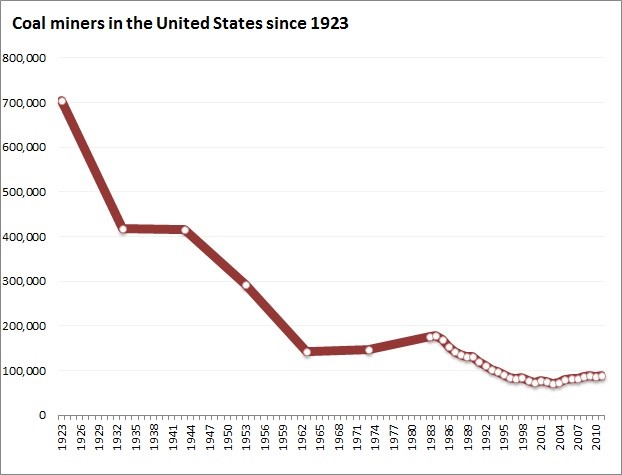
One argument against waging war on coal—that it will cost too many jobs—isn’t really persuasive, because there just aren’t that many coal miners anymore. The National Mining Association has data on the number of miners going back to 1923, when there were over 700,000 Americans doing this work (the data are once a decade until the 1980s, after which they have figures for every year) …

Today, there are fewer than 90,000 Americans mining coal; depending on how you count, there are more people working in the solar power industry. That figure doesn’t include people who work for coal companies but aren’t involved in mining (clerks, accountants, etc.), and of course it doesn’t include people whose livings are dependent on the coal industry, like those who own businesses in mining towns. But the point is that in terms of manpower, coal has become a tiny industry. In the 1920s, one out of every 150 Americans was a coal miner; today it’s one out of every 3,600 Americans.

Cassidy cheers Obama’s war on coal:

In all likelihood, the ultimate fate of Obama’s plan will hinge on the 2016 Presidential election. For now, though, he has taken the initiative and put the onus on other countries that have used the lack of U.S. action as an excuse for doing nothing, or very little, to reduce their carbon emissions. China and India, for instance, are both building coal-fired power plants. If the new policy goes into effect, the United States, at long last, will be able to tell them “Do as I do” rather than just “Do as I say.” Since climate change is a global problem that can only be solved at the global level, that is an important step forward.

Daniel Gross tells the energy industry to quit whining:

The EPA doesn’t plan to proscribe coal generation. It’s simply setting a new standard, telling states that they have to reduce emissions related to energy use—but it is leaving the implementation up to them. Closing coal plants and/or installing carbon-scrubbing technology are only two of many ways to reach that goal. Many of the alternatives have a lower cost, some of them have no cost, and virtually all of them will prove economically beneficial over time. In effect, this standard, like so many other hotly contested standards relating to energy use—the 2007 light bulb rule, new standards for vehicle gas mileage or for appliances—is simply a diktat to the industry to stop being so lazy.

Ronald Bailey is skeptical about the EPA’s claims that these regulations will save money:

The EPA calculates that the maximum cost for implementing the new regulations amounts to $7.5 billion in 2020, while the maximum net climate and health benefits range from $27 to $50 billion at a 3 percent discount rate or $26 to $46 billion at a 7 percent dicount rate. On it’s face, that sounds like a pretty good deal. But as I reported last August in my article, “The Social Cost of Carbon: Garbage In, Garbage Out,” anyone can pretty much conjure whatever number one wants when it comes to cranking out the social cost of carbon through integrated assessment models that combine econometric and climate prognostications.

But Chris Mooney expects the plan to pay off:

There is a long tradition of cost overestimates for new environmental regulations. At the Huffington Post, Pacific Institute President Peter Gleick provides an extensive documentation, going back to the 1970s, arguing that such claims of huge costs not only have a long history, but that they are “always wrong.”

Among other things, Gleick links to a 2011 EPA study finding that the benefits of the 1990 Clean Air Act amendments (which, of course, were attacked on grounds of supposed cost) “exceeded costs by a factor of more than 30 to one.” That’s not the only such study. In fact, as the World Resources Institute’s Ruth Greenspan Bell has noted, from 1999 to 2009, EPA water and clean-air regulations overall were clear cost-benefit winners. The total costs, according to a 2010 Office of Management and Budget report, were some $26-$29 billion, while the benefits were far greater: $82-$533 billion.

The Palin Tendency And Bowe Bergdahl

Tomasky today predicts that the Bergdahl prisoner swap may well become the next Benghazi on the fetid horizons of the Palinite right. I hope he’s wrong, but I’ve learned not to under-estimate the extremism of the Dolchstoss brigade. The Benghazi and Bergdahl “scandals”, after all, are both rooted in the assumption that the president is in some way anti-American, that his loyalty is somehow not to the United US-POLITICS-OBAMA-BERGDAHLStates, but to some other abstract but foreign authority, and so he would obviously be happy to leave Americans to perish in an undefended consulate and lie about it afterwards to cover his negligence up … or be content to deal with the Taliban on behalf of another “anti-American”.

Beneath the intricacies and easy emotional manipulation, this McCarthy era paranoia is what drives both obsessions. The contradictions are, of course, bleeding obvious. Obama is to be excoriated for abandoning Americans in the line of fire in Benghazi and then excoriated for rescuing a servicemember in enemy captivity in the matter of Bowe Bergdahl. You’ll see that, not for the first time, the president cannot win. You’ll also note that one of the American right’s heroes, Bibi Netanyahu, released more than a thousand Palestinian prisoners, some of whom had actually murdered Israeli civilians, in order to retrieve Gilad Shalit. Somehow Netanyahu is not regarded as a terrorist-sympathizer by the Tea Party.

And it is an outright calumny, of course, to impugn this president’s patriotism, the kind instinctually propagated by Palin and her spittle-flecked confreres. Barack Obama is, au contraire, a uniquely and proudly American story. He has been relentless in pursuing the enemy in Afghanistan and Pakistan in his period in office. He killed bin Laden and Anwar al -Awlaki. His emergence as a biracial president would give any sane American a reason to be proud, not squeamish. And what he did, in the case of Bergdahl, requires no further explanation than that a commander-in-chief’s task is to leave no servicemember behind enemy lines, especially as a war comes to a close. (There’s also a strong argument to be made that, as the war in Afghanistan comes to a close, the Taliban commanders at Gitmo had a right under international law to be exchanged.)

I’m not saying, of course, that robust pushback against this tough call is not legitimate. That’s embedded in the very notion of a tough call. There are powerful questions that need addressing:

Was the deal a good one? How effective will the monitoring of the Taliban commanders be? Did the president comply with the letter of the law? But I’d argue vehemently that Bergdahl’s personal politics and Obama’s core motivations aren’t among them. Whether Bergdahl was a deserter or not, whether he was “anti-American” or not, whether he may have cooperated with his captors under duress or not: these questions should be dealt with by the regular process of military justice and investigation. But none of that can truly happen without Bergdahl himself to question and interrogate. And if we are going to rescue a service-member depending on our assessment of his politics or character, we have undermined a key principle of military justice and discipline. You wear the uniform, you get rescued if captured. Period. No other questions need to be asked or answered until after you’re safe and in US custody.

One final thing about the 30-day notification of Congress requirement. The one exception to the executive’s deference to the legislative in statutory matters such as this are contingent, time-constrained executive actions that require immediate implementation. A quick military response, a drone strike, a raid, or a rescue: these fall into the most solid executive area of legitimate, unilateral executive action. For the Republicans who only recently defended a far greater degree of executive power to cavil at this almost text-book case of executive expedition is a triple lutz in hypocrisy and inconsistency. But this, alas, is not news. They will use any weapon at hand, even if they have to trash some of the most important military principles to indict him.

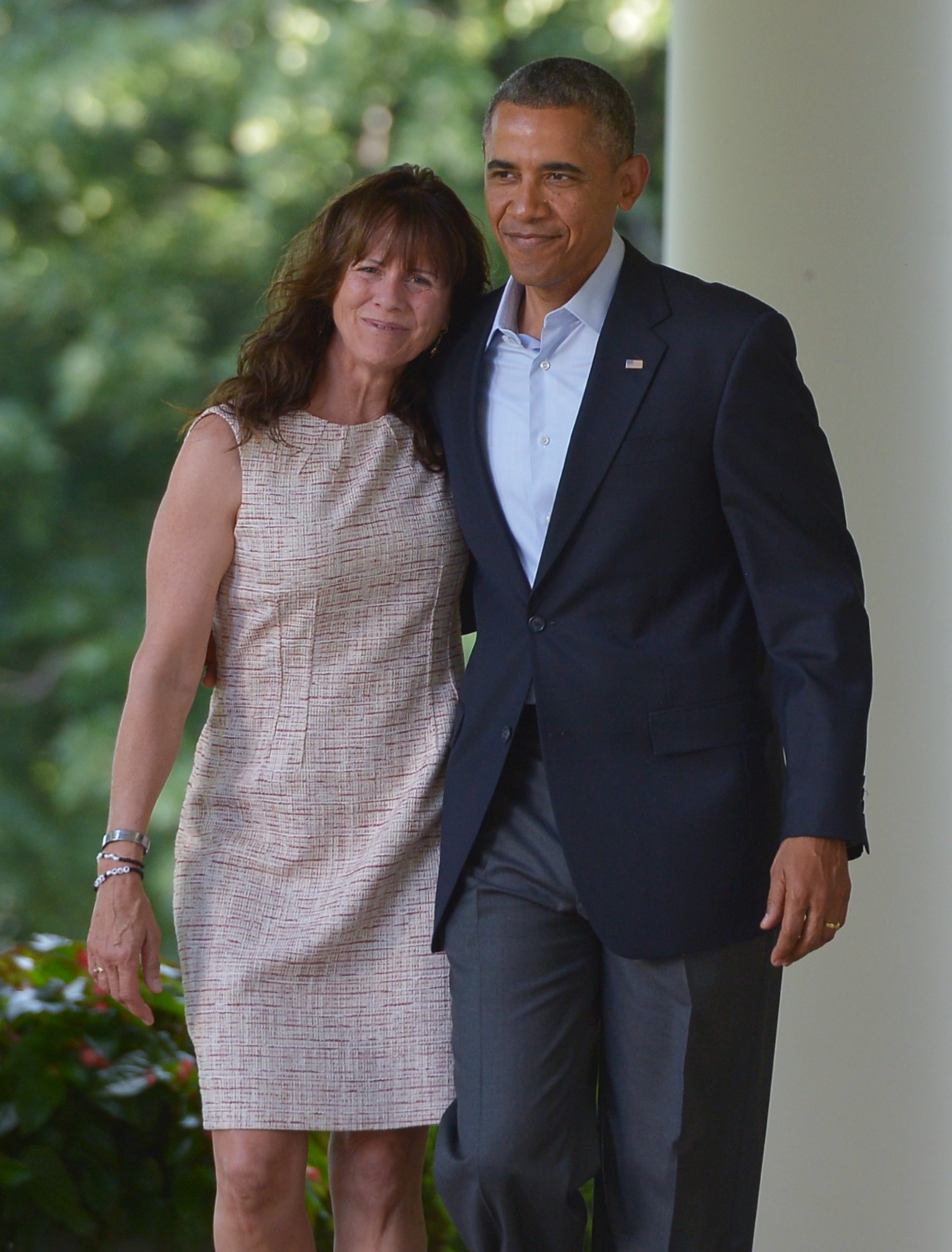
(Photo: Jani Bergdahl, the mother of freed US soldier Bowe Bergdahl, walks through the Colonnade with US President Barack Obama to speak in the Rose Garden of the White House on May 31, 2014 in Washington, DC. Obama spoke after the release of Bergdahl by the Taliban in Afghanistan. By Mandel Ngan/AFP/Getty.)

When “Good Enough” Is Best

In an essay exploring the pitfalls of FOMO, Jacob Burak advocates making do with “good enough” rather than trying to maximize our opportunities – in both business and love:

In business, sacrificing maximisation in favour of a predefined ‘good enough’ is known to be the best strategy in the long run. As the saying goes, ‘Bulls make money, bears make money, pigs get slaughtered’: greediness that looks to maximise doesn’t pay.

Business people also know to ‘leave something on the table’, especially in deals leading to long-term partnerships. Experienced capital market investors understand that aiming to ‘sell at the peak’ will ultimately be less profitable than selling once a satisfactory profit is gained. Corporate graveyards are full of companies that did not stop at a ‘good enough’, profitable product that they could easily market, surrendering instead to ambitious engineers with sophisticated specifications and unrealistic plans. …

Even when it comes to emotional intimacy and love, ‘good enough’ works best. It was the British psychologist Donald Winnicott who gave us the concept of the ‘good-enough mother’ – a mother sufficiently attentive and adequately responsive to her baby’s basic needs. As the baby develops, the mother occasionally ‘fails’ to answer his needs, preparing him for a reality in which he will not always get exactly what he wants, whenever he wants it. The child learns to delay gratification, a key to any form of adult success. As we mature, we make do with ‘good enough’ partners almost by definition. Yes, out there is someone probably more suited to our needs – but we might not live long enough to find him or her.

Go Ahead, Don’t Have Kids

Screen Shot 2014-06-02 at 1.30.10 PM

The Economist wonders whether countries with shrinking populations should stop worrying so much about it:

In a recent study Erich Striessnig and Wolfgang Lutz, of the Vienna University of Economics and Business and the International Institute for Applied Systems Analysis in Laxenburg, Austria, argue that in predicting dependency ratios (the number of children and pensioners compared with people of working age), education should also be taken into account. And that makes optimal rates much lower than previously thought.

Not everyone of working age contributes equally to supporting the dependent population. Better-educated people are more productive and healthier, retire later and live longer. Education levels in most places have been rising and are likely to continue to do so. Using projections by age, sex and level of education for 195 countries, the demographers conclude that the highest welfare would follow from long-term fertility rates of 1.5-1.8. That excludes the effects of migration: for countries with many immigrants, the figure would be lower.

Educating more people to a higher level will be expensive, both because of the direct costs and because the better-educated start work later. But they will contribute more to the economy throughout their working lives and retire later, so the investment will pay off. Moreover, fewer people will help limit future climate change.

Silicon Valley Takes On Wall Street

Kevin Roose reports that “financial start-ups—known collectively as ‘fintech’—are spreading like kudzu, each with a different idea about how to usurp the giants of Wall Street by offering better services, lower fees, or both”:

Part of the reason the tech world is interested in finance is the sheer amount of money involved—financial services is a $1.2 trillion industry, and U.S.-based fintech start-ups raised an estimated $1.3 billion last quarter alone. But banking is also a prime candidate for disruption because, like much of the old-line corporate world, it tends to run on bloated, creaky technology. Even something as simple as applying for a loan can take weeks or months, thanks to the sheer number of human hands such transactions pass through. And, since each intermediary wants a cut, fees are everywhere. Undercutting big banks and speeding up processes might not be as sexy as, say, creating the next Snapchat, but it’s low-hanging fruit for techies who want a way in to a lucrative market. After all, today’s megabanks are really just bundles of particular, loosely related services cobbled together by years of acquisitions and market ­consolidation. If those bundles can be broken apart, the start-up world’s revolution looks a lot more plausible.

Puffin Got Problems

Puffin

The birds are struggling to adapt to a warming world:

[Stephen] Kress [who set up a “Puffin Cam” to live-stream baby Puffin Petey’s development] soon noticed that something was wrong. Puffins dine primarily on hake and herring, two teardrop-shaped fish that have always been abundant in the Gulf of Maine. But Petey’s parents brought him mostly butterfish, which are shaped more like saucers. Kress watched Petey repeatedly pick up butterfish and try to swallow them. The video is absurd and tragic, because the butterfish is wider than the little gray fluff ball, who keeps tossing his head back, trying to choke down the fish, only to drop it, shaking with the effort. Petey tries again and again, but he never manages it. For weeks, his parents kept bringing him butterfish, and he kept struggling. Eventually, he began moving less and less. On July 20, Petey expired in front of a live audience. Puffin snuff.

“When he died, there was a huge outcry from viewers,” Kress tells me. “But we thought, ‘Well, that’s nature.’ They don’t all live. It’s normal to have some chicks die.” Puffins successfully raise chicks 77 percent of the time, and Petey’s parents had a good track record; Kress assumed they were just unlucky. Then he checked the other 64 burrows he was tracking: Only 31 percent had successfully fledged. He saw dead chicks and piles of rotting butterfish everywhere. “That,” he says, “was the epiphany.”

Why would the veteran puffin parents of Maine start bringing their chicks food they couldn’t swallow? Only because they had no choice. Herring and hake had dramatically declined in the waters surrounding Seal Island, and by August, Kress had a pretty good idea why: The water was much too hot.

The big picture:

Life would go on without puffins. Unfortunately, these clowns of the sea seem to be the canaries in the western Atlantic coal mine. Their decline is an ominous sign in a system that supports everything from the last 400 North Atlantic right whales to the $2 billion lobster industry.

(Photo by Andy Morffew)

You Probably Don’t Want Zizek As Your Adviser

Perennial Dish punching bag, the philosopher Slavoj Zizek, produces another gem, this time offering his thoughts on teaching:

“I hate giving classes,” Zizek said, citing office hours and grading papers as his two biggest peeves. “I did teach a class here [at the University of Cincinnati] and all of the grading was pure bluff,” he continues. “I even told students at the New School for example… if you don’t give me any of your shitty papers, you get an A. If you give me a paper I may read it and not like it and you can get a lower grade.” He received no papers that semester.

But it’s office hours that are the main reason he does not want to teach.

“I can’t imagine a worse experience than some idiot comes there and starts to ask you questions, which is still tolerable. The problem is that here in the United States students tend to be so open that sooner or later, if you’re kind to them, they even start to ask you personal questions [about] private problems… What should I tell them?”

“I don’t care,” he continued. “Kill yourself. It’s not my problem.”

Watch a mediocre-quality video of the interview here. Previous Dish on Zizek here, here, here, here, and here.

Creepy Ad Watch, Ctd

mexico-city-breastfeeding-hed-2014

Adding to this reader’s comments, a Colombian reader further contextualizes the debate surrounding the racy breastfeeding campaign in Mexico City:

Many of the protesters of the campaign were against it because it stigmatized those women who choose not to breastfeed for valid reasons. In Spanish, the expression used has multiple meanings that were intentional: Rebecca Cullers’ literal translation fails to capture the contrast meant. Giving your back is equal to be selfish or lazy, and giving your breast also means to be brave (dar el pecho = to face a problem).

Meanwhile, Mya Frazier suggests that bra manufacturers could hold the key to normalizing public breastfeeding:

Fantasy and lust, as embodied in its annual televised Fashion Show, define the Victoria’s Secret brand, but it is also an innovator in bra design, with new product launches a key part of its marketing efforts. Yet while Victoria’s Secret works on a bra with “improved nipple concealment,” other companies appear to be dominating innovation in the nursing bra category. There’s a patent application for a nursing bra that would hold a thin circular heating/cooling device to provide “relief from engorgement, plugged ducts, mastitis and other general nursing pain.” There’s even a patent for a device to connect a breast bump to nursing bra for “hands-free” pumping.

In her book, Breastwork: Rethinking Breastfeeding, Alison Bartlett argues for the acceptance of breastfeeding as a potentially erotic experience, asking: “If it’s generally acceptable or even desirable in Western culture to have sexy breasts available for public viewing, what would be the effect on that set of values and meanings if we regarded lactating breasts as sexy?” Could a brand like Victoria’s Secret use its multi-million dollar advertising budget to disrupt the carefully constructed borders between the sexualized breast and the maternal breast? Millions of babies and their mothers might be better off for it.

To widen the thread further, here’s an excerpt from Chavie Lieber’s piece on “men who drink breast milk”:

Some men who drink breast milk, like Anthony, cite reasons of health or nutrition. Jason Nash, a 55-year-old father of four, started drinking breast milk after the birth of his first child. “It occurred to me that breast milk could be just as healthy and tasteful for adults as infants,” Nash said. “I believe it has kept me from getting sick all these years.” His wife isn’t thrilled, but doesn’t mind as long as the milk comes from a safe source.

For other men (not least those in adult-nursing relationships), breast milk is a kink. “All I’ll say is it’s a fetish for me,” wrote another man, whose post on Only the Breast identified him as a “nice, harmless man in New Jersey seeking breast milk from healthy, non-smoking mom.”